


Artificial intelligence continues to evolve remarkably—from image recognition and text generation to video creation—demonstrating increasingly sophisticated capabilities.
As these digital capabilities mature, the technology sector is shifting focus toward integrating AI into physical environments. This emerging concept, known as physical AI, is gaining significant traction within the industry.
Physical AI represents intelligent agents capable of perceiving physical environments and performing human-like actions beyond digital interfaces.
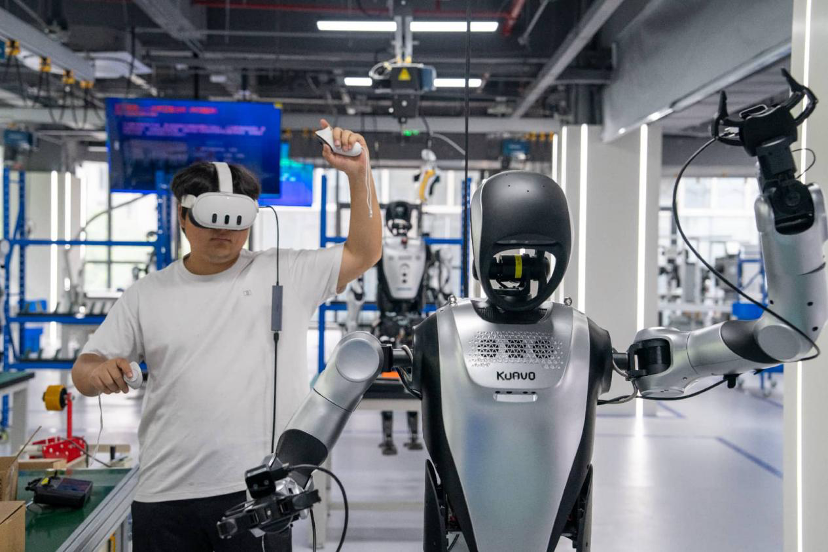
A staff member trains a robot to pick items from shelves at a humanoid robot data collection and training site in Hefei, East China's Anhui Province. (Photos provided to People's Daily)
Ma Xiaojian, head of the joint laboratory between the Beijing Institute for General Artificial Intelligence and Delta Intelligence, noted that physical AI has three defining features: its capabilities are built on real-world physical interaction data, it incorporates an understanding of the physical world and it can be deployed in real-world physical entities.
While generative AI excels in content creation and data analysis, physical AI excels in environmental interaction and motion-control tasks. "While representing different AI dimensions, these domains demonstrate growing convergence," Ma noted. Generative AI's capabilities— including language interpretation, scenario modeling and automated coding—enhance physical AI's task execution and environmental navigation.
Over the past few years, the tech industry has progressed physical AI by enhancing core algorithms and refining ontology engineering through various approaches.
Ma said that there are three main technical pathways currently used to implement physical AI.
The first is the "pre-training and post-training" approach, in which models undergo large-scale pre-training on internet videos, first-person videos and cross-robot manipulation data before being further refined through teleoperation data, reinforcement learning or real-world fine-tuning.
The second is the "real-simulation-real" approach, which reconstructs real-world geometry, materials and dynamics into high-fidelity simulation environments, enabling robots to learn through extensive trial-and-error in digital twins before deployment in physical systems. The third is a large-scale model based approach, where language models generate robot control programs that integrate perception, planning, execution and other functions.
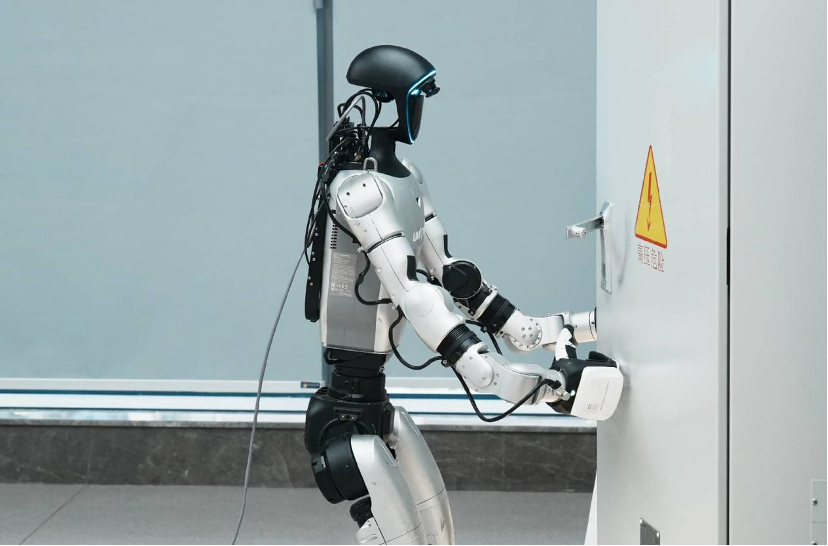
A humanoid robot opens and closes a high-voltage cabinet at an embodied intelligence demonstration and application center in Hangzhou, East China's Zhejiang Province.
Each approach has its own strengths and limitations. "Overall, the three routes are unlikely to replace one another. Instead, they will gradually converge in data, simulation and model reasoning," Ma said.
Industry experts are optimistic about the commercialization prospects of physical AI. On the one hand, physical AI follows the same development trajectory as large AI models, leveraging larger datasets, more capable models, systematic evaluation and continuous iteration to improve performance steadily. On the other hand, commercialization does not depend on the arrival of fully general-purpose robots. In specialized domains, demonstrating strong generalization across similar tasks is already a major step toward real-world adoption.
Looking ahead, frontier fields such as the low-altitude economy, new energy batteries, embodied intelligence, advanced chips and aerospace, where complex simulation and optimization are required, are expected to become key application areas for physical AI. Ma believes the technology will first emerge in scenarios that are unsuitable for long-term human labor and difficult for traditional automation to address fully.
A real-world example exists in remote mountainous power grid inspections. Tiangong, a humanoid robot developed by the Beijing Humanoid Robot Innovation Center, now performs complex tasks previously requiring human workers—including high-altitude inspections, substation operations and grounding wire installation.
"Physical AI complements rather than replaces traditional automation," Ma clarified. Conventional solutions remain more cost-effective when operating in structured environments with fixed workflows. Physical AI's unique advantage lies in dynamic environments that demand real-time adaptation, flexible decision-making and the safe execution of hazardous tasks.
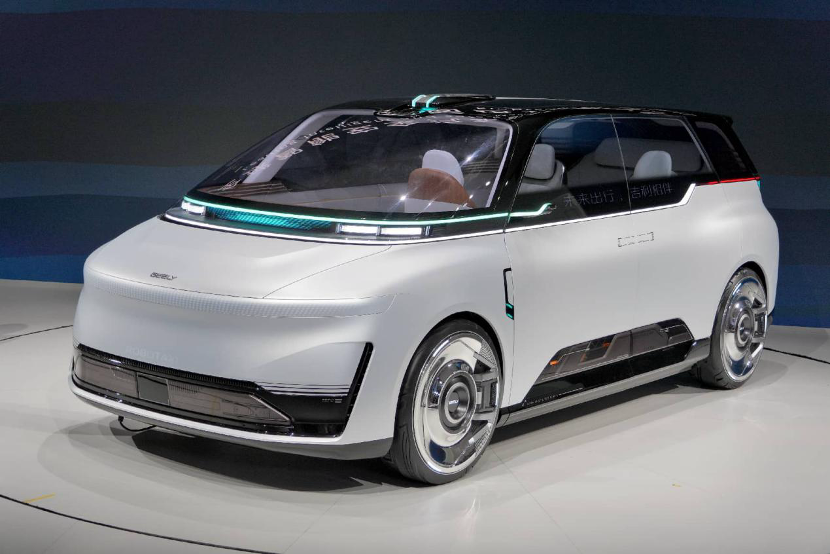
A domestically developed smart vehicle equipped with physical AI capabilities is on display at the 2026 Beijing International Automotive Exhibition.
In industrial applications, training efficiency for physical AI models is also improving rapidly.
"Thanks to years of accumulation in AI infrastructure, we have increased training speed for vision-language-action models by 70 percent, and reduced inference latency for world models by 50 percent. Training cycles that once took weeks can now be reduced to hours," said Shen Dou, executive vice president of Baidu.
The real-world application of physical AI depends on continuous iteration driven by feedback from real scenarios.
Industry experts noted that China's rich application scenarios offer a unique advantage. "Only by applying technologies in frontline settings such as mines, factories, warehouses and inspection sites can physical AI form a virtuous cycle of scenario-data-model-product," Ma said.