


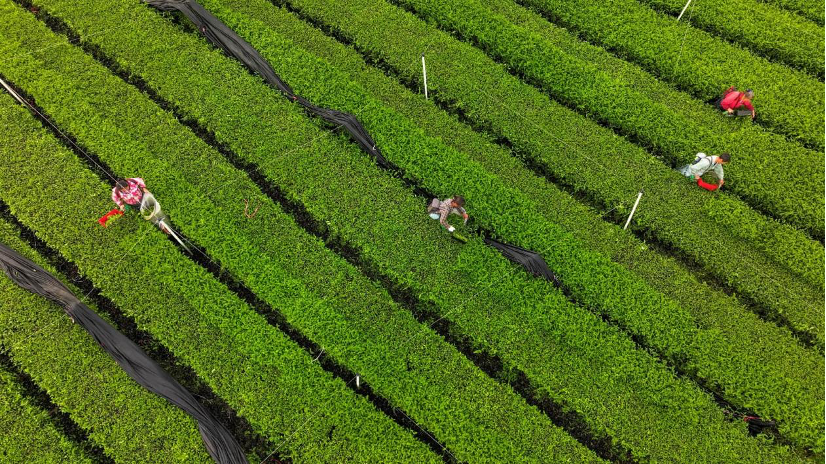
At a matcha plantation in Jiangkou county, Tongren, Southwest China's Guizhou Province, farmers harvest fresh tea leaves destined for matcha production. (Photos provided to People's Daily)
China is the birthplace of tea and the cradle of tea culture. In recent years, the country's matcha industry has expanded rapidly, with both production capacity and international competitiveness reaching new heights.
According to a 2026 report on China's matcha industry, the country's matcha output exceeded 12,000 tons in 2025, accounting for nearly 70 percent of global production. Over the past five years, the industry has posted a compound annual growth rate of 28.67 percent.
Wuyi county of Jinhua, East China's Zhejiang Province, is a time-honored tea-growing area. Zhou Xiaofen, director of the tea technical service station under the county's bureau of agriculture and rural affairs, noted that evolving tea consumption patterns have driven a sharp rise in demand for deep-processed tea goods and diversified tea drinks. This presents great opportunities to revitalize local tea resources, expand the industrial chain and cater to the emerging consumer market.
Inside a matcha processing workshop of Zhejiang Xiangyu Tea Co., Ltd., freshly harvested tea leaves undergo 12 processing steps before being transformed into finely milled, aromatic matcha powder destined for markets around the world.
"We launched our matcha production line in 2019 and built a dedicated 15-member research and development team," said the company head Zhu Lingping.
After over five years of trials and refinements, the team has mastered core processing techniques for matcha production. It has also tackled tough technical hurdles, including maintaining the tea's green hue and achieving precise fineness control. The company now holds distinct technological advantages, delivering premium matcha featuring vivid color, rich fragrance, pure freshness and an ultra-fine texture.
A pioneer in China's matcha production, Zhejiang has emerged as an industrial powerhouse. In 2025, the province produced 8,851 tons of matcha with an output value of 1.1 billion yuan (about $162.45 million). During the first quarter of this year, Zhejiang exported 1,241.97 tons of matcha worth 140 million yuan (about $20.66 million), a 7.3-fold year-on-year increase.
Tongren in Southwest China's Guizhou Province is another key hub of the matcha industry. There, a unique ecological environment characterized by high elevation, low latitude, abundant cloud cover, and limited direct sunlight has provided favorable conditions for the differentiated development of its roughly 467,000 hectares of tea plantations.
Tongren's matcha is primarily supplied to food-processing enterprises worldwide and the premium tea beverage industry. The city has established close partnerships with more than 300 leading new-style tea brands at home and abroad.
In 2025, the city produced and sold 2,500 tons of matcha, including 1,300 tons for export, three times the previous year's volume. Its export volume ranked first nationwide and second globally. In the first quarter alone, exports rose by more than 40 percent year on year, while the number of export destinations expanded to 54 countries and regions.
China's matcha industry has entered a new stage marked by simultaneous growth in both quantity and quality. The number of enterprises, the scale of supporting industrial facilities and export volumes have all expanded significantly.
"Premium matcha requires a fineness of 800 to 1,000 mesh—less than 1/10 the size of milk powder particles," said Meng Zude, chairman and general manager of GuiTea, a major matcha producer in Guizhou.
"Traditional stone mills are no longer sufficient for large-scale production. Advanced equipment such as ultrafine pulverizers, low-temperature ball mills, and jet mills is essential."
The company has expanded its intelligent grinding facilities by adding 10 production lines. Using low-temperature ball-milling technology, it consistently achieves a fineness of 1,200 to 1,300 mesh. A newly built digital and intelligent cold-storage facility with a capacity of 5,000 tons has also been put into operation, providing strong support for raw-material storage and quality assurance.
"We established a dedicated matcha research institute and have worked with research institutions such as the Tea Research Institute of the Chinese Academy of Agricultural Sciences and Jiangnan University to tackle key technological challenges and build joint innovation platforms," Meng said.
The company has filed more than 40 patents while continuously improving tea cultivars and processing techniques. Today, Tongren's matcha has passed more than 500 European Union pesticide-residue tests.
Beyond cutting-edge production, a comprehensive standards system has become another pillar of the industry's success. In recent years, Zhejiang has introduced a series of technical standards covering tea plantation management, matcha processing, and product development.
At Zhejiang Gengxiang Organic Tea Development Co., Ltd. in Baimu township, Wuyi county, more than 74 hectares of organic tea gardens have been transformed into a "5G smart tea plantation." Using Internet of Things technology, the plantation integrates solar-powered insect-trapping lamps, frost-prevention fans, weather-monitoring stations, and other intelligent management facilities. These systems enable functions ranging from growth monitoring and harvest forecasting to pest surveillance and farm operations record-keeping.
"Rigorous quality control has opened global markets for us. End-to-end organic and standardized production is the key to securing a place in the world's high-end supply chains," said Jin Guoqing, general manager of the company.
From admiring, sipping and buying tea to exploring tea culture, matcha serves as a wonderful link. Across China, the integration of tea and tourism continues to deepen, offering diverse immersive experiences for visitors worldwide.
Jingshan township in Yuhang district, Hangzhou, capital of Zhejiang Province, is renowned for its Jingshan tea tradition, which stretches back more than 1,280 years to the Tang Dynasty (618-907). It is widely recognized as the birthplace of the tea-whisking culture that flourished during the Song Dynasty (960-1279), and Japan's matcha-making tradition can trace its origins to Jingshan.
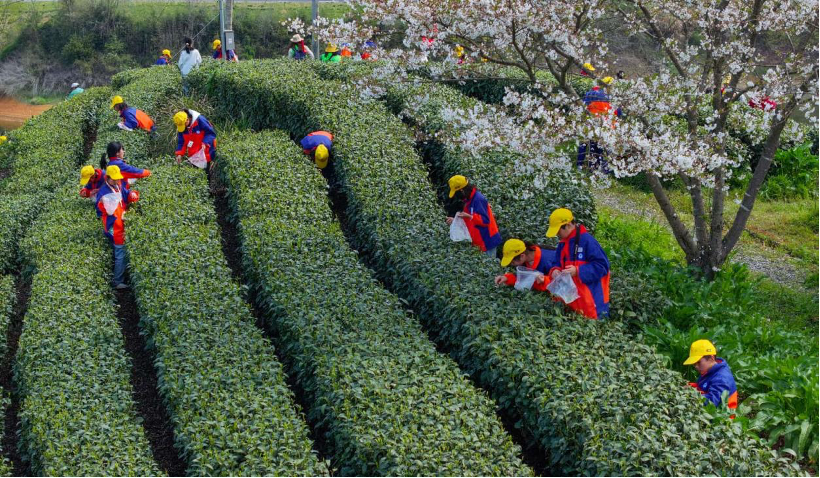
Primary school students take an educational field trip to a local matcha tea garden in Chun'an County, Hangzhou, East China's Zhejiang Province.
In 2022, the "traditional tea processing techniques and associated social practices in China," rooted in the Jingshan Tea Ceremony, were added to UNESCO's Representative List of the Intangible Cultural Heritage of Humanity.
At Wufeng Tea Garden in Jingshan township, rolling green hills and the fragrance of tea create a picturesque setting. On weekends, primary and secondary school students often visit the plantation for matcha-themed study tours.
"We have turned tea plantations into open-air classrooms. By taking part in the full immersive journey from tea bushes to finished drinks, young people get to learn about and carry forward matcha culture," said Ma Kuan, the tea garden's manager.
Meanwhile, in Tongren, local authorities are tapping into historical and cultural resources, preserving the Song Dynasty tea-whisking tradition, and planning the construction of matcha-themed industrial parks, towns, and cultural attractions.
During China's 15th Five-Year Plan period (2026–2030), Guizhou aims to integrate matcha into 10,000 consumption scenarios and expand the industry's total output value to 10 billion yuan (about $1.48 billion).