


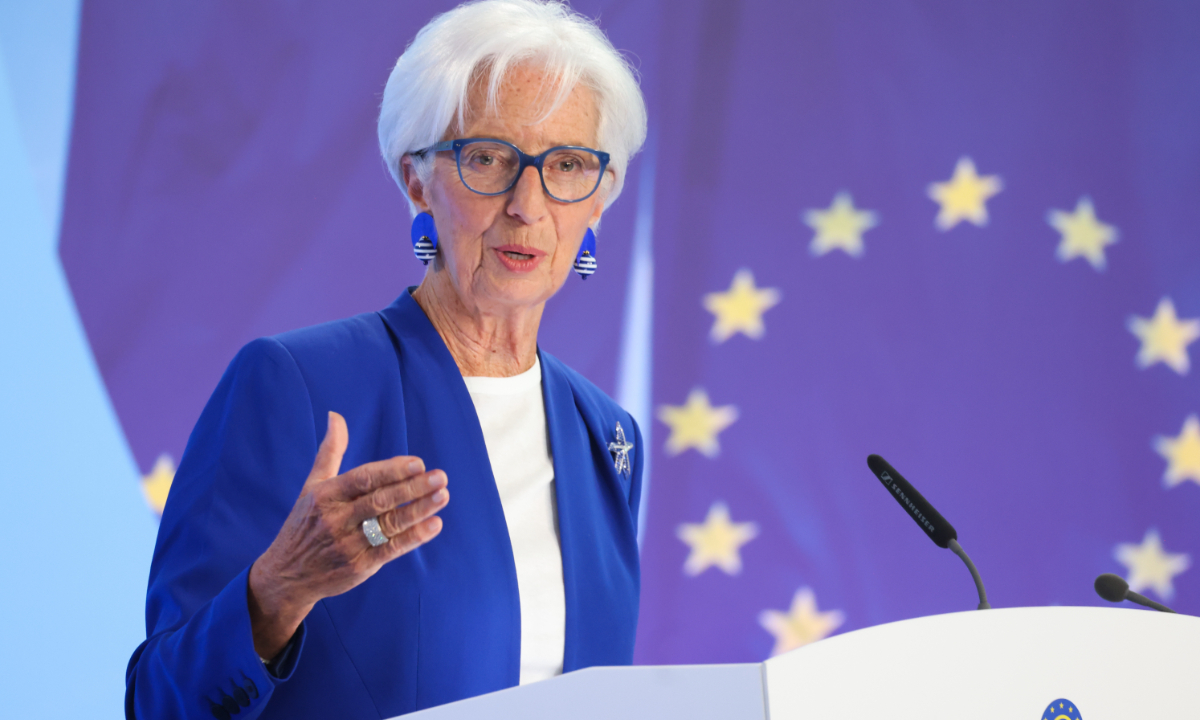
Christine Lagarde, president of the European Central Bank (ECB), speaks at a news conference in Frankfurt, Germany, on June 11, 2026. (Photo: VCG)
European Central Bank President Christine Lagarde on Monday local time urged global leaders to discuss so-called undervaluation of the Chinese yuan as an aspect of the “imbalances endangering the global economy,” Reuters reported.
A Chinese expert on Tuesday pointed out that Lagarde’s claims represent another shift in the EU’s attempt to blame China for its own economic woes, and that relevant claims regarding the yuan's exchange rate is unfounded. The EU’s attempts to shift the blame for Europe's structural challenges onto China are counterproductive, the expert noted.
According to Bloomberg’s Monday report, Lagarde was questioned on comments from German Chancellor Friedrich Merz, who called for international talks about exchange rates as part of the European Union’s resolve to address its deepening trade deficit with China.
In recent months, Western politicians and institutions have continued to hype the yuan's exchange rate. A report released in February by France's Haut-Commissariat à la Stratégie et au Plan (HCSP) claimed that the Chinese yuan was undervalued by roughly 20 to 25 percent and argued that this had contributed to China's cost advantages.
Renewed European rhetoric over the yuan's exchange rate, represented by Lagarde's latest claims, reflects growing anxiety within parts of Europe over declining industrial competitiveness, said Jian Junbo, director of the Center for China-Europe Relations at Fudan University's Institute of International Studies.
Jian stressed that exchange rates are shaped by market-based mechanisms and are not policy tools that can be manipulated at will. Attempts by some European politicians to link the yuan's exchange rate to China's export competitiveness, and to use it as an explanation for trade imbalances, are both unfounded and misguided.
China's central bank has repeatedly refuted claims regarding the yuan’s exchange rates.
The People's Bank of China (PBC) has previously noted in a report that short-term fluctuations of the yuan’s exchange rates are driven by market forces, while its long-term trajectory is determined by economic fundamentals. The strong fundamentals of the Chinese economy provide a solid foundation for the yuan's stability, the PBC said.
In addition, Pan Gongsheng, governor of the PBC, stressed at the China Development Forum 2026 that China has neither the need nor the intention to gain trade advantages through currency depreciation, according to Xinhua News Agency.
Pan reiterated that the PBC's position has remained clear and consistent: allowing the market to play a decisive role in exchange-rate formation, maintaining exchange-rate flexibility, strengthening expectation management, and keeping the yuan basically stable at a reasonable and equilibrium level.
"The problems Europe faces today stem largely from insufficient investment, slow industrial upgrading and other structural issues at home, not from China's exchange-rate policy," Jian said.
The EU’s attempts to blame China for its own economic difficulties are signs of EU officials’ failure to take responsibility, Jian said. "Such an approach neither strengthens Europe's competitiveness nor contributes to healthy China-EU economic ties. Ultimately, it is a counterproductive choice that serves neither side's interests," he added.