


Exploring karst caves emerges as new fad in youth tourism
GUIYANG, June 24 (Xinhua) -- Entering 100 meters into the Yanzi Cave in southwest China's Guizhou Province, mobile signals vanish and the outside world is silenced, as a subterranean world of bizarre stalactites and ancient fossils opens up.
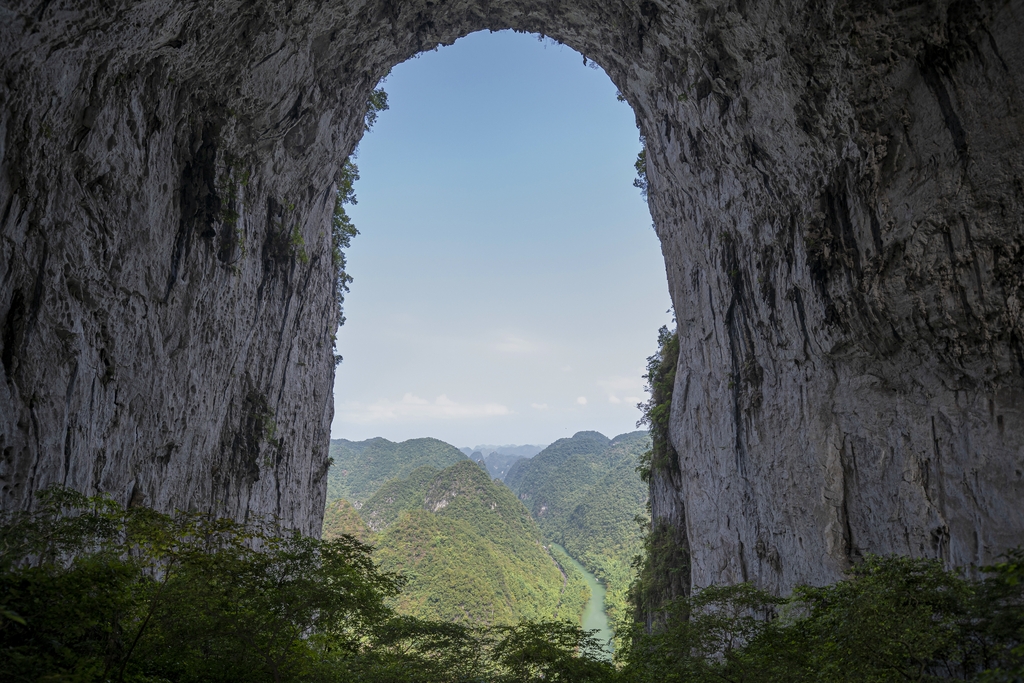
File photo: IC
For a growing number of young Chinese thrill seekers, this sense of disconnection is exactly what they are looking for.
On Douyin, the Chinese version of TikTok, and Xiaohongshu, a popular Chinese lifestyle-sharing platform, videos and posts tagged with "Guizhou cave exploration" have amassed hundreds of millions of views.
Young adventurers are journeying deep into the rural karst landscapes, sharing photos of themselves scaling cliff faces, paddleboarding on underground rivers, or simply sipping coffee in caves.
"Every step inside is unknown. I am more than willing to pay for this thrill," said Chang Ting, a tourist from northwest China's Shaanxi Province. After watching an online exploration video, Chang traveled to Guizhou, dedicating two of her three days there to cave adventures.
Driven by the growing interest, Guizhou's cave tourism has evolved beyond explorations featuring ziplines and wire bridges. It has developed into a multi-tiered industry catering to diverse appetites, ranging from underground paddleboarding and cave camping to coffee tasting and live concerts.
Behind these new upgrades is a wave of young entrepreneurs who have planted their roots in Guizhou's subterranean world.
After spending over a decade working at a major tech firm and a globally-renowned creative marketing agency in Shenzhen in south China, Peng Wei found himself increasingly nostalgic for the mountains and rivers of his hometown. "The longer I stayed away, the more I missed home," he said.
Two years ago, his old classmate Gao Shenghua, an outdoor enthusiast, traveled extensively across Guizhou and came up with the idea of opening a business inside a karst cave.
Last summer, Peng and his team finally opened their coffee shop in a cave in Xiuwen County in Guizhou. During the recent Dragon Boat Festival holiday, the coffee shop sold an average of over 600 cups of coffee daily.
Beyond serving coffee, the team is preparing to launch underground paddleboarding and exploring ways to link up with nearby scenic spots.
The booming industry has also created new career paths for local youth. Lei Yinggui, a 23-year-old cave guide, started with zero experience in 2021 and has since grown into the role professionally.
"In the past, sports graduates mostly became basketball or football coaches. Now, we have more employment options," said Lei, who aspires to become a project manager.
However, given that there is no unified standard, entrepreneurs are navigating the delicate balance between development and conservation.
Peng said that his team deliberately abandoned flashier design options to protect the cave's geological structure and prevent contamination.
"Guizhou needs a key to transform underground wonders into wealth, such as the karst cave resources," said Zhang Zaijie, head of the Green Development Strategy Research Institute of Western China.
A comprehensive survey conducted by the provincial department of natural resources in 2025 revealed that the number of karst cave entrances in the province has reached 42,800, up from the previously known 25,600.
Earlier this year, Guizhou launched preliminary research and feasibility studies for the "Guizhou Province Cave Management Regulations," aiming to ensure the sustainable development of its vast underground heritage.
Such local efforts are also in line with the national push. China's outline of the 15th Five-Year Plan (2026-2030) has emphasized enriching the supply of high-quality tourism products by integrating local resources, enhancing tourism services across the entire value chain, and strengthening project oversight.