


China releases assessment report on UNCLOS, exposing Philippines' core tactics of abusing the Convention
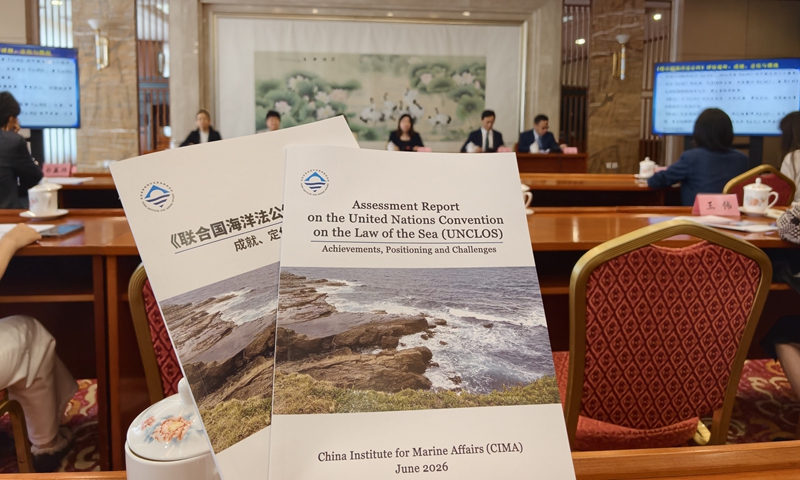
China’s Ministry of Natural Resources releases the “Assessment Report on the United Nations Convention on the Law of the Sea – Achievements, Positioning, and Challenges” via a press conference on June 30, 2026. (Photo: Hu Yuwei/GT)
China's Ministry of Natural Resources released the "Assessment Report on the United Nations Convention on the Law of the Sea - Achievements, Positioning, and Challenges" on Tuesday. The report conducts a comprehensive evaluation of the Convention's historical achievements, legal nature, roles and functions, as well as its problems and challenges. It was launched amid the Philippines' continued abuse of the Convention to promote its illegal so-called South China Sea arbitration case.
The report notes that 2026 marks the 30th anniversary of China becoming a State Party to the United Nations Convention on the Law of the Sea (UNCLOS, or "the Convention"). Over the past three decades, China has consistently and faithfully fulfilled its obligations under the Convention and has been an active participant, builder, and contributor to the Convention and its mechanisms. However, the implementation of the Convention continues to face inherent difficulties and external challenges that urgently need to be addressed.
"Particularly against the current backdrop where the authority of the United Nations is being challenged and the foundations of multilateralism are being eroded, practices such as misinterpreting and distorting the meaning of the Convention's provisions, abusing its dispute settlement procedures, and arbitrarily expanding judicial or arbitral jurisdiction have quietly emerged. All of these are gradually undermining the Convention's seriousness, integrity, and authority," the report further points out.
A typical representative of such behavior is the so-called "South China Sea Arbitration" initiated by the Philippines.
Luo Gang, deputy director of the Law of the Sea Division at the Ministry of Natural Resources' China Institute for Marine Affairs and the lead author of the report team, told the Global Times that the biggest trick in the Philippines' "South China Sea Arbitration" is packaging a territorial sovereignty dispute as a maritime rights dispute in an attempt to use the Convention to resolve it. In reality, however, territorial sovereignty disputes fall outside the jurisdiction of the Convention.
"The UNCLOS only regulates matters related to maritime rights and has no authority to handle territorial sovereignty disputes. The core of the China-Philippines dispute is precisely the issue of territorial sovereignty over islands and reefs," Luo said. "Since the Convention has no jurisdiction over territorial sovereignty, if the Philippines wanted to initiate compulsory arbitration under the Convention, it had no choice but to rely on litigation tactics to deliberately package the dispute - disguising the essential territorial sovereignty issue as a purely maritime rights dispute in order to meet the conditions for arbitration. This is the core tactic of the Philippines' malicious abuse of the Convention."
The report explains the operational logic behind the Philippines' fabrication of "mixed disputes": The arbitration claims submitted by the Philippines encompass both territorial sovereignty and maritime rights issues, yet it unilaterally demands that the tribunal avoid the territorial sovereignty aspect and rule only on maritime rights. Luo illustrated this legal trap with a dough metaphor: "If maritime rights are likened to green dough and territorial sovereignty to white dough, the Convention only has authority over the green dough. Yet the Philippines mixes the two into a multicolored dough and asks the tribunal to separate and adjudicate only the green part. However, the two types of rights are deeply intertwined and cannot be fully separated. Although the tribunal appears to rule solely on maritime rights, it is in fact making implicit determinations on territorial sovereignty throughout the process."
In short, by relying on deliberate litigation packaging, the Philippines forcibly transforms a territorial dispute that the Convention has no authority to handle into an admissible issue. This act seriously distorts and undermines the original purpose and operational logic of the dispute settlement mechanism established by the Convention, Luo emphasized.
"In the report, we also analyze the complex underlying motivations for the tribunal's active accommodation of the Philippines' claims. Some scholars point out that the tribunal intended to create a groundbreaking precedent through this case, but the legal reasoning behind it contains many flaws," Luo said. He believes it is important to highlight the core fact that the Philippines, through malicious litigation packaging, misinterpreted the Convention and violated its established purposes and fundamental principles.
The report quotes French Professor Jean-Louis Iten at Paris 8 Vincennes-Saint-Denis University, who, commenting on the South China Sea Arbitration, pointed out that the dispute adjudicated by the so-called arbitral tribunal is in fact a dispute detached from the substance of land territorial sovereignty, one that has been "artificially determined by the claimant" (French: artificiellement déterminé par le demandeur). The claimant's manner of initiating the proceedings appears to be a kind of "procedural trick" (French: astuce procédurale) designed to prevent the arbitral tribunal from losing jurisdiction. The report said such "procedural tricks" not only damage the credibility of the Convention's dispute settlement mechanism and the legitimacy of its outcomes, but may also trigger tensions and conflicts.
The assessment report also details the inherent difficulties and external challenges facing the implementation of the Convention that urgently need to be addressed. It explicitly points out challenges such as misinterpretation of provisions and abuse of procedures. For example, certain countries maliciously distort "freedom of the seas," abuse "freedom of navigation," and invent the term "international waters."
The report states that some countries advocate a so-called "rules-based international order" while adopting an opportunistic attitude toward international law - using it when it suits them and abandoning it when it does not. Such double standards also endanger the foundation of the international maritime rule of law.
To safeguard the international rule of law and uphold the Convention's seriousness, integrity, and authority, the assessment report urges the international community, especially governments, academia, and policy circles, to view the Convention objectively and dialectically, interpret and apply it in good faith, properly balance its inheritance and development, and firmly resist practices that distort its provisions, abuse procedures, or exceed jurisdiction.
The report also calls on countries around the world to jointly implement China's Global Development Initiative, Global Security Initiative, Global Civilization Initiative, and Global Governance Initiative, address the difficulties and challenges in implementing the Convention, promote the building of a more just and reasonable global ocean governance system, and steadily advance toward a community with a shared future for mankind.