


AI fuels growth in China's booming pet economy
China's pet care market continues its impressive expansion. According to a report on the Chinese pet industry, the number of pet dogs and cats in urban areas surpassed 126 million in 2025, propelling the overall market size to 312.6 billion yuan (about $46.03 billion).
A new wave of pet owners, primarily from the post-90s and post-00s generations, is reshaping conventional pet care practices. The convergence of rising consumer demand and significant advances in AI is driving the emergence of intelligent and highly personalized pet care solutions as a major industry trend.
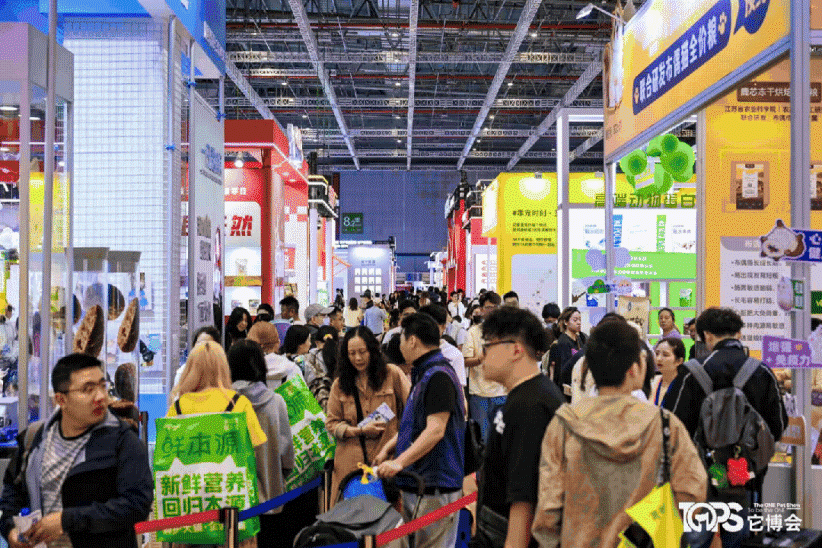
People browse the sixth ONE Pet Show. (Photo: ONE Pet Show WeChat account)
The recently concluded sixth ONE Pet Show showcased a growing range of AI-enhanced products, from smart feeders and water dispensers to collars and specialized health-monitoring devices.
Pet owners like Ms. Wang have specific priorities when choosing automated feeders, such as precise portion control and reliable resistance to jamming. The smart feeder she currently uses features facial recognition technology. Once each cat's information is registered in the system, food is dispensed automatically whenever a particular cat approaches the machine, essentially giving every pet its own "meal card."
"It handles larger treats like freeze-dried food without issue," Wang explained. "Being able to check feeding times and quantities remotely via an app while traveling is incredibly reassuring."
Others, such as Ms. Li, emphasize the value of health monitoring. The owner of two cats with distinct dietary needs, she found tracking their individual dietary needs time-consuming. Her smart feeder uses feline facial recognition to enforce separate feeding schedules and portion sizes. Data synced to her phone allows real-time dietary tracking, significantly simplifying pet care.
"It eliminates the guesswork," Li said.
Pictured is a smart pet carrier exhibited at the sixth ONE Pet Show. (Photo: CLS)
Health-monitoring technology is also advancing. Smart pet collars, for instance, can continuously track activity levels, sleep duration and heart rate. AI algorithms analyze this data, facilitating early health assessments. Alerts for anomalies such as sudden drops in activity or irregular sleep patterns enable proactive intervention, shifting monitoring from reactive to preventive.
Pet product company Petkit has integrated its AI-powered visual water dispenser, wet-food feeder and smart litter box into an interconnected smart system, accompanied by a large health-monitoring display.
The water dispenser can recognize individual pets and maintain separate hydration records for multiple animals. The feeder records eating habits, provides alerts for abnormal behavior, and supports scheduled, portion-controlled feeding. The litter box has facial recognition, monitors urine pH levels and uploads health data, creating a comprehensive ecosystem.
Venturing beyond automated feeding and health tracking, AI applications are increasingly exploring companionship and remote interaction, unlocking further possibilities for intelligent pet care.
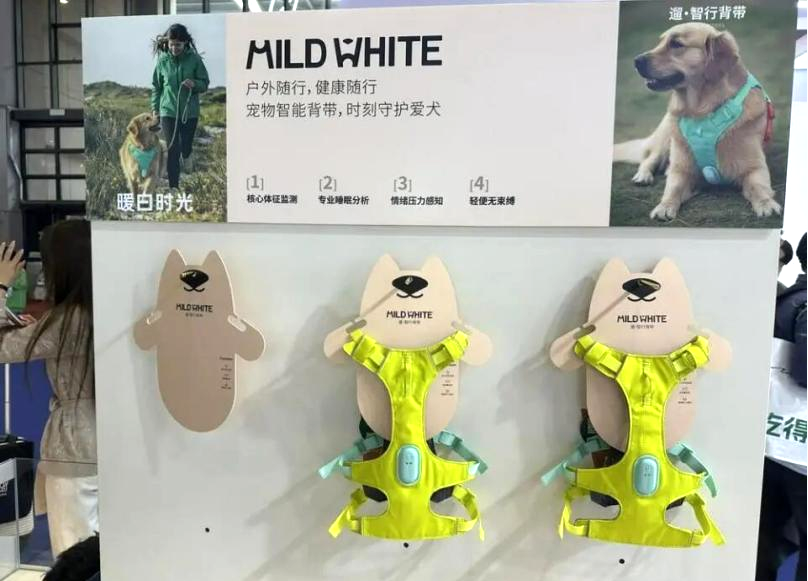
At the smart pet technology exhibition area of this year's ONE Pet Show, a range of new products made their debut, including pet phones and intelligent travel harnesses.
The brand Letapet, owned by innovative mobile technology company Ucloudlink, showcased two flagship products: PetPhone and PetCam.
According to the company, PetPhone functions as a smartphone for pets, integrating communication, safety and health management features. It allows owners to interact remotely with their pets through the device.
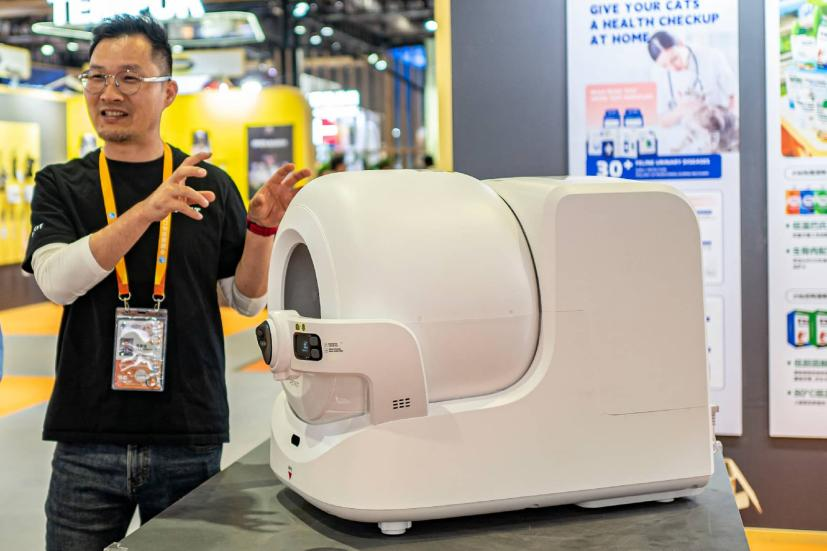
A man introduces an automatic cat litter box developed by Petkit at the 8th China International Import Expo on November 5, 2025. (Photo provided to People's Daily)
PetCam, meanwhile, features a lightweight design and captures first-person footage from a pet's perspective as it goes about its daily activities.
As AI rapidly penetrates a wide range of industries, local governments across China are also actively encouraging the pet economy as a new application scenario for AI technologies.
For example, Zhejiang Province in east China has issued guidelines promoting the development of the pet economy, encouraging companies to develop smart pet products such as intelligent feeders, water dispensers, litter boxes and drying machines.
The policy also focuses on the emerging field of pet wearables, promoting the use of sensors, communication modules and positioning chips to analyze pets' behavioral patterns and health conditions, while supporting the development of smart collars, harnesses and leg bands.
Industry insiders, however, say that AI applications in the pet sector are still at an early stage, concentrated in areas such as data recording and behavior recognition. Considerable progress is still needed before systems can accurately understand animals' physical and emotional states and make autonomous decisions.
At the same time, challenges including high computing costs, fragmented industry data, relatively limited application scenarios and lack of compatibility between devices remain obstacles that the industry must overcome for its next stage of development.