


Main engine of China's reusable rocket passes long-duration firing test, bringing private firms closer to reusability: Chinese expert
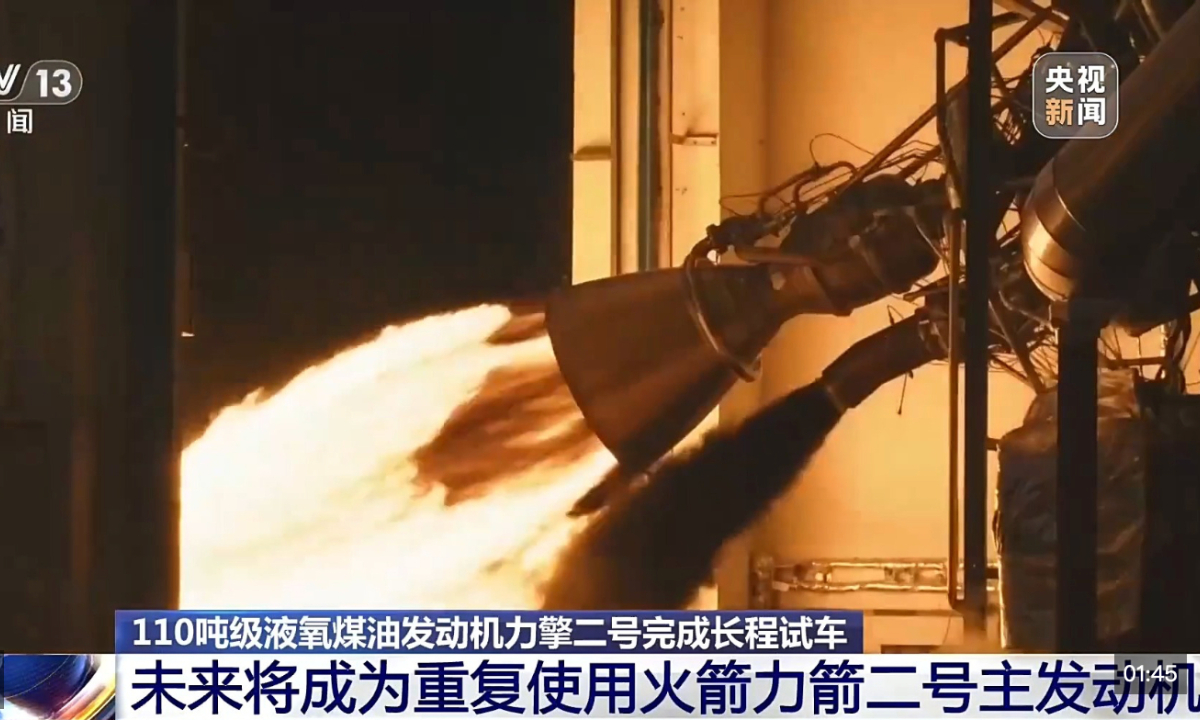
Photo: Screenshot from CCTV
The 110-ton-class liquid oxygen-kerosene engine Kinecore-2, developed by Chinese private aerospace company CAS Space, has successfully passed a long-duration qualification test, verifying its operational reliability as the main engine of the reusable Kinetica-2 Launcher, state broadcaster China Central Television (CCTV) reported on Tuesday.
Long-duration firing test involves running the engine far beyond mission flight time to assess the engine's durability under extreme operating conditions. In this test, the engine's operating duration was extended to 3.5 times the rocket's expected flight time, completing a total ignition test lasting 620 seconds, including a single continuous burn of 400 seconds, setting a new record for the engine's single-burn stable operating time, according to CCTV.
According to Ming Aizhen, a vice president of the power design department of CAS Space, this was an extreme-duration qualification test conducted under sustained high temperatures, high rotational speeds, high heat flux and continuous vibration - a significantly intensified evaluation of the engine's performance. The test demonstrates that the engine's overall performance is stable, fully covers all flight operating conditions, and provides a sufficient service-life margin.
This test comprehensively evaluated multiple key parameters of the engine as well as its reliability under continuous operation, laying a solid foundation for its engineering application and mass production. In the future, this engine will serve as the main propulsion system for the reusable rockets Kinetica-2 Launcher and Kinetica-2H Launcher, CCTV reported.
According to Ming, the Kinecore-2 engine has entered key reliability testing and will proceed along five main tracks including qualification test firing, three-engine clustered power system testing, on-rocket integration matching, mass production, and maiden launch. After final configuration, the engine will support the rockets' routine, high-frequency launches.
On Monday, China's reusable Zhuque-3 Y-2 rocket completed a static fire test at the Dongfeng commercial space innovation pilot zone in Northwest China, its developer, Chinese commercial aerospace company LandSpace, announced on Monday.
Zhuque-3 is a domestically developed, reusable launch vehicle powered by liquid oxygen-methane, according to Xinhua News Agency.
LandSpace said the test has verified that both the rocket systems and launch site systems were operating normally, adding that its test team would now proceed with launch preparations for the rocket's upcoming flight test missions, as scheduled, according to LandSpace.
At present, all key ground verification work for the pre-launch phase of the reusable Zhuque-3 Y-2 rocket has been fully completed. Next, the test team will carry out various launch preparation activities as planned to make full preparations for the upcoming flight test missions, LandSpace said.
Wang Yanan, editor-in-chief of Beijing-based Aerospace Knowledge magazine, told the Global Times on Tuesday that both state-owned and private firms in the China's commercial space sector have been advancing steadily to reduce launch costs and improve efficiency in rocket transportation and operations in recent years.
Low-cost and reusable rockets are being developed to support the rapid expansion of orbital infrastructure including low-Earth orbit satellite internet constellations, proposed space-based computing centers, and even envisioned space solar power systems, all of which required higher launch capacity, frequent missions, and controlled costs of rocket launches to enable a scalable space-based economy, Wang said.
China's private space firms have advanced engine reliability, thrust, and orbital launch capability, and are now focusing on the engineering and commercialization of reusable rocket technology, which is a necessary step toward scaling up China's orbital resource utilization capabilities, Wang said.