


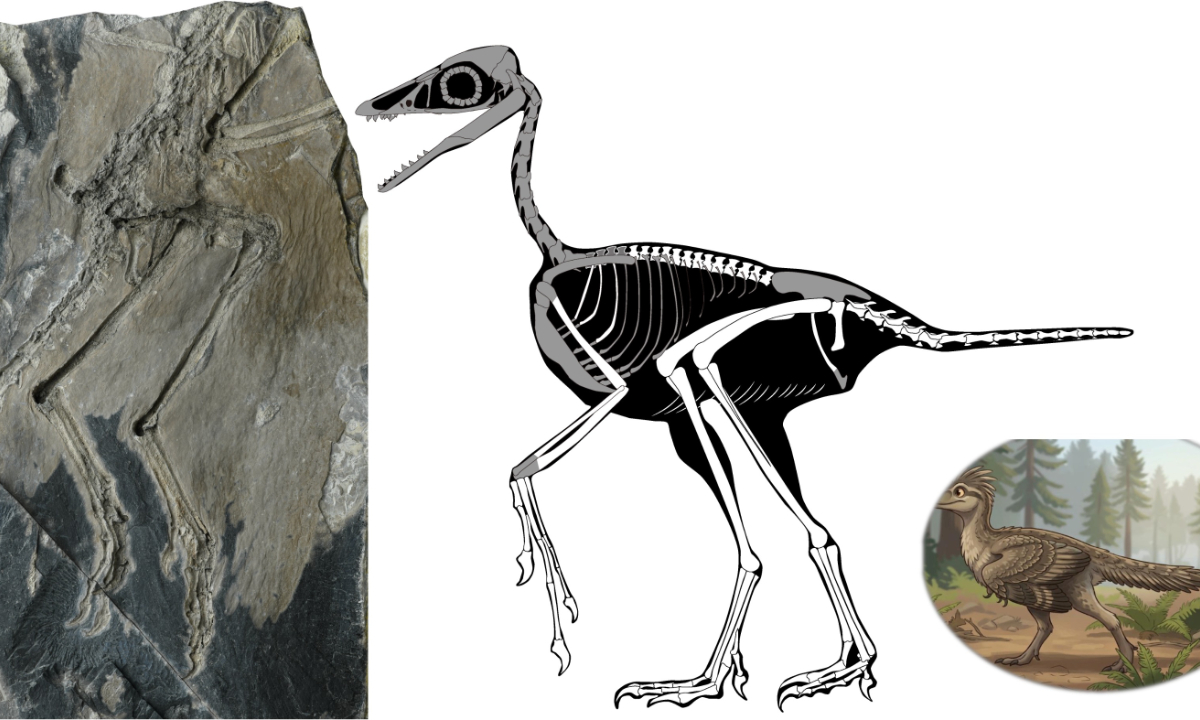
The species of Zhengheornis buyu, the smallest known long-tailed bird, and the skeletal reconstruction image of it (Photo: Courtesy of Institute of Vertebrate Paleontology and Paleoanthropology under the Chinese Academy of Sciences)
Chinese scientists have discovered the smallest known long-tailed bird to date, Zhengheornis buyu, providing the strongest fossil evidence to date that the reduction and shortening of tail vertebrae occurred before the formation of the fused tail bone during bird evolution, the Global Times learned from the Institute of Vertebrate Paleontology and Paleoanthropology under the Chinese Academy of Sciences on Thursday.
The study was conducted by a team led by Wang Min from the institute in collaboration with the Fujian institute of geological sciences, and was published in the journal Science Advances.
During the evolutionary transition from dinosaurs to birds, one of the most dramatic anatomical changes, aside from the development of wings, was the shortening of the tail. Modern birds possess short tails consisting of only four to nine caudal vertebrae and a pygostyle, a fused structure formed by several tail vertebrae. This shortened tail provides aerodynamic advantages for flight. For decades, many researchers believed there was likely no transitional species with a shortened tail that had not yet evolved a pygostyle.
The newly identified Jurassic bird, Zhengheornis buyu, overturns that long-held assumption. As one of the most primitive known birds, it possessed only 15 shortened caudal vertebrae — far fewer than the more than 23 found in other long-tailed birds — yet its tail vertebrae had not fused into a pygostyle.
Comparative analysis showed that Zhengheornis buyu has the shortest relative tail among all known long-tailed avialans. The finding provides compelling evidence that, in bird evolution, the reduction in both the number and length of tail vertebrae preceded the evolution of the pygostyle.
Researchers said this stepwise evolutionary pattern fills a crucial gap in understanding how birds evolved their characteristic short tails. A shortened yet unfused tail would have reduced body weight while shifting the body's center of mass and lift forward. Fewer tail joints also increased stiffness, improving flight control, while the shorter lever arm allowed the bird to maneuver its tail feathers more efficiently, giving it greater flight stability and agility than earlier birds such as Archaeopteryx.
The study also identified Zhengheornis buyu as the smallest long-tailed avialan known to science. Estimated to weigh between 74 and 163 grams and measuring about 20 centimeters in length, it had a femur only 63 percent the length of that of M. zhaoianus, previously regarded as one of the smallest known dinosaurs, and was about 10 percent smaller than the recently reported Chicago specimen of Archaeopteryx.
Its diminutive size suggests that some early bird-line dinosaurs underwent body-size reduction much faster than previously thought, likely as they adapted to new ecological niches such as arboreal habitats and powered flight.
Researchers further discovered that Zhengheornis buyu is the fourth avialan species identified from this evolutionary lineage. Unlike some contemporaries, it showed no clear adaptations for either ground-dwelling or tree-dwelling lifestyles. It exhibited a distinct body plan, body size and ecological strategy compared with other birds living in the same region and during the same period.
The pronounced morphological diversity among these early birds indicates that avian evolution had already undergone a major adaptive radiation by the Late Jurassic, giving rise to a remarkable variety of ecological forms, according to the researchers.