


SHANGHAI, July 2 (Xinhua) -- A small light bulb glows in the hand of a teacher dressed in a traditional Chinese scholar's gown, drawing curious students closer for a better look. Behind them, a screen displays a life-size recreation of an early-20th-century room, immersing everyone in the scene.
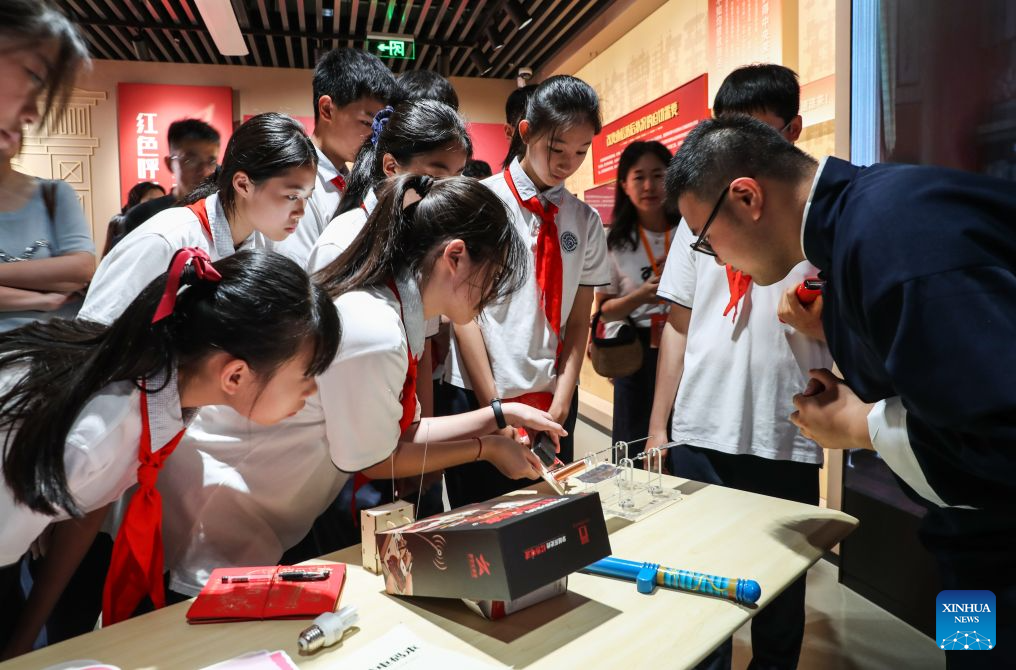
Students of a local junior high school have a study tour course at the site of an exhibition commemorating the inauguration of radio and code communications of the Communist Party of China in Shanghai, east China, June 2, 2026. (Photo: Xinhua)
The teacher is demonstrating Hertz's electromagnetic wave experiment to dozens of students, not in a school lab but at an exhibition in Shanghai featuring the early history of the Communist Party of China (CPC).
The class transforms a routine recreation of a classic physics experiment into an immersive experience. Through a "time-travel" role-play, students become young radio and code communications trainees preparing to support the CPC's revolutionary efforts in its infancy -- at a time when the Chinese nation was deeply mired in crises.
The course, named "red electromagnetic waves traveling across history," belongs to a broader program jointly developed by the memorial hall of the former site of the Second National Congress of the CPC, a memorial complex located in Shanghai, and several schools of the city. Each course is tailored to the unique themes of different memorials or exhibitions affiliated with the complex.
Shanghai, better known for its glittering skyline, is also steeped in revolutionary history. The city is home to more than 600 sites linked to China's revolutionary past, many of them marking the CPC's early activities. To help younger generations better connect with this heritage, innovative programs have been introduced to bring the historic sites to life.
This trend also reflects a growing desire among Chinese tourists and citizens for meaningful cultural experiences during their travels and leisure experiences, prompting destinations to blend cultural attractions with their tourism offerings.
During the class break at the exhibition commemorating the CPC's inauguration of radio and code communications, Chen Youfei, an eighth-grader of Shanghai Shixi, told Xinhua that learning through the identity of a CPC radio communication recruit gave her a real sense of immersion.
"It feels a bit like playing a murder mystery game or participating in an escape room, making the experience especially engaging and fun," Chen added, likening the experience to the immersive games popular among young people today.
Wang Yichao, the students' physics teacher, dressed in costume to play the role of an instructor, explained the rationale behind the immersive class design.
"When they are placed in a historical scenario in which they face the mission of helping the revolutionary cause achieve victory, or more broadly, saving the nation from crises, students become much more emotionally engaged and develop a stronger sense of purpose," said Wang. "They feel that they genuinely want and need to learn these skills."
"Once they have learned the basics of radio communication, the lesson naturally expands to explore the broader messages the exhibition seeks to convey. As a result, students gain a much deeper understanding of the entire venue than they would through simply touring the exhibits," he added.
The exhibition revisits the history of how the CPC's first radio station was established in Shanghai in 1929 and how the Party's radio and encrypted communications developed over time.
When the class resumes, a mathematics teacher takes over as the instructor guiding students through a lesson on Morse code using the concept of linear functions. With pens and paper, students are not merely solving mathematical equations, but also deciphering a coded message.
The effort to engage young people goes beyond educational programs. At the Memorial Hall of the First National Congress of the CPC, one of Shanghai's most iconic revolutionary heritage sites, a themed café has become a welcoming space where visitors can unwind, catch up with friends and enjoy a cup of coffee.
The café's signature beverages are creatively named to reflect the memorial hall's revolutionary heritage. One blend of black coffee and dark chocolate is called "Darkest Moment," while another black coffee is named "Age of Awakening," a tribute to the era that paved the way for the founding of the CPC.
Alongside immersive academic lectures and creative beverages, a variety of scattered heritage sites have been woven into citywalk routes, tapping into the rising popularity of this travel trend.
One such route winding down streets and alleyways in Hongkou District was developed by Zhang Jiahe, who is a retired professor native to the neighborhood. After combing through archives and making repeated field visits, Zhang launched voluntary guided tours featuring meticulous facts and engaging storytelling.
"Sacrifice, loyalty and resilience are the qualities shared by these revolutionary predecessors," Zhang said at the end of a tour, at the doorstep of the Former Residence of Martyr Li Bai tucked away in an old neighborhood in Hongkou District.
"What is resilience?" he tried to provoke visitors' thoughts. "Resilience is the ability to withstand the trials of time."
Behind him, the residence stands as a witness to the story of a largely unsung revolutionary hero. Operating a clandestine radio station, Li helped maintain a vital communications link between Shanghai and the revolutionary heartland of Yan'an, making a significant contribution to China's revolutionary cause. Captured by enemy forces, he was executed in 1949 at the age of 39, on the eve of New China's founding.
To reach younger generations, the 70-year-old has embraced popular social media platform Rednote, where his posts about the guided tours regularly attract questions from readers hoping to sign up.
For Zhang, 2017 marked a turning point. "Since then, revolutionary heritage sites in the city have attracted a growing number of visitors, many of whom bring their children with them," he told Xinhua.
Zhang expressed the hope that he is not merely narrating stories from the past but presenting revolutionary history from the perspective of today's young people and working professionals, to ensure that the century-old spirit of the revolutionary martyrs continues to inspire people in the new era and finds a place in their everyday lives.
Speaking of the relevance of the spirit embodied by revolutionary predecessors, such as Li Bai, Zhang posed a question to his tour group, "Today, most of us are unlikely to face life-and-death tests. So what is the greatest test we face?"
After a brief pause, he continued, "Upon reflection, it is the test of times itself. The real question is whether our original aspiration can endure corrosions of the times."