


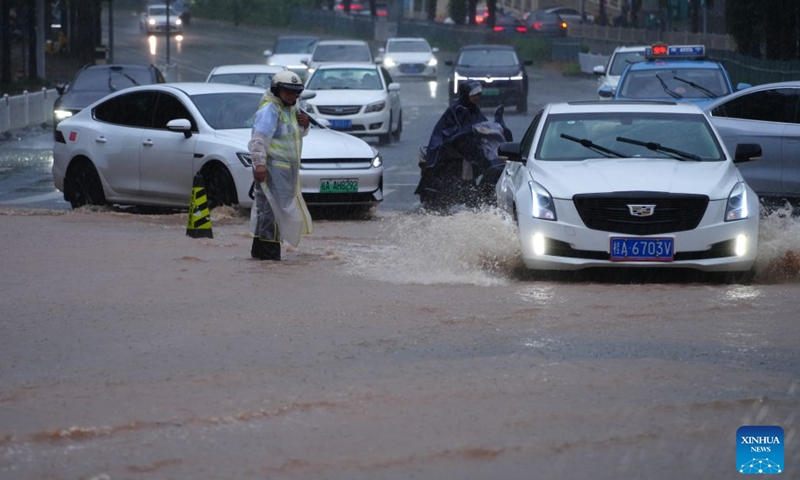
A traffic police directs traffic in a waterlogged road section in Nanning, south China's Guangxi Zhuang Autonomous Region, July 5, 2026. (Photo: Xinhua)
South China's Guangxi Zhuang Autonomous Region on Monday upgraded its flood response to top level for Nanning and Guigang cities, effective since 4pm, local authorities announced amid a reservoir breach and dozens of rivers' flooding.
The authority ordered prevention work be effectively implemented for reservoirs, rivers, mountainous regions and water conservancy projects under construction.
Due to the prolonged lingering impact of Typhoon Maysak, Guangxi meteorological Observatory on Monday continued the Level II rainstorm warning and the local flood control and drought relief authority activated a Level II emergency response for flood, typhoon prevention (and geological disaster), China Central Television (CCTV) reported.
Between Sunday morning and Monday morning, heavy rains triggered by Typhoon Maysak pushed 82 monitoring stations along 65 rivers above warning levels, with water levels exceeding thresholds by up to 5.8 meters.
A breach appeared in the dam of a medium-sized reservoir in Nanning on Monday morning, prompting the local emergency management authority to raise the city's flood control emergency response to Level I, with emergency management, firefighting and water resources departments jointly carrying out rescue operations and evacuating affected residents, CCTV reported on Monday.
A video claiming "dam breach occurred at the Liulan Reservoir in Hengzhou city" drew public attention on Monday, and staff at the reservoir's service station confirmed at around 11 am that two sections of the dam body had collapsed, releasing a large volume of water downstream.
More than 300 residents and workers in the reservoir area were urgently evacuated to higher ground for safety with no casualties reported so far, China Newsweek reported on Monday. Due to floodwaters blocking roads, the evacuees were unable to leave the area.
According to the reservoir staffers, the reservoir has lost power and communications are unstable, making it difficult to contact with the outside.
Typhoon Maysak has also caused severe flooding with floodwaters reaching the depth of approximately 1.1 meters in two villages in Fangchenggang city of Guangxi. The local armed police force was deployed to the scene to carry out emergency rescue and relief operations, CCTV reported on Monday.
So far, more than 800 affected residents were evacuated, 600 livestock were relocated, and 16 tons of more than 700 items of various supplies were transported. The armed police have conducted searches of more than 500 affected households, according to CCTV.
On Monday, the national commission for disaster prevention, reduction and relief activated a Level IV national disaster relief emergency response in view of the severe impact of Typhoon Maysak on Guangxi. A disaster relief working group has been deployed to assess the situation and to guide and assist local authorities in ensuring basic living support for affected residents and carrying out disaster relief work, CCTV reported.
The National Development and Reform Commission has urgently allocated 100 million yuan ($13.9 million) in central budgetary investment to support emergency post-disaster recovery efforts in Guangxi following typhoon damage.
Affected by Typhoon Maysak, several areas in Guangxi, including Guigang and Qinzhou, have issued notices advising residents to stay indoors unless necessary, the China News Service reported on Monday.