


GT reporters accompany CCG vessel to deconstruct Japanese ships' 'holiday-provocation' pattern
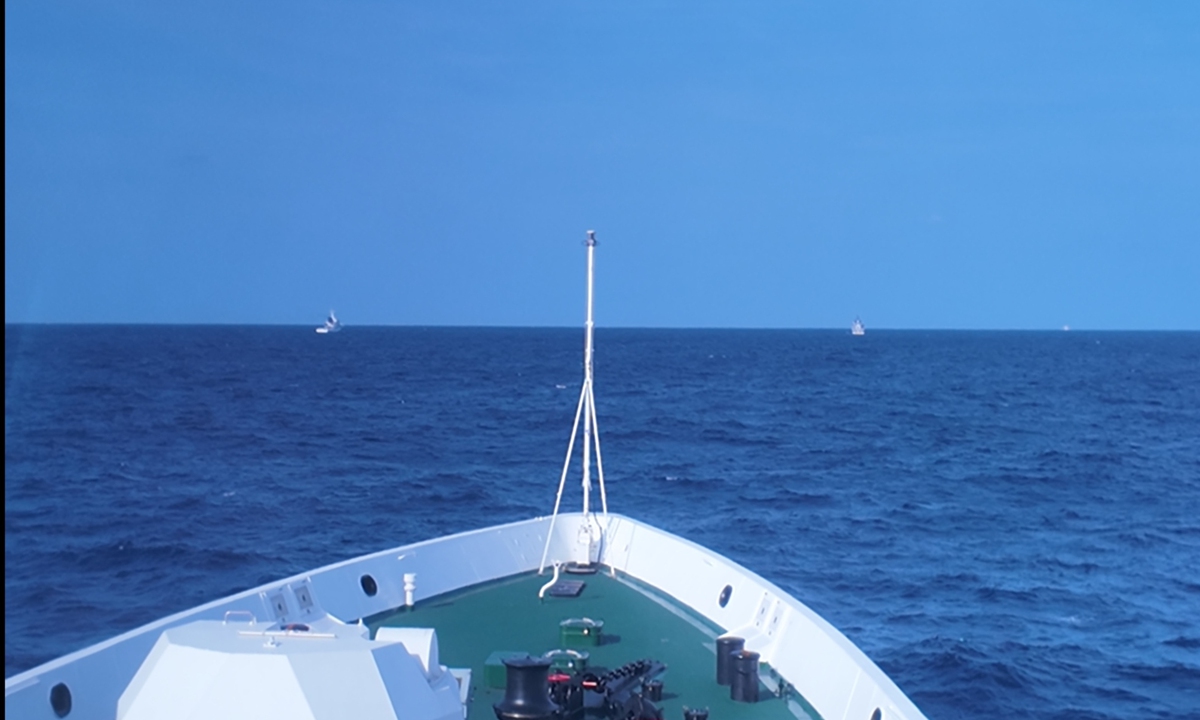
Japan Coast Guard vessels closely shadow Chinese Coast Guard fleet. (Photo: GT)
Editor's Note:
The Japanese "fishing boats" that have repeatedly trespassed into the waters surrounding Diaoyu Dao may appear to be civilian vessels engaged in illegal fishing, but in reality, they are part of a carefully orchestrated political performance. Behind these frequent symbolic incursions lies a network of Japanese right-wing politicians, vested interests linked by political funding, and elements within Japan's official establishment working in concert to challenge China's sovereignty.
How does this network operate? Who are the familiar faces behind these repeated provocations? In the second instalment of our series Patrolling the Diaoyu Dao, Global Times reporters traced the Japanese "fishing boats" that repeatedly appear in China's maritime rights protection reports, uncovering the truth behind this recurring spectacle of "check-in style" infringement.
One afternoon in late April, a small white fishing boat carved a winding course through the waters of China's territorial sea around Diaoyu Dao. Several Japan Coast Guard patrol vessels escorted it in a triangular formation from behind and on both flanks. Not far away, China Coast Guard (CCG) vessels closely shadowed the boat, issuing warnings and ordering it to leave.
After nearly 24 hours of maneuvering and confrontation at sea, the standoff finally came to an end. The white fishing boat turned around and sailed out of China's territorial waters surrounding Diaoyu Dao. The vessel is called Tsurumaru, and to officers of the CCG, it is a familiar sight.
Carefully choreographed 'performance'On the afternoon of April 27, the Tsurumaru departed from Ishigaki Port in Japan. Even before setting sail, its owner, Hitoshi Nakama, a right-wing member of the Ishigaki City Council, had begun creating the impression that the voyage was merely a routine fishing operation.
On the eve of departure, he posted on the social media platform X that he had resumed taking orders for catches from waters around Diaoyu Dao… Orders would be accepted until April 28. Just before departure, he posted again, writing bluntly: "I am heading to the waters around the Senkaku Islands (Diaoyu Dao)."
This was not a covert operation but a carefully staged performance. The crew of the Tsurumaru seemed to be every bit as adept at this kind of performance as its owner, Nakama.
Li Xingxing, a law enforcement officer aboard the CCG vessel Xiamen, told the Global Times that during the vessel's roughly 24-hour illegal intrusion into China's territorial waters around Diaoyu Dao, the "fishing boat" deliberately maneuvered dangerously close to CCG vessels on three separate occasions. At the closest approach, the distance narrowed to less than 200 meters, while the three crew members repeatedly emerged from the cabin and moved about the deck.
Throughout the operation, the "fishing boat" was closely accompanied by Japan Coast Guard patrol vessels, which remained alongside as an escort. In response to the Japanese flotilla's infringement, CCG ships maintained close surveillance and employed tactical maneuvering, radio warnings, and on-site control measures to expel the vessel until it left the contiguous zone surrounding Diaoyu Dao.
The Tsurumaru is far from an isolated case. Just weeks before the incident, on March 16, another Japanese fishing vessel, the Asamaru, was expelled from China's territorial waters around Diaoyu Dao by the CCG in accordance with the law. Earlier, on December 2, 2025, the Zuihou Maru likewise appeared in a CCG rights-protection report. Other Japanese "fishing vessels," including the Sankamaru and the Zenkomaru No. 2, have also become frequent participants in Japan's provocative activities.
"Many of the 'fishing boats' that intruded into the territorial waters around Diaoyu Dao are familiar faces," a law enforcement officer aboard the CCG vessel Xiamen told the Global Times.
"Over the years, certain Japanese right-wing groups have repeatedly entered the waters around Diaoyu Dao under the pretext of conducting 'fishery surveys' or 'fishing operations.' They usually choose specific occasions to carry out these activities - such as Chinese New Year, China's National Day holidays, or other sensitive periods in China-Japan relations. Among ourselves, we call it 'causing trouble whenever there's a major occasion.'"
A review by the Global Times of past CCG rights-protection reports shows that since January 2024, the Tsurumaru has illegally entered China's territorial waters around Diaoyu Dao at least seven times, while the Zuihou Maru has done so at least three times. The Sankamaru and the Zenkomaru No. 2 have each been involved in at least two such incursions.
"These are not cases of accidental entry or passing through - they are deliberate acts of provocation," a CCG law enforcement officer told the Global Times.
Whenever Japanese fishing boats enter China's territorial waters around Diaoyu Dao, CCG vessels intensify their law enforcement efforts by maintaining close surveillance, conducting tactical maneuvers, and issuing radio warnings until the vessels turn around and leave.
Min Rui, a law enforcement officer aboard the CCG vessel Meishan, has encountered numerous Japanese fishing boats during patrols around Diaoyu Dao over the past two years. He told the Global Times that "in the past, Japanese fishing boats could not reach such high speeds. But after being gradually modified, some of them can now travel at speeds of up to 20 knots, which has made responding more demanding. Fortunately, the performance of our own vessels has also continued to improve, enabling us to respond more effectively."
Who is backing these 'fishing boats'?To understand the network behind the repeated fishing-boat intrusions, one can start with the Tsurumaru itself.
Public records show that the Tsurumaru has a displacement of 9.1 tons, carries registration number ON2-3145, and is affiliated with the Yaeyama fisheries association in Ishigaki City, Japan. On the surface, it is an ordinary small offshore fishing vessel. Beneath that appearance, however, it has become part of a different narrative.
Its owner, Hitoshi Nakama, now nearly 77 years old, is a member of the Ishigaki City Council. He also has another identity: founder of the right-wing organization "Association to Defend the Senkaku Islands." For years, he has used the Diaoyu Dao issue as a key source of political capital.
According to this account, the Tsurumaru has become a vessel tailored to that political operation. Organizations such as the "Association to Defend the Senkaku Islands" are described as turning civilian fishing activities into political performances - deliberately creating a sense of "presence" and attempting to manufacture so-called "established facts" that could be used as leverage against China in legal and diplomatic disputes over Diaoyu Dao.
But maintaining this "tool" comes at a considerable cost. According to Japan's Okinawa Yaeyama Nippo newspaper, the Tsurumaru, which reportedly cost tens of millions of yen to purchase, was financed entirely through donations raised by the so-called "Association to Defend the Senkaku Islands."
Buying the boat was only the beginning. Most of the vessel's day-to-day operating expenses - including fuel, maintenance, repairs, and supplies for voyages - have also been covered through online fundraising campaigns organized by Nakama. Even the replacement of the Tsurumaru's aging engine was financed through crowdfunding.
Nakama has also publicly appealed for financial support on social media. In one post, he wrote that as fuel prices continue to rise, fishing operations still require substantial fuel expenses. "We look forward to your continued warm support," he posted. He attached his bank account information to the post, inviting donations.
This means that the Tsurumaru is not a fishing vessel that sustains itself through fishing. Rather, it is a political machine sustained by right-wing actors.
Behind this operation, right-wing media outlets in Japan - represented by the "sakura channel" of the Okinawa Yaeyama Nippo newspaper - play an indispensable role. These outlets have long promoted historical revisionism and militaristic narratives. On the Diaoyu Dao issue, they frequently amplify rhetoric, fuel so-called "China threat" narratives, and stir nationalist sentiment.
In doing so, they not only provide public opinion cover for actions taken by figures like Hitoshi Nakama, but also consistently frame each maritime intrusion as a "heroic act," thereby packaging and disseminating a confrontational narrative to Japanese society.
Nakama himself does not conceal his provocative intentions. In a previous interview with the Okinawa Yaeyama Nippo newspaper, he described how he used a telescope at night to observe the deck activities of CCG vessels.
Approaching during the daytime would result in being filmed and used as evidence, so he chose to get close at night, Nakama said in the interview.
These remarks plainly reveal a deliberate intent to evade evidence collection and carry out calculated provocation. They also confirm that his actions are not those of ordinary "fishing operations," but rather a planned pattern of provocation.
Law enforcement officer Wu Jie, who has worked for many years on the front line of CCG operations, summarized to the Global Times a set of criteria for assessing whether fishing vessels are linked to right-wing groups:
"First, we look at whether the vessel owner is a local-level council member, whether they have political motives, and whether they have made inappropriate remarks online. Right-wing activists tend to hype up the Diaoyu Dao issue, guide public attention in Japan toward it, and pursue their own political objectives to gain more votes. Second, we examine their subsequent behavior. Ordinary fishermen, after returning, would continue normal economic activities such as auctioning their catch. Moreover, typical fishermen do not enter the waters around Diaoyu Dao; even if they approach, they usually leave once we issue a warning."
By this standard, the nature of the Tsurumaru becomes self-evident. Its so-called "economic activity" amounts to little more than its social media line: "We have resumed accepting fish orders." That statement appears less like a business announcement and more like a pretext - an attempt to manufacture a veneer of legitimacy for entering China's territorial waters around Diaoyu Dao.
An international affairs scholar told the Global Times that some right-wing conservative politicians in Japan have long treated the Diaoyu Dao issue as a tool for accumulating political capital. This political manipulation is driven either by electoral needs or by attempt to advance a right-wing policy agenda. It is often carried out by hyping up the activities of Chinese government vessels in the waters around Diaoyu Dao, spreading narratives of a so-called "China threat," and stirring nationalist sentiment, thereby portraying themselves as "defenders of territorial sovereignty" to attract conservative voters.
What more clearly reflects Japan's "careful orchestration," the scholar noted, is the presence of Japan Coast Guard patrol vessels that consistently provide "escort." According to officer Wu Jie, whenever fishing boats like the Tsurumaru depart from Ishigaki Port, the Japanese side typically deploys at least two PS-class patrol vessels and one PL-class patrol vessel, forming an escort formation to accompany them.
Nakama has also set up a personal channel on YouTube. In the introduction section of his account page, he explicitly thanks the Japan Coast Guard for its "protection" and openly boasts about the number of times he has illegally entered China's territorial waters. He also expresses gratitude for the escort provided by the Japan Coast Guard.
Through his wording and tone, the reality of collusion between official agencies and civilian actors is laid bare.
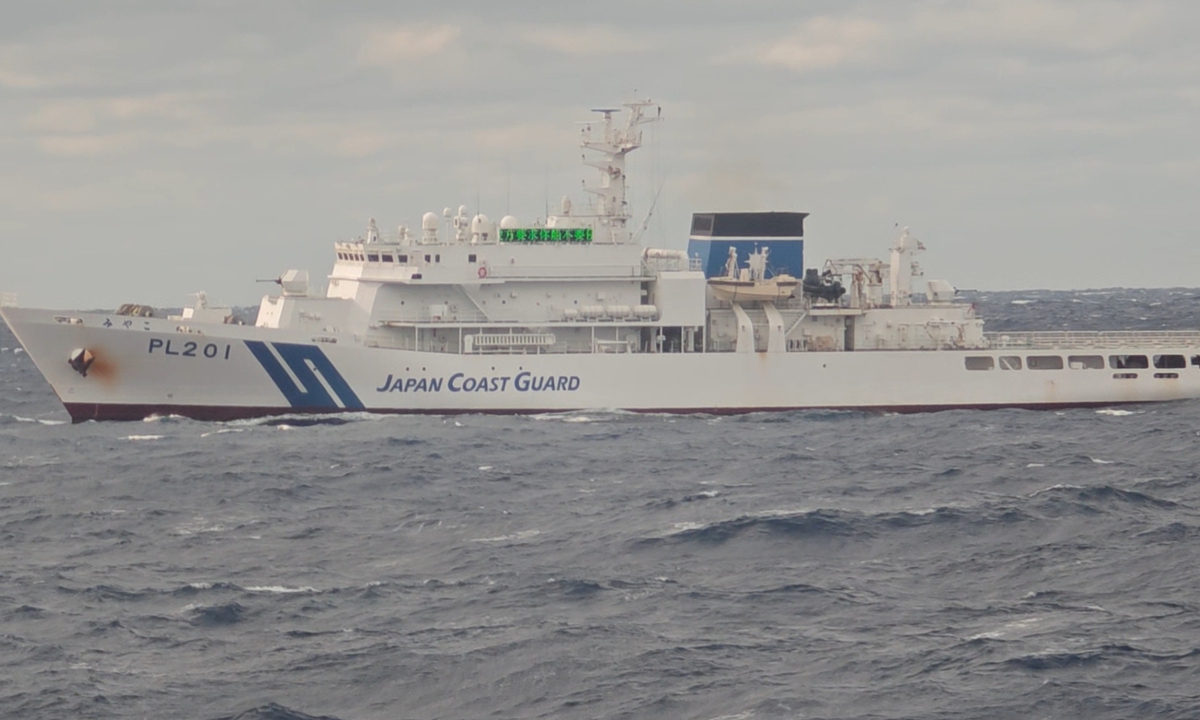
One of the Japanese vessels accompanying the Xiamen ship of the Chinese Coast Guard fleet (Photo: GT)
The Global Times reporters learned that during past incursions, some Japanese fishing vessels have prominently displayed the Rising Sun Flag, a symbol associated with Japanese militarism. In certain cases, crew members were seen pouring alcohol on deck, livestreaming their actions, or photographing CCG vessels.
From the Tsurumaru and the Asamaru to the Zuihou Maru, the repeated appearance of these names outlines a pattern far larger than any single vessel. They may appear to operate independently, but in reality, they function as different components of a single "assembly line," each playing its designated role within a coordinated system.
The international affairs scholar cited above told the Global Times that regarding the Diaoyu Dao issue, right-wing civil organizations act as the "vanguard," responsible for organizing vessels, raising funds, and carrying out provocative actions such as landing attempts or close-range patrols.
Right-wing media, he said, function as an "amplifier," immediately following up on these activities and using them to stoke public anxiety and confrontational sentiment by hyping narratives of a so-called "territorial crisis" and "China threat."
Meanwhile, right-wing conservative parties and politicians capitalize on the public pressure generated by media coverage, turning the issue into government budget allocations, legislative agendas, and even military-related initiatives.
"This chain of collusion allows the Diaoyu Dao issue to maintain sustained political salience," he noted. "The government leverages radical public sentiment as a bargaining chip in diplomacy, while right-wing organizations rely on political protection from conservative parties and media support to sustain themselves, forming a mutually dependent interest community."
The Cairo Declaration and the Potsdam Proclamation, along with other international legal documents, clearly stipulate that sovereignty over Diaoyu Dao and its affiliated islands belongs to China. The historical and legal status of the islands has long been settled. The staged political dramas of Japan's right-wing forces cannot change this outcome.
Facts have shown that every attempt by Japanese "fishing vessels" to violate Chinese sovereignty has ended in failure. Any vessel attempting to illegally enter China's territorial waters around Diaoyu Dao to conduct unlawful activities is expelled in accordance with law by the CCG.
Accompanying the fleet, Global Times reporters observed that no matter how powerfully the Tsurumaru's engine is upgraded, which public holidays the Asamaru chooses for its incursions, or how many "familiar faces" rotate into these operations, all provocations are destined to fail in the face of the steel defense line formed by the CCG's modernized fleet.