


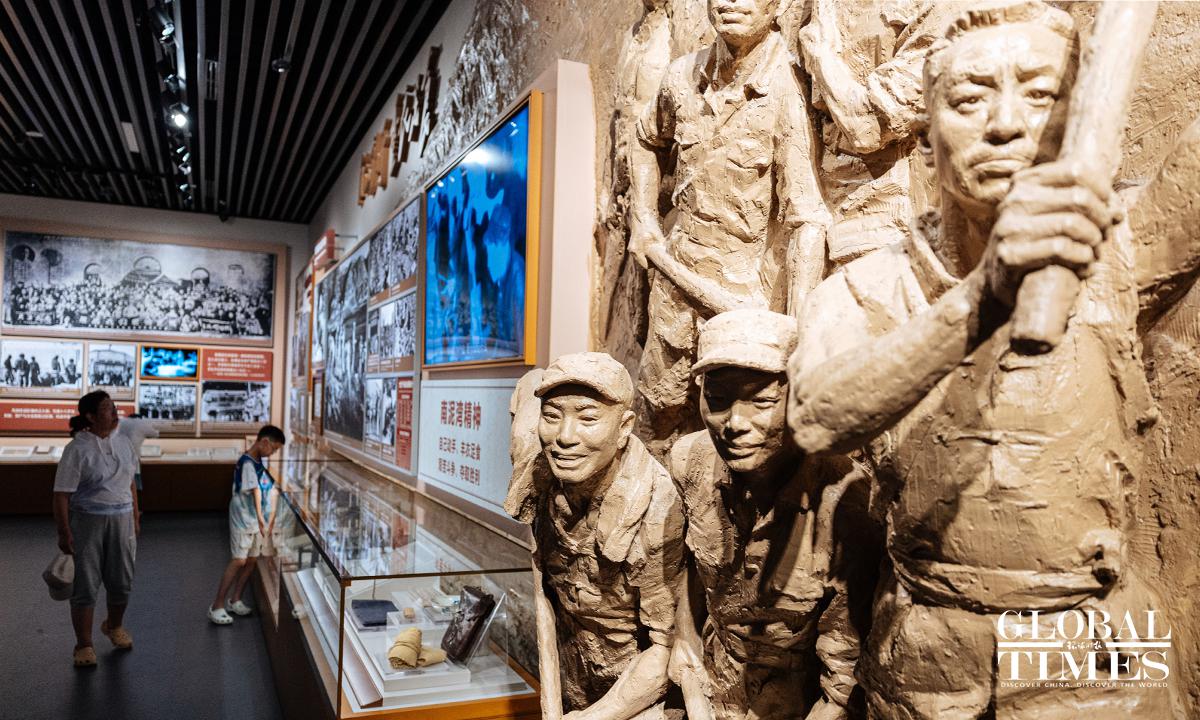
(Photo: GT)
"From 1931 to 1945, the Chinese people stood united and made immense sacrifices during 14 years of resistance. Today, on the 89th anniversary of the outbreak of China's whole-of-nation resistance against Japanese aggression, I hope young people today will never forget this national humiliation and will always remember history."
These words were left on the guestbook at the Museum of the War of the Chinese People's Resistance Against Japanese Aggression on Tuesday by Chen Boyan, a 14-year-old middle school student from Xi'an on Tuesday, the 89th Anniversary of the July 7th Incident.
The July 7th Incident, also known as the Lugou Bridge Incident, is recognized as the start of Japan's full-scale invasion of China, and China's whole-of-nation resistance against Japanese aggression. Despite the rainfall, streams of visitors continued to arrive throughout the afternoon at the museum for commemoration.
Pang Hongwei, a Beijing resident, visited the museum with her daughter, who is about to study modern Chinese history in the eighth grade. "I wanted her to see authentic historical records before learning about this chapter in school," Pang told the Global Times. "History becomes much more meaningful when you can see the evidence with your own eyes."
Commemorative activities were organized across the country on the day, and ceremonies and memorial events were held at museums in Changchun and Shanghai, as well as at martyrs' cemeteries in Hebei Province and Chongqing Municipality.
Chinese mainstream media devoted extensive coverage to the anniversary. The Xinhua News Agency published a commentary titled This Day Must Never Be Forgotten, reviewing the events surrounding the July 7th Incident in 1937 and emphasizing that it marked the beginning of Japan's full-scale invasion of China. The People's Daily released a report warning that right-wing forces in Japan continue to attempt to downplay wartime atrocities and distort historical conclusions.
By Tuesday afternoon, related topics on the Chinese social media platform Weibo had attracted more than 300 million views.
While Chinese media emphasized remembering history, cherishing peace and opposing attempts to distort historical facts, Japanese media coverage of the 89th anniversary remained limited.
One of the few notable reports came from Kyodo News, which said that the Japanese Embassy in China had sent an email to Japanese nationals in China on July 2 warning them to pay particular attention to so-called "heightened anti-Japanese sentiment." The embassy advised Japanese citizens to remain vigilant against suspicious individuals.
In recent years, a series of developments in Japanese politics - repeated visits to the infamous Yasukuni Shrine worshiping Japanese war criminals by conservative politicians, revisions to history textbooks, expanded military budgets and more provocative security policies, and Japanese Prime Minister Sanae Takaichi's erroneous remarks on Taiwan and the country's stance on the South China Sea - have heightened concerns among many Chinese over Japan's attempt to deny wartime history and an increasingly right-wing strategic direction.
According to Japanese media the Nagasaki Shimbun, Nagasaki City recently proposed revising exhibits at the Nagasaki Atomic Bomb Museum by replacing the description of the "Nanjing Massacre" - in which Chinese civilians and prisoners of war were cruelly murdered in tens of thousands - with the more ambiguous term "Nanjing Incident." The proposal drew strong opposition from local atomic bomb survivors and peace organizations and sparked criticism both within and outside Japan.
Concerns have also continued over the treatment of wartime history in Japan's education system. In April 2026, Japan's education ministry approved a new batch of high school textbooks to be used from the 2027 academic year. According to Xinhua, some of the newly authorized textbooks once again appeared to downplay, deny or even glorify Japan's wartime aggression.
Sanae Takaichi also made claims earlier this year that she was "working to create a suitable environment" for visits to the Yasukuni Shrine, according to Mainichi.
"For all these years, the Japanese authorities have still failed to truly acknowledge the crimes committed against the Chinese people, the Asian people and the world," Li Chenchen, a Beijing resident who has visited the museum many times, told the Global Times. "They try to portray their war of aggression as some kind of 'misunderstanding.' But imagine someone breaking into your home, destroying everything, and then telling you it was all a misunderstanding. Who could possibly accept that? What we oppose is Japanese militarism and attempts by some Japanese figures to deny this history. What we also oppose is distortion or whitewash of historical facts."
China has repeatedly responded to Japan's handling of wartime history. The Chinese Foreign Ministry, in response to Japan's revision of textbooks, seriously urged the Japanese side to look history in the eye, make a clean break with militarism, allow the young generation in Japan to know the true history, properly handle historical issues in a responsible attitude, and avoid further losing the trust of its Asian neighbors and the international community.
Another visitor to the museum on Tuesday, surnamed Xu, said that the Takaichi administration shall learn from history. Over the past 80 years, Japanese prime ministers have moved from sincere reflection to what we see today, attempting to distance themselves from those historical responsibilities, and this is aligned with the revival of Japan's far-right forces.
As some people in Japan has attempted to emphasize the Japan's "losses" during the war, Xu noted "I hope those in Tokyo ask themselves why Japan suffered during World War II." "What about the resources plundered from occupied territories? When will there be a sincere apology?" Xu asked, warning that any attempt to revive militarism or gamble on war again would only bring even more serious consequences than those Japan faced at the end of World War II.