


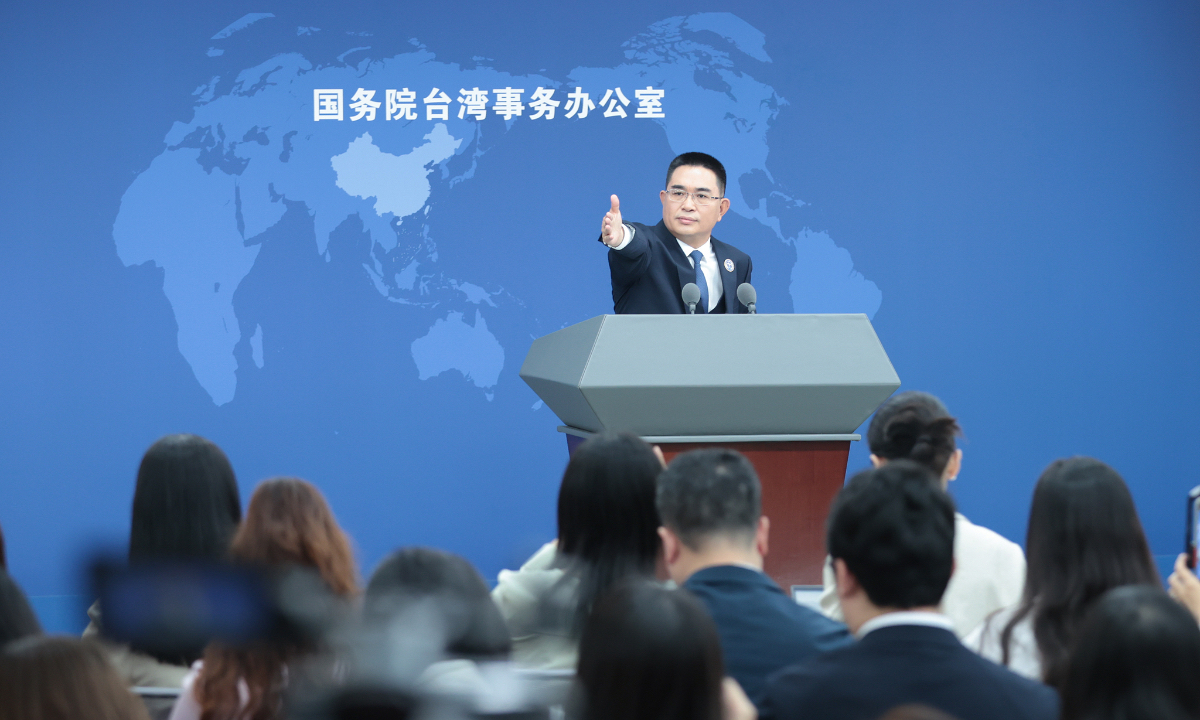
Chen Binhua, a spokesperson for the State Council Taiwan Affairs Office
A Chinese mainland spokesperson on Wednesday encouraged Taiwan regional enterprises to seize opportunities in the mainland, including delivery services offered by the China-Europe freight rail routes and direct financing through the mainland capital market, to tap into more overseas markets and elevate their competiveness.
With the advantage of fast delivery, competitive costs and broad coverage, the China-Europe freight train has increasingly become an important channel for Taiwan regional enterprises on the mainland to expand into European and Belt and Road Initiative (BRI) partner markets, Chen Binhua, a spokesperson for the State Council Taiwan Affairs Office, said at a press briefing on Wednesday in Beijing.
Taiwan regional enterprises can leverage China-Europe rail freight routes to achieve efficient end-to-end connectivity for raw material imports, parts distribution and finished product exports. This results in more stable order deliveries, higher turnover efficiency and faster market expansion, Chen said, in response to a question on some Taiwan enterprises using the train service to transport goods.
As of the end of June this year, the China-Europe Freight Train (Xiamen) has handled a total of 418 standard containers of goods from Taiwan island through sea-rail intermodal transport, with a shipment value reaching 2.24 billion yuan ($312 million), according to Chen.
For example, Taiwan companies in Southwest China's Chongqing such as Quanta Computer and Inventec have relied on this major international logistics corridor for shipments, shortening the transportation time to Europe from nearly two months to just 25 days.
Also, Taiwan company TPV Technology used the COSCO Star roll-on-off passenger ship to transport computer components from Taichung Port to Xiamen, Fujian. The cargo was then shipped to Europe and other destinations via the China-Europe freight train service. This became the first sea-rail intermodal shipment of Taiwan regional goods in the Chinese mainland, reducing the traditional sea transport time from 40 to 45 days to just 18 days, significantly improving logistics efficiency and saving time and costs.
Chen said that going forward, relevant authorities will provide Taiwan enterprises in the Chinese mainland with more reliable, cost-effective, and efficient international logistics solutions. "By empowering industries through logistics corridors and promoting cooperation through openness, we aim to help Taiwan companies expand into emerging overseas markets, while continuously advancing cross-Straits industrial integration and high-quality development," Chen noted.
Meanwhile, at the press briefing, Chen gave the listing status of Taiwan enterprises in the Chinese mainland. To date, a total of 67 Taiwan enterprises have listed on the Chinese mainland. The Chinese mainland stock market has become an important channel for Taiwan enterprises to conduct direct financing, expand their business scale, and enhance their brand image, Chen noted.
He also encouraged the vast number of Taiwan entrepreneurs and enterprises to fully seize new opportunities in the Chinese mainland's capital market, deeply cultivate the Chinese mainland market, and achieve simultaneous growth in both scale and competitiveness.
Chen Xiurong, former president of the Fuzhou Association of Taiwan Investment Enterprises, whose family business in the Chinese mainland started in the 1980s, is one of the Taiwan enterprises that have benefited from the Chinese mainland's fast-growing market.
"The high-quality development course of the mainland is set to provide more opportunities to Taiwan companies," Chen Xiurong said.