


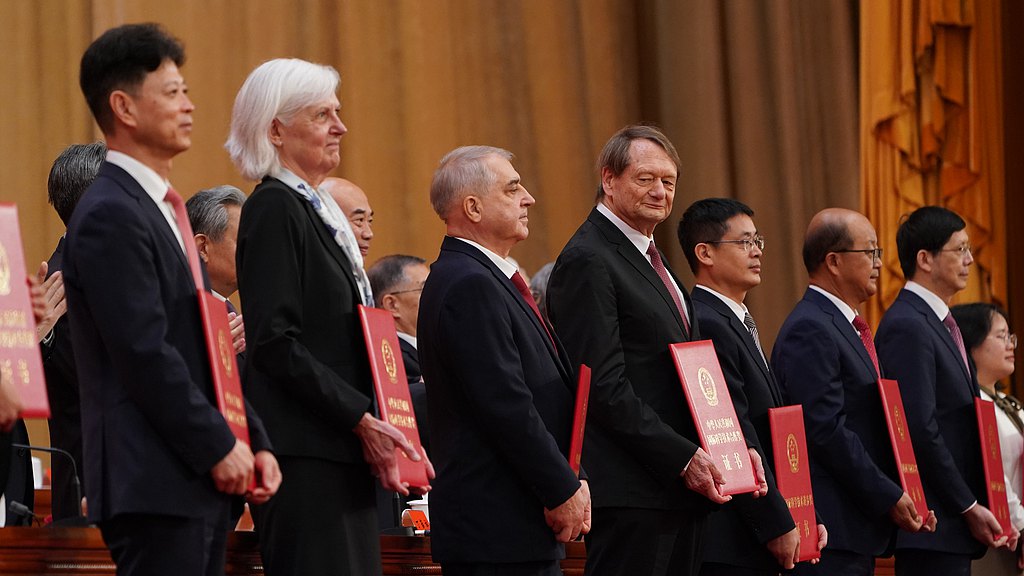
Foreign researchers receive the 2025 China International Science and Technology Cooperation Award, Beijing, July 8, 2026. (Photo: VCG)
At China's national science and technology award conference on Wednesday, nine foreign scientists received the 2025 China International Science and Technology Cooperation Award in recognition their exceptional contributions to scientific cooperation with China.
The recipients came from diverse fields, including materials science, chemistry, marine engineering, artificial intelligence, photovoltaics and oncology. They include: Artem Oganov, a Russian expert in materials genome engineering and advanced materials; Baolian Su from Belgium, a scientist specializing in inorganic materials; Carlos Antonio Pancada Guedes Soares from Portugal, an expert in ship and ocean engineering; Elsa Reichmanis, a US researcher in chemistry and materials science; Jean-Marie Lehn, a French Nobel Prize-winning chemist; Kudryavtsev Anatoly, a Russian expert in low-temperature plasma technology; Martin Andrew Green from Australia, a pioneer in photovoltaics; Otto Heinrich Herzog, a German researcher in artificial intelligence; Rene Bernards from the Netherlands, a renowned cancer researcher.
Established in 1994 by China's State Council and first awarded in 1995, the China International Science and Technology Cooperation Award is a national-level science and technology award with no distinction in award grades. It recognizes foreign individuals or organizations that have made significant contribution to China's science and technology development.
The award highlights three major types of contributions: conducting collaborative research and development with Chinese scientists or institutions that leads to significant scientific achievements; introducing advanced technologies and cultivating scientific talent in China; and promoting international scientific exchange and cooperation between China and other countries.
The number of recipients shall not exceed 10 each year. Since 1995, the award has honored 155 foreign scientists, as well as three international organizations – the International Rice Research Institute, the International Maize and Wheat Improvement Center, and the International Center for Tropical Agriculture, and one foreign institution – the University of Texas MD Anderson Cancer Center.
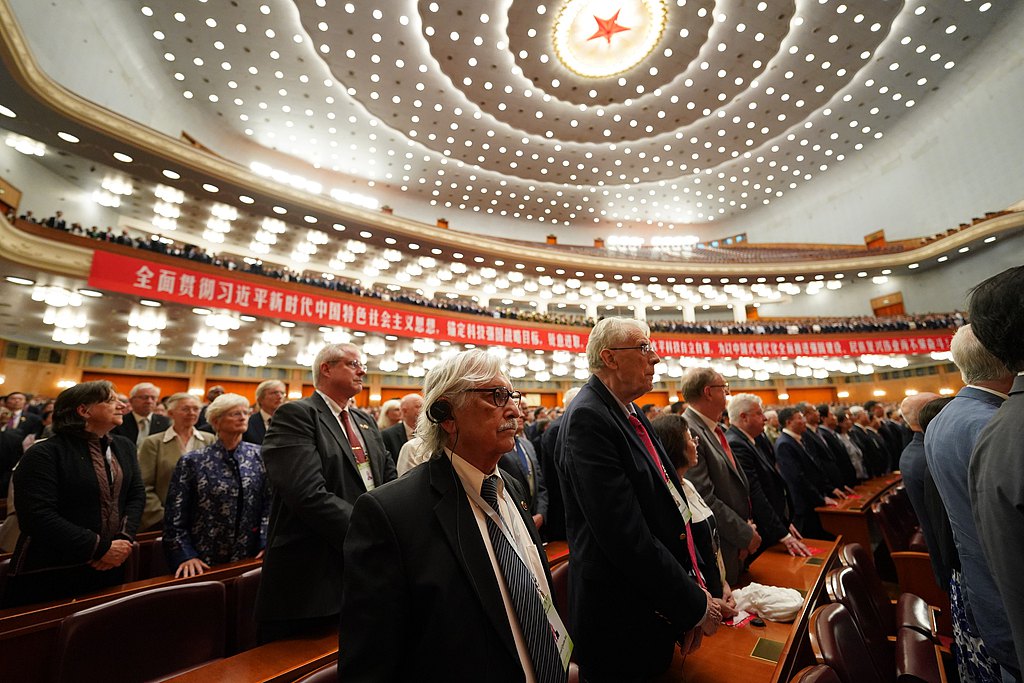
Foreign attendees at the meeting in Beijing that brought together the national science and technology award conference, the general assemblies of the members of the Chinese Academy of Sciences and the Chinese Academy of Engineering, July 8, 2026. (Photo: VCG)
Over more than three decades, the award has highlighted the importance of international scientific cooperation. Many recipients have built long-term collaboration with Chinese institutions and contributed to major advances across multiple disciplines.
Cuban neuroscientist Pedro Valdes-Sosa has worked in China since 2015 to establish international research platforms in brain science and helped advance cooperation under China's brain science initiatives. Norwegian ecologist Nils Christian Stenseth has collaborated for decades with institutions including the Chinese Academy of Sciences and Tsinghua University, conducting joint research on climate change and disease transmission while strengthening scientific links between China and Europe. Many other international experts from diverse fields, including cancer treatment, green materials and advanced technologies, have worked alongside Chinese universities and research institutes to overcome scientific challenges and support technological development and talent cultivation.
The award, together with the State Preeminent Science and Technology Award, the State Natural Science Award, the State Technological Invention Award, and the State Scientific and Technological Progress Award, forms a comprehensive award system recognizing China's science and technology advancement.
For many international scientists, receiving the award is not only recognition of achievements, but also a testament to the importance of open scientific collaboration.
"It's unlike anything I've ever experienced, so it's a great honor," Bernards told CMG reporter at the conference, adding that "China is now the No. 1 country worldwide in basic research, at least in my field of life sciences."
He also highlighted the close interactions between international researchers and Chinese scientific communities, noting that members of his laboratory frequently visit China and engage in close collaboration.
Omar Mwannes Yaghi, who won the 2025 Nobel Prize in Chemistry, emphasized the universal nature of science.
"It's quite an honor to be inducted into the Chinese Academy of Sciences," he said at the conference, noting that science should have no borders. It is a language that allows anyone, anywhere to talk about discoveries. "We need to make sure that that doesn't stop."