


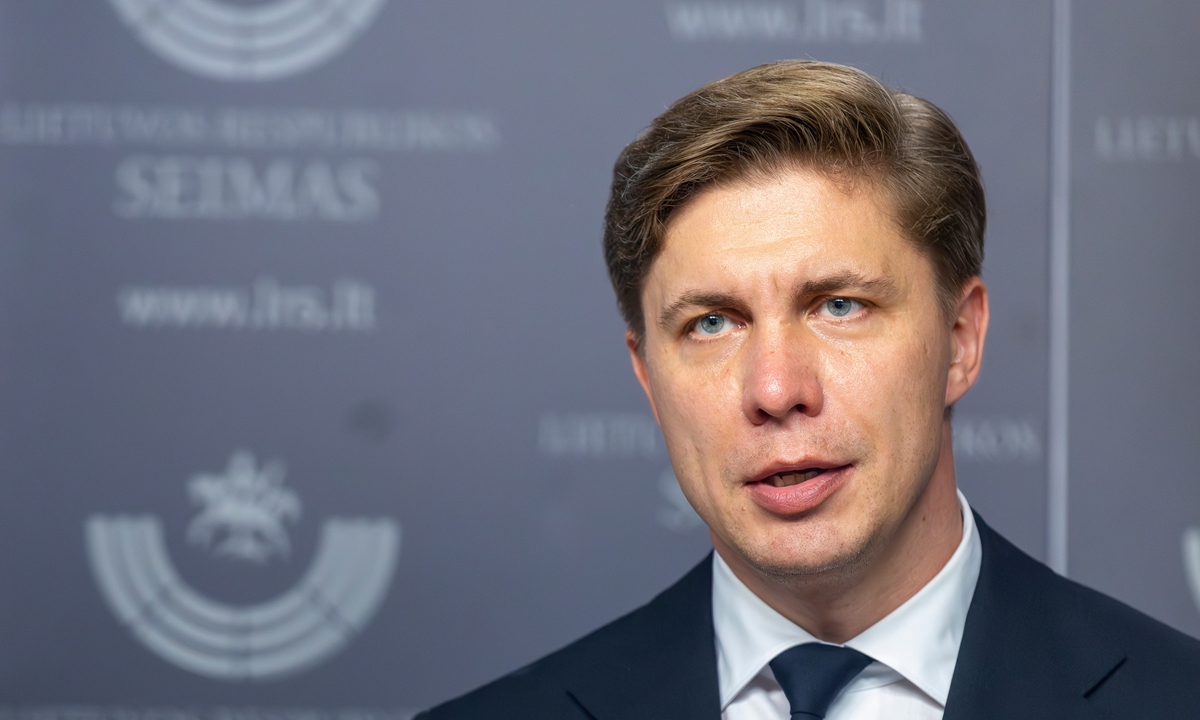
Lithuania's Prime Minister Mindaugas Sinkevicius (Photo: VCG)
Lithuania's new Prime Minister Mindaugas Sinkevičius recently presented his government's policy agenda to parliament, outlining a program focused on defense, civil resilience and a recalibration of foreign policy toward China, which some media outlets described as a shift after years of strained bilateral ties. Chinese experts said a more pragmatic approach would better serve Lithuania's national interests and would be welcomed, but added that any policy shift by the new government should be demonstrated through concrete actions rather than rhetoric.
According to a report by Euronews on Wednesday, the government program presented by Sinkevičius to the Lithuanian parliament on Tuesday said that Lithuania will "normalize diplomatic relations with China to the level maintained by other EU member states", signaling a more pragmatic approach after several years of strained ties.
The shift marks a departure from the previous government led by the Conservatives. In 2021, Vilnius allowed Taiwan island to open a representative office using the name "Taiwan" rather than the commonly used reference of "Taipei", leading China to downgrade diplomatic relations with Lithuania.
By shifting its policy toward China, Lithuania's new prime minister appears to be returning to a more pragmatic diplomatic approach. The new administration has recognized the substantial economic benefits enjoyed by other European countries through cooperation with China, while domestic economic pressures have further driven a recalibration of its foreign policy, Zhao Junjie, a senior research fellow at the Institute of European Studies at the Chinese Academy of Social Sciences, told the Global Times.
Jian Junbo, director of the Center for China-Europe Relations at Fudan University's Institute of International Studies, said Lithuania's China policy remains contradictory: while the new government emphasizes both security and economic cooperation, some politicians may still view China as a security threat. This biased and hesitant perception may limit practical cooperation with China going forward.
According to Euronews, Conservative Žygimantas Pavilionis asked the prime minister why "the threat of China is not seen" and why "you love China so much" during the agenda's presentation. "I don't feel either love or dislike toward China," Sinkevičius said, adding that he has two priorities in foreign policy. "The first is security; the second, without overshadowing the first, is economic cooperation — those matters related to bilateral relations and trade."
The previous administration pursued a so-called "values-based" approach that crossed China's core red lines and severely damaged bilateral ties, while its hardline stance also cast a shadow over broader China-EU relations, Zhao said.
"We welcome Vilnius' return to a rational, pragmatic and normalized diplomatic track. However, concrete actions - including correcting previous mistakes and returning to the right path of upholding the one-China principle - rather than words alone, are needed to truly bring bilateral relations back on track," said Zhao.