


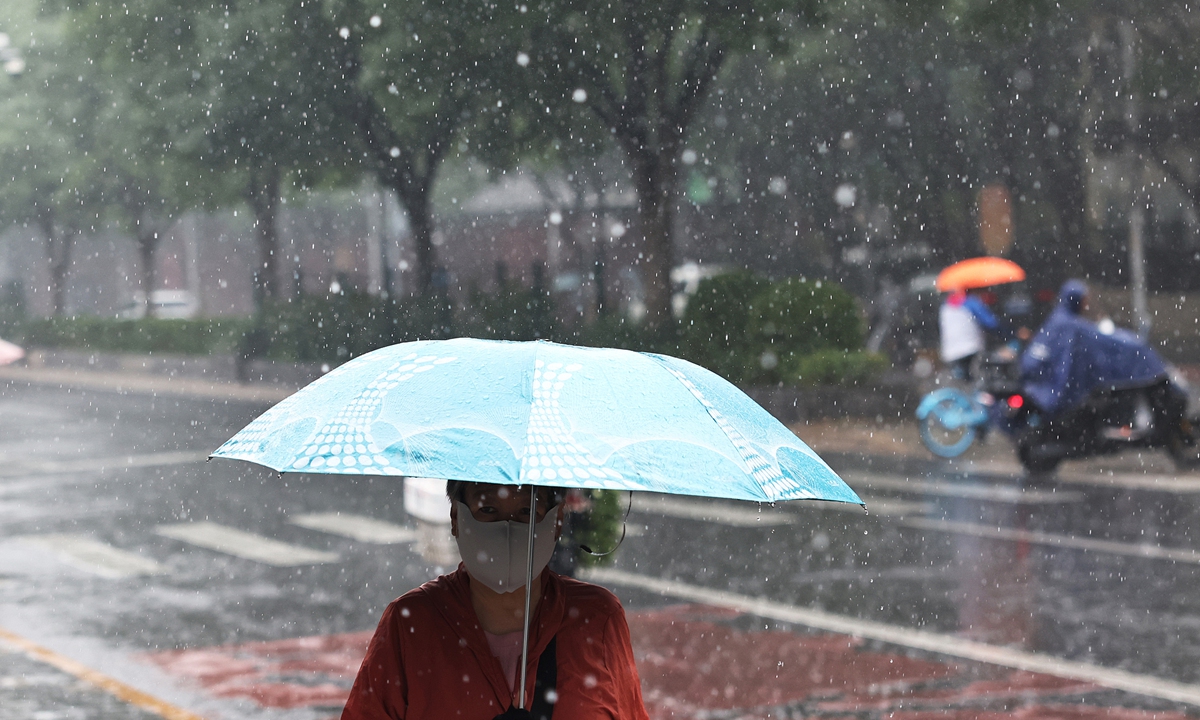
Residents in Beijing travel in the rain amid heavy rainfall on July 10, 2026. (Photo: VCG)
The city of Beijing has taken emergency measures on Friday as Typhoon Bavi's moisture and cold air converged to bring heavy rainfall. A total of 21,021 households involving 57,181 people had been relocated as part of precautionary evacuations, according to local media.
According to Beijing's flood control and drought relief headquarters, the city had closed 180 tourist attractions, suspended operations at 176 tent camping sites, and temporarily shut down 4,311 rural homestays as of Friday noon, Beijing Daily reported.
The Beijing meteorological service activated an orange alert for rainstorms at 1:30 pm on Thursday, forecasting heavy rainfall in the city from 2 pm on Friday to 8 am on Sunday.
This was the first orange rainstorm alert that Beijing has issued i since the start of the 2026 flood season, and the city has activated a Level-II emergency response for flood control, according to local authorities.
According to the forecast, torrential rain is expected in several districts, including Huairou, Miyun, Pinggu, Shunyi and Fangshan, with some areas likely to experience extremely heavy rainfall. Rainfall in some areas is expected to exceed 70 millimeters per hour, with 24-hour accumulated precipitation potentially surpassing 150 millimeters, it said.
Local meteorological authority warned that mountainous and semi-mountainous areas face high risks of hazards including flooding in small and medium-sized rivers, flash floods, mudslides and landslides. Low-lying areas may also experience water accumulation and urban flooding. Transportation authorities advised residents to reduce unnecessary travel. In areas under red alerts, people are advised not to travel unless absolutely necessary.
Authorities have also instructed relevant departments and organizations to adjust working arrangements based on risk alerts and notices issued by flood control agencies at various levels. They have also encouraged flexible working arrangements, including working from home, and called for the timely and proper relocation and accommodation of personnel stranded at workplaces due to the severe weather.
Besides, the Miyun Reservoir increased its overall water discharge flow starting at 9 am on Thursday, raising the rate from approximately 135 cubic meters per second to 205 cubic meters per second, Beijing News reported.
Among the adjustments, the discharge flow through the Chaohe water transfer tunnel was increased from 80 cubic meters per second to 150 cubic meters per second, setting a record high for the tunnel's discharge rate since the reservoir was built, the media report said.
The Ministry of Emergency Management activated a Level-IV national emergency response for geological disasters in Beijing and North China's Hebei on Friday given that some parts of these areas face a high risk of geological disasters, according to the ministry's website.
From Friday to Monday, northern and central parts of North China will experience heavy to torrential rainfall, with some areas seeing extremely heavy rain and locally severe downpours due to the combined influence of the southwest monsoon and Typhoon Bavi, the website showed.