


The at-sea phase of the China-Russia "Joint Sea-2026" exercise concluded on Saturday, marking the first time Chinese and Russian navy submarines have been featured together in the same image during the drill, according to China Bugle, an official media account affiliated with the Chinese People's Liberation Army (PLA) news media center. A military affairs expert told the Global Times that this demonstrated a high level of mutual trust between the two countries that goes beyond the ordinary.
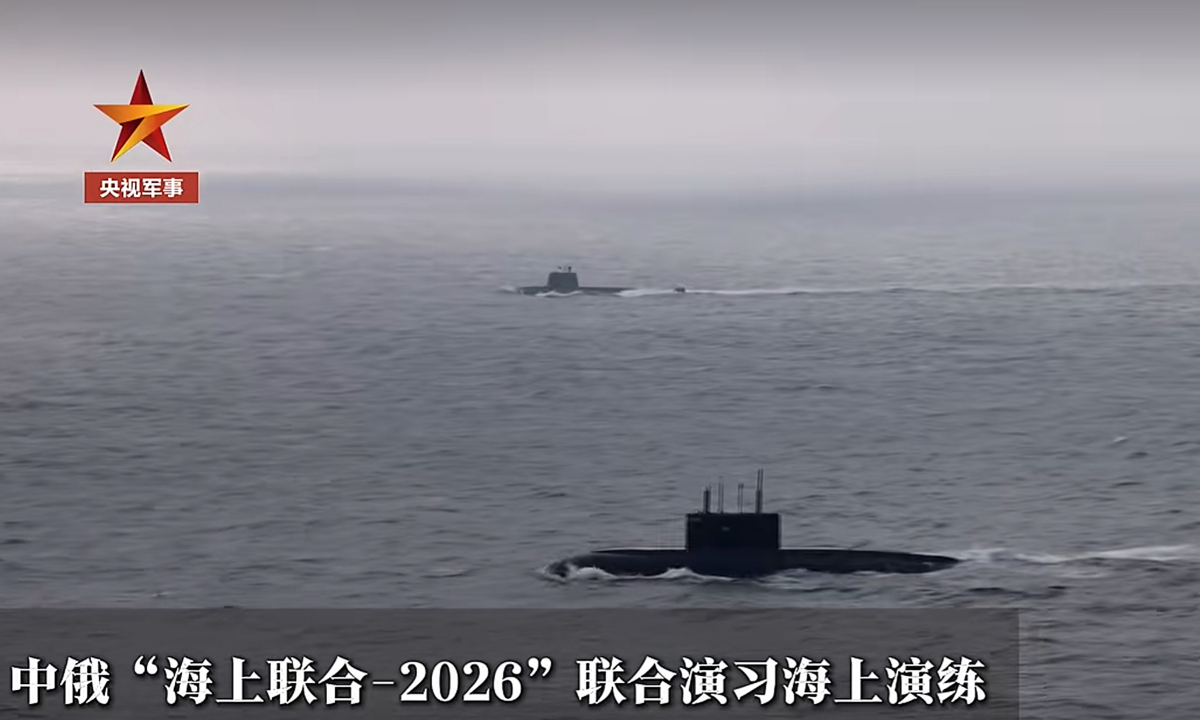
Chinese and Russian naval submarines are seen together at sea for the first time. Photo: screenshot from the CCTV Military channel
During the exercise, the Chinese and Russian naval formations conducted drills covering submarine rescue, surface strikes, air defense and anti-missile operations. Through efficient coordination, both sides deepened mutual trust and further enhanced their joint operational capabilities, China Bugle said.
The exercise featured flexible planning and high demands for operational coordination. The joint drills were conducted without fixed scripts, with operations adjusted dynamically based on battlefield conditions, hydrometeorological factors and other variables.
Meanwhile, participating forces were organized in mixed formations, leveraging sea, air and submarine platforms to build an integrated multi-domain combat system. This effectively tested the two sides' joint reconnaissance and early warning, command coordination and firepower strike capabilities in complex electromagnetic environments, said China Bugle.
During the air defense and anti-missile drills, Chinese and Russian vessels operated with clear division of labor and close coordination, leveraging the strengths of their respective weapon platforms to successfully intercept incoming targets in the shortest possible time, demonstrating the joint combat capability of the China-Russia maritime formation.
Since 2012, the "Joint Sea" series of exercises has become an important platform for naval cooperation between China and Russia. In this exercise, both sides deployed elite forces, covering surface, underwater, air and support elements. The participation of submarines and submarine rescue ships in particular reflects the continued expansion of bilateral naval cooperation from "surface operations" to "surface-plus-undersea" integrated combat, per the official release.
As the first-ever joint appearance of Chinese and Russian submarines in the same image was reported, Wang Yunfei, a Chinese military affairs expert, told the Global Times on Sunday that this signals a level of mutual trust that is not commonly seen.
Wang said that submarines operating together is rare worldwide. Submarines are inherently stealthy by nature, and their acoustic signatures are highly classified by each country. Such vessels are generally not displayed in close proximity. If two submarines appear together, it means they are operating at close range, and their acoustic signatures, including not only noise levels but also frequency characteristics, could be exposed to each other.
Official footage from the exercise shows that the Russian submarine participating was an improved Kilo-class conventional submarine, the Ufa, while the Chinese side deployed an improved Type 039B conventional submarine, said the expert.
In the past, when China operated Russian-made Kilo-class submarines alongside Russian vessels of the same type, the significance was different because the acoustic signatures were already known to each other. This time, however, China has showcased its indigenously developed and world-advanced Type 039B submarine to Russia, reflecting a level of mutual trust that goes beyond the ordinary, Wang said.
Wang added that the participation of submarines in joint exercises also involves communication and data exchange, which is another important aspect of demonstrating high-level mutual trust.
Underwater communication is complex. One method is to raise the antenna above the surface at communication depth; another is underwater acoustic communication, which uses specialized equipment to maintain contact. The latter is technically more challenging. Regardless of the method used, both sides must share technical communication characteristics, methods and tactics with each other, which enables a high degree of tactical coordination when facing common adversaries, Wang explained.
The fact that both submarines participated together, shared communication data and coordinated strikes on targets is something extremely rare. The ability of China and Russia to accomplish this reflects the high level of mutual trust between the two sides, as well as the Chinese military's strong confidence in its own capabilities. This serves as a positive start for further enhancing the depth and intensity of future joint exercises, Wang added.
Following the conclusion of the exercise, some participating forces will conduct a joint maritime patrol in relevant waters of the Pacific, continuing to contribute to regional and international peace and stability, China Bugle reported.
On July 6, China and Russia launched the "Joint Sea-2026" exercise at a military port in Qingdao in East China's Shandong Province, reported Xinhua News Agency.
A joint command has been established, comprising task forces from the navies of the two countries. The exercise will be carried out in three phases: force assembly, harbor-based planning, and at-sea operations, said Xinhua.
The at-sea operation phase of the China-Russia "Joint Sea-2026" exercise has come to a conclusion. Looking ahead, both sides will continue to uphold the principles of openness, transparency and mutual trust, further expanding the depth and breadth of joint training, and contributing greater efforts to building a maritime community with a shared future and safeguarding world peace and stability, China's Ministry of National Defense reported on Sunday.