


Heavy rains cautioned as Typhoon Bavi moves north
China's meteorological authorities on Monday warned of potentially extreme rainfall and related disasters in parts of the country as Typhoon Bavi moves northeast after making landfall in eastern China.
Although it has weakened since landfall, the typhoon's impact should not be underestimated, especially in northeastern China, where rainfall could be highly extreme, said Chen Tao, chief forecaster of the National Meteorological Center.
"Even though Typhoon Bavi has weakened, its impact cannot be ignored, particularly in Liaoning and Jilin provinces," Chen said.
From Monday to Tuesday, parts of Liaoning, Jilin, Shandong, Anhui, Jiangsu and Jiangxi provinces are forecast to experience heavy to torrential rains, with isolated areas expected to experience extraordinarily heavy rainfall, according to the NMC. Daily rainfall in some localities may break historical records.
Record rainfall reported in northern China
China's National Climate Center also said Monday that precipitation in the Beijing-Tianjin-Hebei region has been significantly above normal this year.
According to Chen Lijuan, chief forecaster at the NCC, from the start of the flood season on April 1 to July 12, average rainfall in northern China reached the highest level for the same period in the past decade. Hebei province and Tianjin city recorded the highest precipitation for the same period since observations began in 1961. Average rainfall in northern China also measured the highest on record for the same period.
Chen Tao, chief forecaster with the NMC, said that with climate change, extreme weather events have been intensifying and becoming more complex, making monitoring and forecasting more difficult.
"Sudden high-impact hazardous weather is occurring more frequently, often exceeding historical experience and defense standards and breaking historical climate thresholds," he added.
Strong El Niño to influence coming seasons
A strong or even super El Niño is expected to develop between summer and autumn before peaking sometime between autumn and winter, according to Chen Lijuan, chief forecaster at the NCC.
The El Niño is likely to affect China's rainfall and typhoon patterns by strengthening the western Pacific subtropical high and increasing moisture transport, raising the likelihood of heavy precipitation, Chen said.
She added that during the autumn and winter when El Niño peaks, southern China may see above-average rainfall, while nationwide temperatures are expected to be higher than normal.
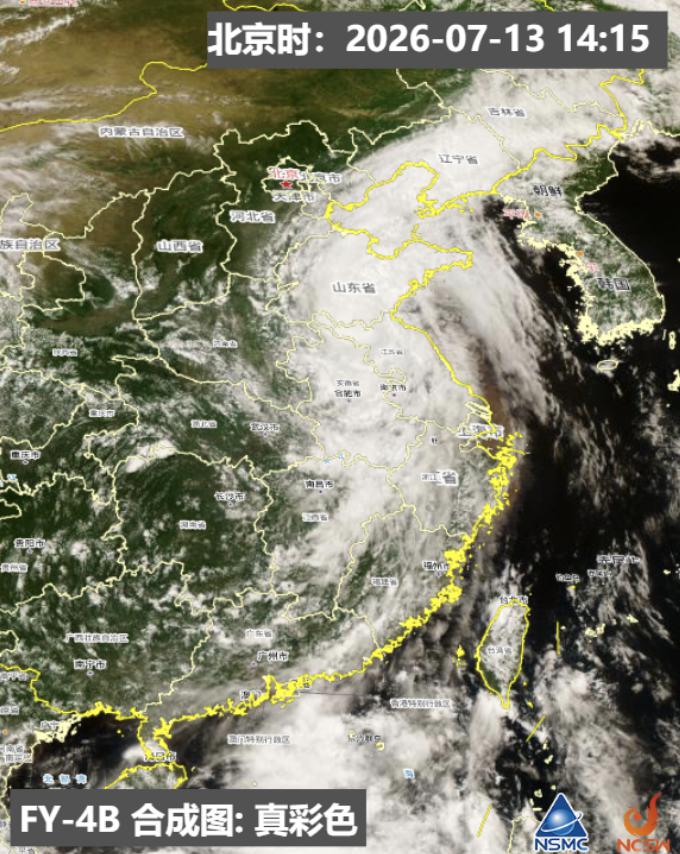
A true-color satellite image shows Typhoon Bavi, monitored by the Fengyun-4B meteorological satellite at 2:15 p.m. on July 13, 2026. (Photo: CMA)