


Despite its size, Beijiao township boasts an extraordinarily robust manufacturing ecosystem. Vast factory compounds stretch across its compact 92 square kilometers, while freight trucks shuttle continuously between production facilities.
Today, one in every 20 industrial robots made in China is produced here, making Beijiao in Foshan, South China's Guangdong Province, the country's largest industrial robot manufacturing hub.
Inside the Intelligent Robot Manufacturing City of HiTrom Han's, a major smart manufacturing base in Beijiao, one machine immediately caught the eye: a collaborative robot undergoing testing. Its bright orange robotic arm performed operations with an accuracy of less than 0.02 millimeters.
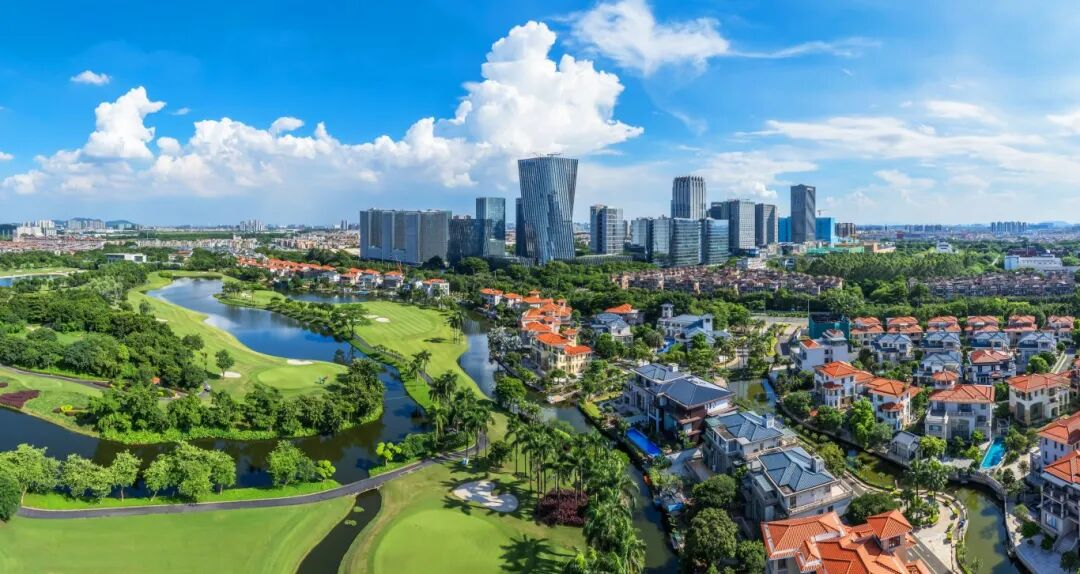
Beijiao township (Photo from Shunde district publicity department WeChat account)
"Can you guess how many companies operate in this building?" asked Qiu Zhan'ou, deputy general manager of HiTrom Han's Industrial, pointing to a factory building and raising two fingers with a smile.
"More than 20 firms work under one roof. Some make reducers, others produce servo motors, robot bodies or integrated robotic systems. Components manufactured upstairs can simply be sent downstairs by elevator for immediate assembly," he explained.
"Engineers can finish a design on the first floor in the morning, have components delivered from the second floor in the afternoon and complete prototype testing the very same day," added Tao Yuanming, secretary-general of the Shunde Robotics Association. In Beijiao, "design in the morning, verification in the afternoon" has become routine.
"For a single robot, more than 90 percent of its supply chain can be sourced locally in Beijiao. All required components can be assembled within half a day," said Huang Jinshuo, general manager of a local robotics company.
According to Yuan Xuehua, deputy general manager of another robotics company, this rapid response capability and close collaboration have significantly shortened the process from design and prototyping to testing, creating a highly efficient industrial ecosystem with tightly integrated local supply chains.
Qiu said the manufacturing base is now home to more than 200 robotics and related enterprises. Once fully operational, the park is expected to generate an annual output value of 10 billion yuan (about $1.47 billion).
"Development of Beijiao's robotics industry was born out of necessity," said Hu Bing, deputy mayor of Beijiao township.
Known as one of China's leading home appliance manufacturing centers, Beijiao is home to renowned companies such as home appliance maker Midea. Benefiting from China's reform and opening-up, entrepreneurs in Shunde built a thriving home appliance industry. But local businesses understood that its growth would eventually reach its limits.
Around 2010, as the home appliance market slowed and labor costs continued to rise, automation became an urgent necessity.
"Without automated production, factories simply could not keep up with order demands," Tao recalled. Market pressure became the first major force driving Beijiao's transition into the robotics industry.
The confidence to make that transition came from Beijiao's strong manufacturing foundation.
By then, the township had already developed more than 900 manufacturing enterprises covering sheet metal processing, plastic injection molding, motor production and surface treatment. Many of the core technologies required for industrial robots were already available locally.
Welling Motor, a Midea subsidiary, is an industry leader in servo motors, one of the key components of industrial robots. Precision gears required for reducers can be manufactured by nearby mold makers.
Meanwhile, years of automation upgrades by major manufacturers in Beijiao and surrounding areas had cultivated a large pool of engineers with expertise in manufacturing processes, equipment and industrial control systems. Many later launched their own businesses, becoming the first generation of entrepreneurs in Beijiao's robotics industry.
After KUKA, a German manufacturer of industrial robots and factory automation systems, established its China factory in Beijiao, a cluster of world-leading robotics companies followed. Upstream and downstream suppliers gathered around the industry leader, gradually forming a complete, self-sufficient industrial chain.
A mature industrial ecosystem is not just about attracting companies. It is about helping them take root and grow.
Huayan Robotics is one such success story within the Intelligent Robot Manufacturing City of HiTrom Han's.
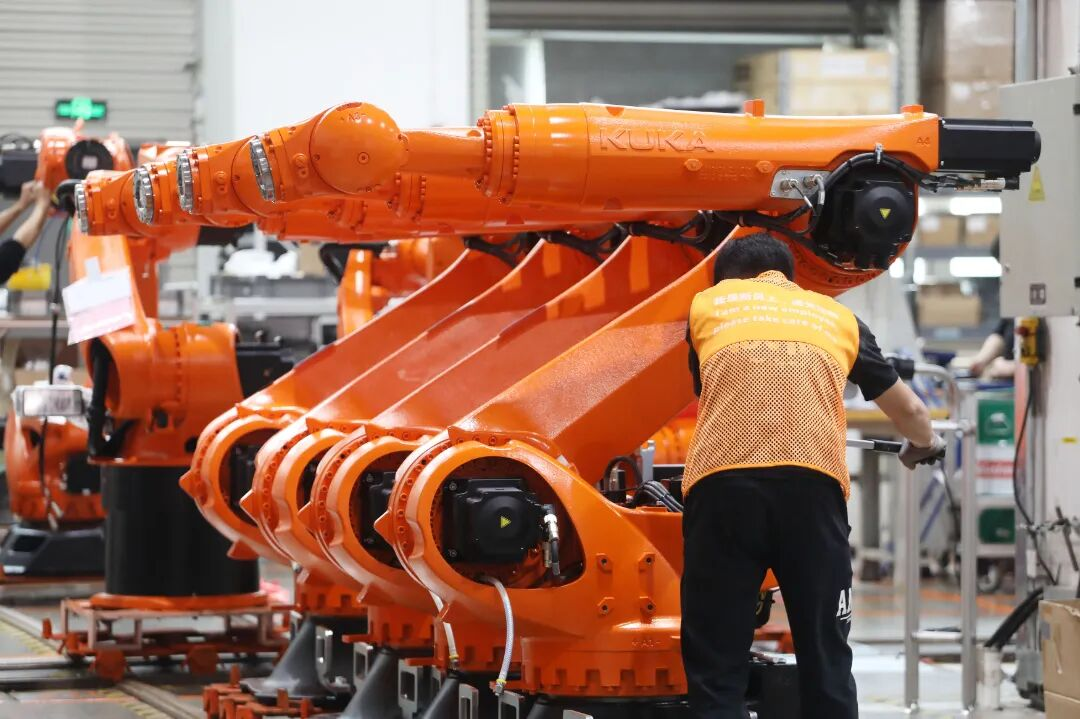
A worker adjusts a robot in a Kuka factory (Photo from Shunde district publicity department WeChat account)
In 2018, officials from the Sino-German Industrial Park in Foshan met a team from Huayan Robotics by chance at Hannover Messe in Germany. Although the company possessed advanced collaborative robot technology, its growth was constrained by limited space and high operating costs.
Over the following two years, local investment promotion officials made repeated visits, introducing Shunde's manufacturing strengths and Beijiao's industrial ecosystem. Their persistence eventually convinced the company to relocate.
Beijiao provided exactly what the company needed. The Intelligent Robot Manufacturing City of HiTrom Han's offered modern factory facilities. The industrial park positioned Huayan as a leading enterprise within the local industrial chain, fostering coordinated innovation with upstream and downstream partners. Meanwhile, the local government provided full life cycle support, including credit guarantees, intellectual property protection and other services. In March 2025, Huayan Robotics officially relocated its headquarters to Beijiao.
With ample industrial space, comprehensive support services, strong talent retention and diverse financing channels, Beijiao has developed a comprehensive support system for the robotics industry, allowing enterprises to put down roots as soon as they arrive.
Today, embodied AI robots have emerged as a global industry hotspot. Rather than competing directly with major metropolitan areas in AI talent or training infrastructure, Beijiao has chosen a differentiated path, continuing to focus on industrial robot bodies, core components and manufacturing.
Lavichip, a company that specializes in robot controllers, moved into the industrial park and has since cut operating costs by 30 percent while increasing its output value year after year. The park also hosts manufacturers of specialized robots for tasks including solar panel cleaning, underwater pool cleaning, automated cooking and high-rise curtain wall cleaning.
The transformation of Beijiao demonstrates how a traditional manufacturing township can nurture emerging industries and organically develop a complete industrial cluster.
The experience of Beijiao's robotics industry shows that developing new quality productive forces requires an application-oriented approach, a strong manufacturing foundation and close collaboration across industrial chains. By building on existing strengths and continuously refining them, traditional manufacturing can create powerful new drivers of high-quality development.