


At Taoxichuan Art Center, one of the country's most influential art hubs in Jingdezhen, East China's Jiangxi Province, foreign artists are picking up Chinese brushes and Chinese habits as quickly as they pick up clay.
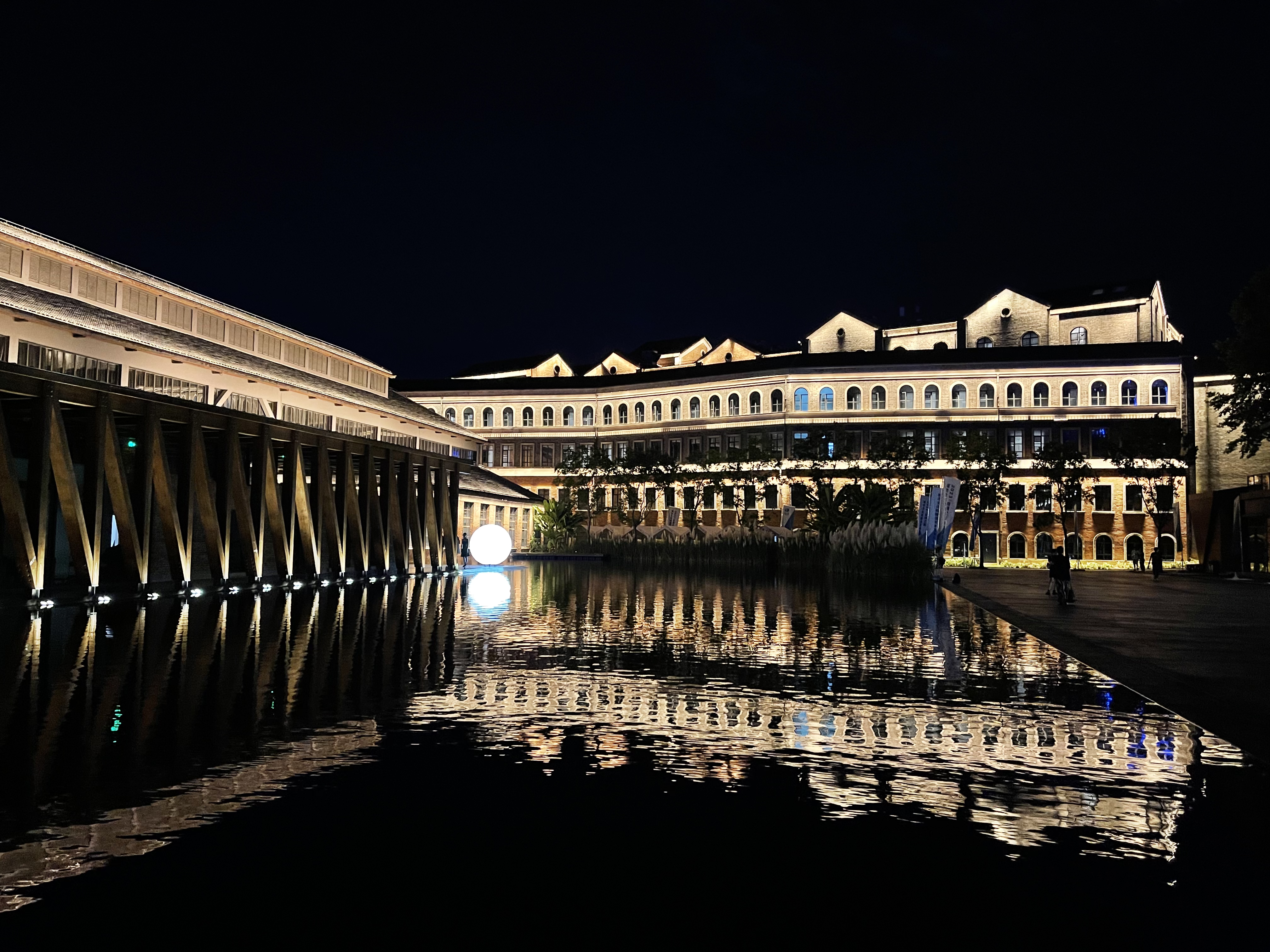
Night view of the Taoxichuan Ceramic Art Avenue in Jingdezhen, East China's Jiangxi Province. (Photo: CGTN)
Tutorial of Chinese Landscape Painting, a textbook once found mostly among college students, has become essential reading for foreign artists in Jingdezhen.
Sophie Lambelet is a Swiss ceramic artist. "I started doing ceramics when I was a little kid because I learned it from my father. I've also tried other forms of art, but I'm just not as good at them as I am at pottery. I'm happy that I can join the residency. Here, art is like a universal language, and it's really nice to go around the world and meet people who have different techniques."
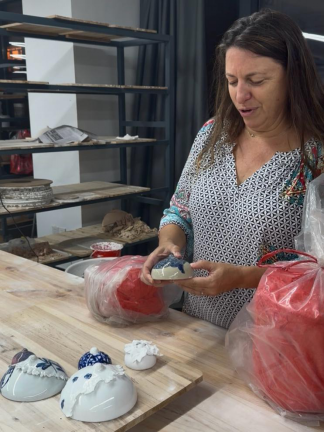
Sophie presents her artwork at Taoxichuan Art Center on July 6, 2026. (Photo provided to People's Daily)
Sophie was invited to participate in the 2026 "Migratory Birds Project." Taoxichuan Art Center in Jingdezhen launched the project to bring together artists working in pottery, glass and wood art from China and abroad.
"Do you know the ghost market here? " She asked. "It only opens on Mondays, very early in the morning, around 5:30 am, and disappears by sunrise. Look, I bought these from the market." Lambelet pulled out a plastic bag containing Tutorial of Chinese Landscape Painting and a copy of Gongbi Painting Techniques.
"I went to a Chinese painter's studio here and he taught me how to paint, so I bought many new brushes."
Lambelet's work explores themes of womanhood and identity, and Chinese elements have become a steady source of inspiration in her recent pieces.
"When you ask someone about their identity, everyone will say something different. For me, my identity is motherhood because I have two children."
Natural elements are a major source of inspiration for her work, which echoes Taoism's emphasis on living in harmony with nature. Flowers, fish and feathers all recur as motifs on Lambelet's bowls. Chinese painting techniques allow her to render texture and detail differently than she would at home.
"In Europe, I don't paint this way," she said. "I would just use a bigger brush and wouldn't put so much water [in the pigment]."
Like Lambelet, Jonathan Ausseresse is also an artist at Taoxichuan Art Center.
"This is my first time visiting China. Before I came here, I knew absolutely nothing about Jingdezhen, pottery or China. But I think as an artist, you have to be open-minded and draw inspiration from what's around you."
For Jonathan, a French artist with the Migratory Birds Project, glassmaking is a family tradition.
"My father and grandmother were also glassmakers," he said. But in his current project, he is applying techniques completely different from the European glass tradition to create a color effect he could not achieve at home.
Inspired by the misty effect of Chinese watercolors, Jonathan developed a pigmentation technique that fuses color deeper into the glass.
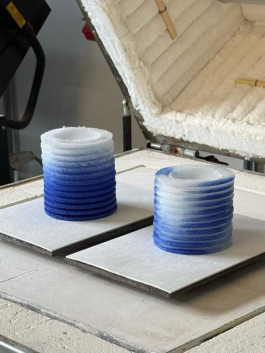
Pictured are some of Jonathan's artwork in the Glass Studio at Taoxichuan Art Center. (Photo provided to People's Daily)
"I'm not a painter, and this is a really different way of working. It's not easy, but you have to be patient."
"Imagine the pigment as a cube of sugar," he said. "When you dip a glass pillar into water and drop the cube in, you get a color effect that changes with the concentration from bottom to top. It was inspired by Chinese ink painting. I found it here."
He pulled a few books from the studio shelf, including Tutorial of Chinese Landscape Painting.
"I found these in the Jingdezhen Library and learned some Chinese painting techniques from them."
The Migratory Birds Project is launched by the Jingdezhen Ceramic Culture & Tourism Group with government financial support. Nearly half of the participating artists receive full or partial funding for transportation, accommodation and studio costs.
While Lambelet and Jonathan work in the same medium or even know each other, they share a persistent pursuit of beauty and a genuine passion for Chinese art. Like them, more foreign artists are coming to Jingdezhen every year to draw inspiration from Chinese culture and learn its techniques.
In the birthplace of porcelain, ancient Chinese painting techniques and contemporary art practices collide, creating an unexpected chemistry: one that revitalizes Chinese painting and ceramic arts while offering endless inspiration for Western art. In Lambelet and Jonathan's cases, cultural exchange happens not only when new techniques are tested, but when distinct philosophies from different countries come to coexist in the same room.