


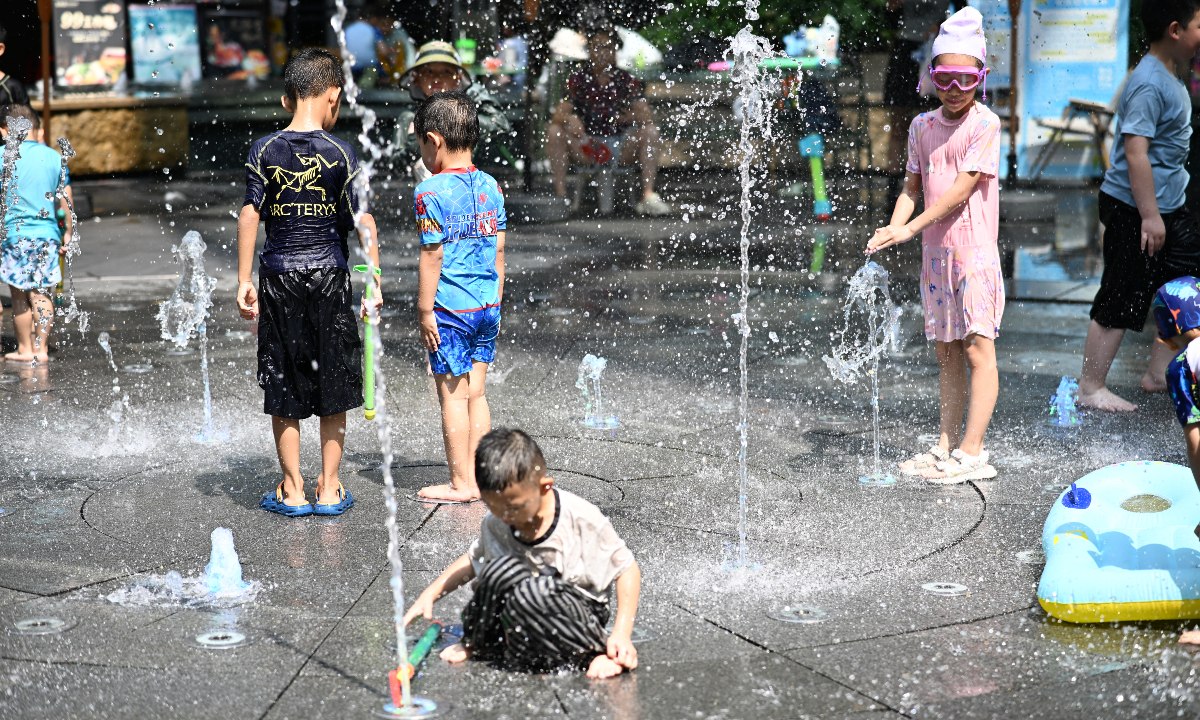
Children cool off at a water-play area set up by a shopping mall in Chengdu, Southwest China’s Sichuan Province on July 15, 2026, the first day of sanfu, as the city endures high temperatures.
As China entered sanfu, or the “dog days” of summer – the hottest and most humid period of the year in the traditional Chinese calendar – the National Meteorological Center renewed a yellow alert for high temperatures on Thursday, with temperatures forecast to exceed 40 C in parts of Xinjiang, Sichuan and Chongqing. Authorities across the country are reportedly stepping up measures to help residents cope with the heat.
China’s National Meteorological Center on Thursday forecast highs of 35 C to 36 C across much of the country, including Inner Mongolia, Xinjiang, southern Hebei, Beijing, Anhui, Jiangsu, Shanghai, Zhejiang, Hubei, central and eastern Hunan, eastern Sichuan and Chongqing. Temperatures could climb to 37 C to 39 C, while parts of northern Xinjiang and the Turpan Basin, eastern Sichuan and western Chongqing may experience highs above 40 C, chinanews.com reported.
Beijing experienced scorching heat on Wednesday, with over 80 percent of meteorological stations across the city recording temperature highs of 35 C or above. The city’s Nanjiao Observatory recorded a high of 36 C. The heat will persist on Thursday before temperatures ease on Friday, according to weather.com.cn.
Heat indexes have topped 40 C in many parts of China in recent days, putting pressure on the power grid as electricity demand hit record levels. China’s national power load hit a new record of 1.551 billion kilowatts on Tuesday. Cross-regional power transmission reached 278 million kilowatts, helping secure electricity supplies nationwide, CCTV reported, citing the National Energy Administration.
Authorities across the country are stepping up heat-relief measures to protect people from heat. For example, the Chongqing Municipality issued its first high-temperature red alert of the year on Tuesday and local authorities have increased cooling operations by water-spraying vehicles and deployed drones to patrol high-risk forest areas, CCTV reported.
East China’s Jiangxi Province issued its first yellow high-temperature alert of the year on Tuesday. Cities including Xinyu, Jiujiang and Ji’an have rolled out heat-relief measures, including deploying water-spraying vehicles and opening air-conditioned service stations with drinking water and supplies for outdoor workers.
While authorities in Ankang in Northwest China’s Shaanxi Province adjusted outdoor work schedules and provided heat-relief supplies, including mung bean soup and Huoxiang Zhengqi shui, a traditional Chinese herbal remedy, to help people cope with the extreme heat, CCTV reported.