


Guo Guangsen spent the first half of his life as a forest ranger in the Dongzhai National Nature Reserve, located in Luoshan county, Xinyang, central China's Henan Province. After retirement, he became a bird guide, helping birdwatchers find their way.

Birdwatchers from across the country come to the Dongzhai National Nature Reserve in search of rare bird species. (Photo: People's Daily Online)
In the early years, the Dabie Mountains, where the nature reserve is located, suffered from poor soil conditions and frequent crop failures. For local villagers, relying on the mountains was their only way to make a living. Families would go into the mountains to collect firewood for cooking, while some villagers secretly set up bird nets, traps, hunted wildlife, and cut down trees to sell for extra income.
In 2001, the Dongzhai National Nature Reserve was officially established. A forest closure and restoration policy was introduced across the area, completely banning uncontrolled firewood collection and illegal hunting. Guo recalled that villagers initially found it difficult to accept.
To address villagers' concerns, the local government provided ecological compensation, guided communities in developing forest-based industries that supported conservation, and encouraged residents to participate in protection efforts. It also offered training and assistance to help villagers find work outside the mountains.
After decades of protection, the forests have changed dramatically year by year. New bird species are discovered in the nature reserve almost every year. Today, the nature reserve has recorded 356 bird species, including 74 species under key state protection.
In 2006, the Dongzhai National Nature Reserve was approved as China's first site for the reintroduction and wild release of crested ibises, an endangered bird once thought to be extinct. From the original 17 birds introduced, the wild population has grown to more than 700 and spread to 11 counties and districts across Henan and Hubei provinces.
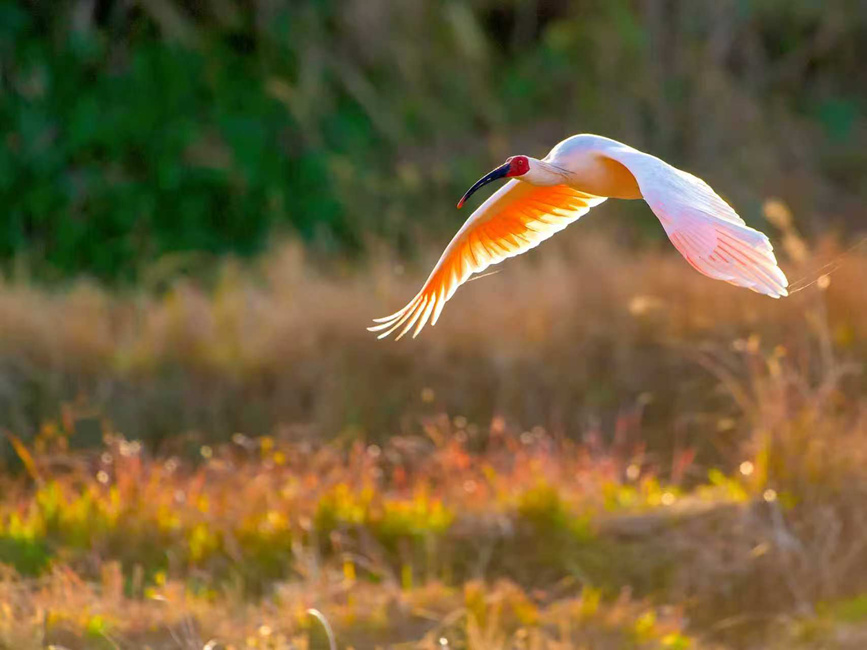
The crested ibis, a rare and endangered bird known as the "oriental gem," and a species under first-class state protection in China, is seen in the Dongzhai National Nature Reserve, located in Luoshan county, Xinyang, central China's Henan Province. (Photo courtesy of the Publicity Department of the Communist Party of China Luoshan County Committee)
As bird populations increased, birdwatchers began flocking to Dongzhai, giving rise to a unique birdwatching economy. Guo was among the first professional bird guides in the area.
Today, photography enthusiasts and researchers from across the country regularly come to the mountains. Visitors often stay for a week, spending more than 1,000 yuan (about $147) per person on average, allowing local residents to benefit from the ecological economy.
Driven by Guo's efforts, residents in Lingshan town of the county have jointly built 16 birdwatching sites, each capable of receiving hundreds of photography enthusiasts a day.
Around Dongzhai, birdwatching tourism is thriving. The nature reserve has trained a professional team of more than 30 bird guides, established 69 birdwatching and photography sites, and built 66 supporting accommodation and dining facilities.
It now receives more than 30,000 birdwatcher visits every year, including over 10,000 dedicated bird photographers. The birdwatching economy generates more than 50 million yuan in economic value annually, creates jobs for more than 2,000 people, and increases workers' annual incomes by more than 20,000 yuan on average.
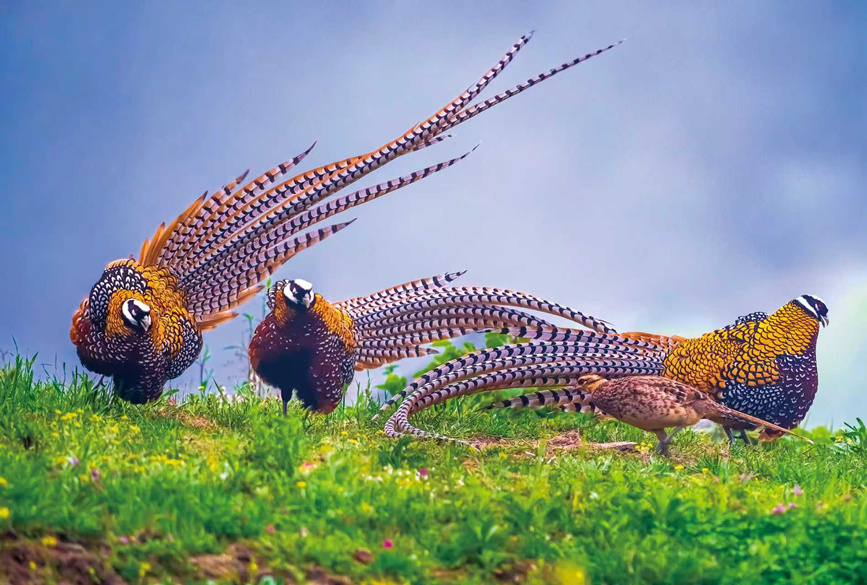
Reeves's pheasants are seen in the Dongzhai National Nature Reserve, Luoshan county, Xinyang, central China's Henan Province. (Photo courtesy of the Publicity Department of the Communist Party of China Luoshan County Committee)
The rise of Dongzhai's birdwatching economy is a microcosm of Henan's achievements in ecological conservation. To date, Henan has recorded 502 wild bird species, accounting for one-third of all bird species in China.