


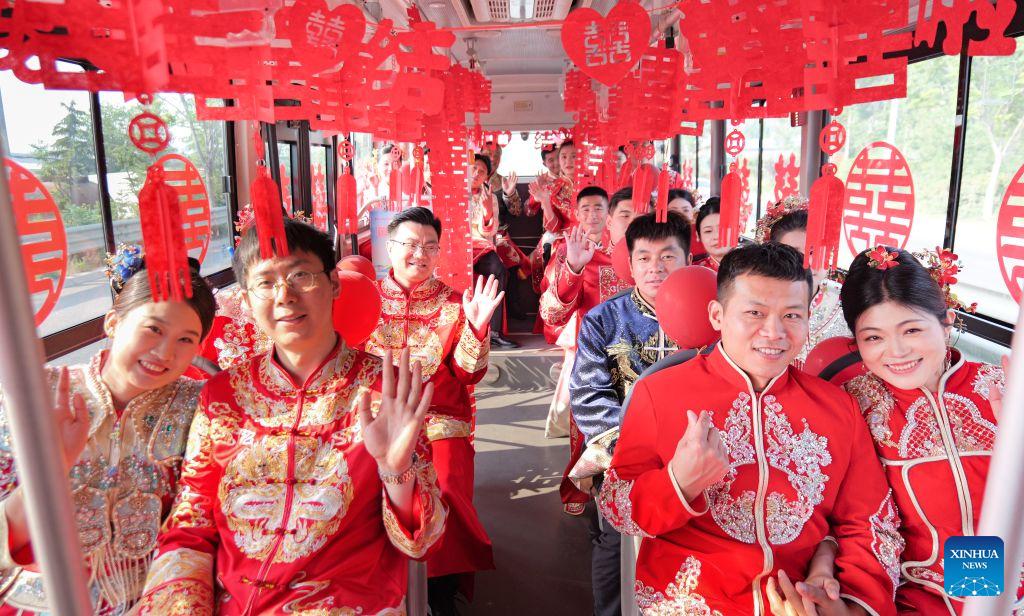
This photo taken on May 28, 2025 shows newlyweds riding a bus as their wedding vehicle in Feixian County of Linyi City, east China's Shandong Province. (Photo: Xinhua)
JINAN, July 16 (Xinhua) -- When post-2000s couple Li Zhenghong and Sima Miaomiao in the city of Linyi, east China's Shandong Province, were planning their wedding, they opted for a "lightweight" package at just over 10,000 yuan (about 1,473 U.S. dollars). No lavish spending and no one-upmanship could be detected, just the warm blessings of family and friends.
"A simpler ceremony doesn't mean less happiness," Sima said. "Marriage is the start of a life together. A wedding that feels comfortable and sincere matters more than one that's all about show," Li added.
In many parts of rural China, weddings were once a contest of "face." Everything, from bride prices and banquets to luxury cars for the procession and cash gifts, was measured against that managed by other couples. Some families drained their savings, or borrowed heavily, just for a single day. In some cases, crude rituals and lavish waste turned celebration into a debt trap.
In fact, for decades, many grassroots communities across China, from townships to rural villages, have been rolling out locally tailored initiatives to promote civilized wedding practices.
As local experiments matured, the Chinese government included the issue of wedding customs in its annual "No. 1 central document" for the first time in 2019, a move that marked the beginning of a top-down effort to deepen wedding-related reforms.
The country's "No. 1 central document" for 2026 calls for continued efforts to transform outdated rural customs, rein in exorbitant bride prices, and strengthen coordinated governance among neighboring provincial regions.
In Daicun Village of Lanling County in Linyi, hosting weddings in a new, frugal way has become a shared consensus among villagers. The village has set up a local committee to oversee weddings and funerals, known locally as a "red-and-white council," and revised its village rules and regulations to promote alternatives such as destination weddings, lawn weddings and collective weddings.
Specific restrictions have been put in place, including no ceremonial arches, no hired bands, no fireworks, no luxury vehicles and no upscale banquet dishes. The village has also built a public dining hall, providing free kitchenware, as well as tables and chairs, to help residents hold dignified yet cost-effective celebrations.
"The goal of transforming outdated customs is not to do away with social bonds, but to prevent them from becoming a burden of debt," said Wang Chuanxi, head of the Daicun community.
Over the past two decades, the village has helped residents save more than 20 million yuan in wedding-related expenses, with bride prices gradually dropping to around 20,000 to 30,000 yuan.
The trend toward civilized weddings is also spreading from townships in eastern China to more rural areas in the west.
In Gongjiaquan Village, northwest China's Shaanxi Province, an old opera stage with over 50 years of history has been transformed into a village-level community events venue, equipped with a 20-square-meter LED screen, kitchenware, tables, chairs and other facilities.
"With its full range of functions and user-friendly setup, it has become the venue of choice for young couples in the village to hold their wedding banquets," said Li Junping, director of the village's supervisory committee for routine affairs.
It was right here that villagers Lu Qiao and Pan Yanzi held their wedding banquet. They hosted a feast for relatives and friends from both families, following a set standard of no more than 30 tables and a budget of no more than 200 yuan per table. In the end, their actual expenses came in 50,000 yuan below their original budget.
"It feels very meaningful to hold our wedding on the old opera stage that carries so many childhood memories," Lu said.
In response to the problem of excessive bride prices in rural communities, some neighboring provincial regions across China are now stepping up joint governance efforts to address it.
Yanggu County in Shandong and its neighboring counties of Taiqian and Fanxian in central China's Henan Province, for example, now hold regular matchmaker exchanges, with agreed-upon caps on bride prices and wedding banquet costs, and jointly host group certificate-presentation ceremonies for newlyweds. Yanggu has also brought skits about bride-price issues to village stages, helping local residents understand new wedding customs through humor.
"My parents didn't ask for a bride price. The 88,000 yuan was what my fiance and I agreed upon -- just for good luck," said Shang Lina, a local villager.
"But on the very day of our engagement, my parents gave the money back to us, hoping it would not only help support our new family, but also give our marriage the best possible start," she added.