


As people age, many experience memory decline and slower cognitive processing, along with a higher risk of cerebrovascular disease and cognitive impairment. One important question in aging research is how changes in the brain's blood vessels contribute to cognitive decline.
Scientists from the Shenzhen Institutes of Advanced Technology (SIAT) of the Chinese Academy of Sciences have identified a mechanism by which aging weakens the blood-brain barrier, the brain's protective interface with the bloodstream.
The study was published in Neuron under the title "TGF-β1-induced endothelial transcytosis drives blood-brain barrier leakage during aging."
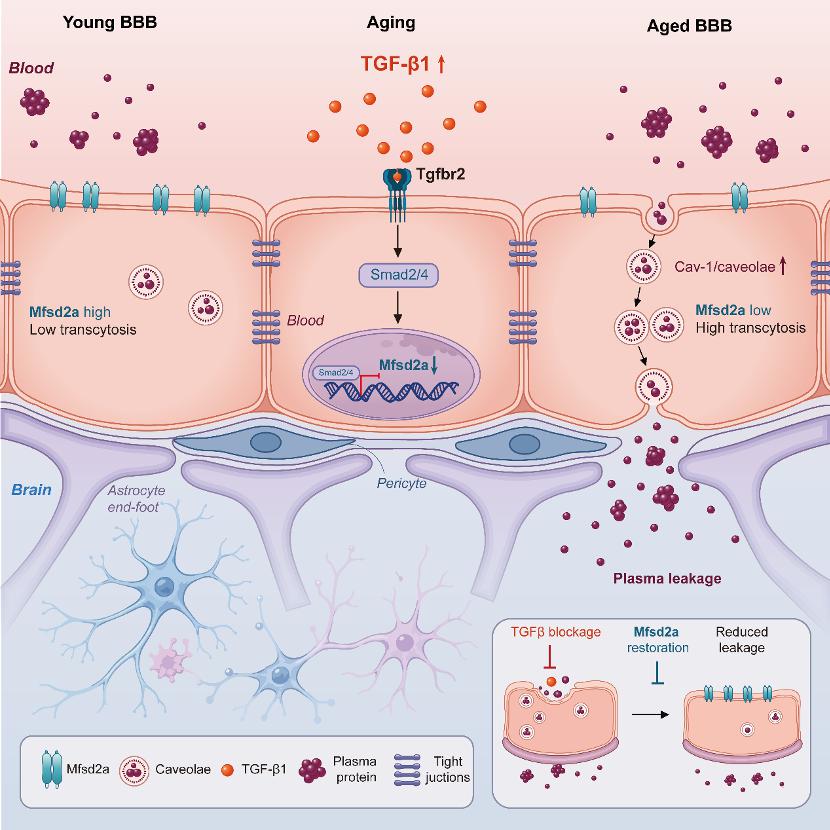
The study shows how aging disrupts transport in brain blood vessel cells, leading to blood-brain barrier leakage. (Photo: SIAT)
The blood-brain barrier, or BBB, acts as a selective security system. It allows essential nutrients to reach the brain while preventing potentially harmful substances in the blood from entering brain tissue. Damage to this barrier has been linked to cognitive aging, cerebral small vessel disease and several neurodegenerative disorders.
Scientists have traditionally attributed BBB leakage mainly to damage to the tight seals between cells lining brain blood vessels. However, the new study found that another process occurs earlier during aging.
By examining mice at different ages, the researchers found that BBB leakage was already detectable in middle-aged mice and worsened in older animals. The change appeared early in the hippocampus, a brain region important for learning and memory.
At this stage, the seals between blood vessel cells remained largely intact. Instead, the cells' internal transport system became abnormally active, allowing blood-borne substances to pass through the cells and enter brain tissue.
"Rather than first leaking through gaps between cells, the aging blood-brain barrier appears to lose control over transport pathways inside the cells," the researchers said.
The team identified a protein called Mfsd2a as an important part of this protective system. Mfsd2a normally limits unnecessary transport across brain blood vessels. Its levels declined with age, while Caveolin-1, a protein involved in the formation of transport vesicles, increased.
When the researchers restored endothelial Mfsd2a expression or knocked down Caveolin-1 in aged mice, abnormal vesicle transport and BBB leakage were significantly reduced.
The researchers then investigated why Mfsd2a declines during aging. They found that levels of TGF-β1, a signaling molecule involved in inflammation, tissue repair and aging, increased in both the brain and the bloodstream as mice aged.
Excessive TGF-β1 reduced Mfsd2a expression in the cells lining brain blood vessels, causing their transport activity to increase. Raising TGF-β1 levels in young mice caused them to develop several features normally seen in the aged BBB, including increased leakage.
By contrast, blocking TGF-β signaling in aged mice reduced BBB leakage and improved their performance in memory-related behavioral tests.
The findings suggest that age-related BBB damage is not simply the result of passive wear and tear. Instead, it involves biological signals that alter how brain blood vessel cells transport substances.
The study may help explain how vascular changes contribute to cognitive aging. It also points to potential approaches for protecting the aging brain, including maintaining Mfsd2a function or preventing excessive activation of TGF-β signaling. Further research will be needed to determine whether these strategies can be safely translated into treatments for humans.