


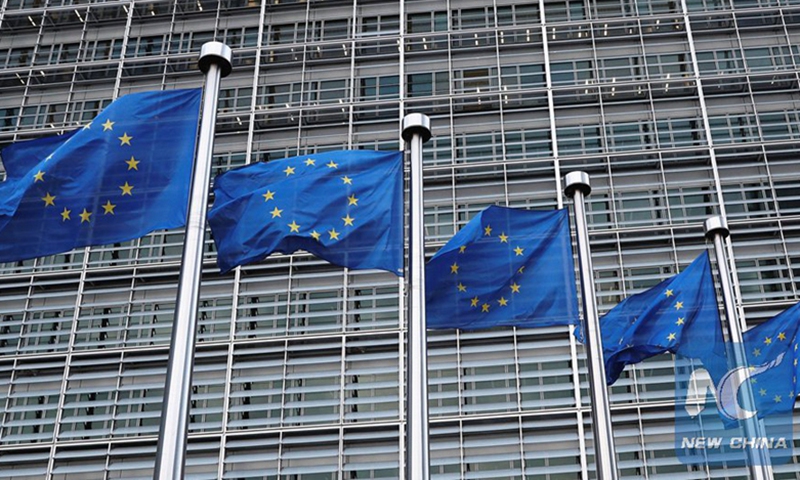
The European Union flags in front of EU headquarters in Brussels, Belgium. (Photo: Xinhua)
EU foreign ministers issued a joint assessment of the risks posed by China, claiming that Beijing threatens not only the bloc’s economy but also its security by highlighting the so-called shared ambition of China and Russia to assert regional dominance, Euro News reported on Thursday. Chinese experts have warned that the EU should be cautious about defining the future direction of its relations with China based on subjective judgments or creating new tensions and confrontation over China-Russia relations.
According to the European media report, EU foreign ministers delivered an assessment of China’s geostrategic role, claiming that China holds “asymmetric advantages” over the EU through its economic and technological dominance, making it a "critical long-term strategic challenge" for the bloc.
The document, which was adopted by the EU’s 27 foreign ministers on Monday without any announcement, accusing China of being both a “key enabler” and “crucial enabler” of the Russia-Ukraine conflict, language previously used by NATO, the South China Morning Post said.
Chinese experts pointed out that scapegoating China for the Russia-Ukraine war and politicizing China-Russia cooperation have become a familiar EU playbook, especially as the bloc sees the conflict entering a critical phase.
“In recent years, certain EU political figures and European media have repeatedly hyped unsubstantiated claims of substantive military cooperation between China and Russia. Such narratives are central to their campaign to paint China as a ‘challenge’ or ‘threat,’” Cui Hongjian, a professor at the Academy of Regional and Global Governance at Beijing Foreign Studies University, told the Global Times on Friday.
Framing routine China-Russia cooperation as a security challenge only serves to shift attention away from underlying issues and deflect responsibility, Cui noted.
China has repeatedly refuted those groundless allegations leveled by European politicians and media regarding its stance on the Ukraine crisis.
When asked to respond to EU High Representative for Foreign Affairs and Security Policy Kaja Kallas’ claim that the EU had verified reports alleging that the Chinese military had been training Russian military personnel to fight in Ukraine, Chinese Foreign Ministry spokesperson Lin Jian said at a regular press conference on June 16 that the relative claims have no factual basis and are purely slander and defamation.
On July 6, Chinese Foreign Ministry spokesperson Mao Ning similarly denied reports which alleged that the Chinese army had trained Russian soldiers on its territory, saying that related reports are groundless and purely fabricated to smear China.
“Europe’s bid to shift blame and offload responsibilities for the Ukraine conflict eastward is irresponsible,” Cui said, noting that on key international issues, Europe has long lacked strategic autonomy and has been largely influenced by the US.
The document also claimed that Beijing’s growing “ambitions and assertiveness,” combined with its “strategic” competition with the US, “will increasingly impact the EU’s security, competitiveness, and economic security and resilience,” according to Euro News.
Chinese analysts argue such rhetoric shows Europe’s China strategy, worldview and approach to major-power ties remain trapped in ideological framing. It prioritizes geopolitical rivalry over win-win cooperation and lays bare Europe’s pervasive anxiety across economic and security domains — an anxiety that increasingly distorts its foreign policy and strategic evaluations of major powers.
“Such a biased framework prevents Europe from handling major-power relations and geopolitical challenges in an objective, open and cooperative manner. Viewing other major states through a narrow geopolitical lens creates self-imposed constraints for Europe and undermines broader global collaboration,” Dong Yifan, associate research fellow of Academy of International and Regional Studies, Beijing Language and Culture University, told the Global Times on Friday.
China and the EU recently have stepped up dialogue to manage their trade differences, including discussions on rare-earth export controls
The EU is preparing for a possible renewed trade dispute with China in October, when a temporary arrangement on rare-earth export controls is set to expire, the Financial Times reported on Wednesday, citing three officials.
Cui warned that the newly adopted assessment currently functions primarily as a tool to pressure China, a vehicle for the EU to signal its stance and test Beijing’s policy response; however, it may also gain further traction and gradually become part of the EU’s future policy statements on China. Either way, it sends an unwelcome signal that works against the sound development of China-EU relations, the expert added.