


As artificial intelligence advances rapidly, discussions are increasingly shifting from what AI can do to how it should be governed.
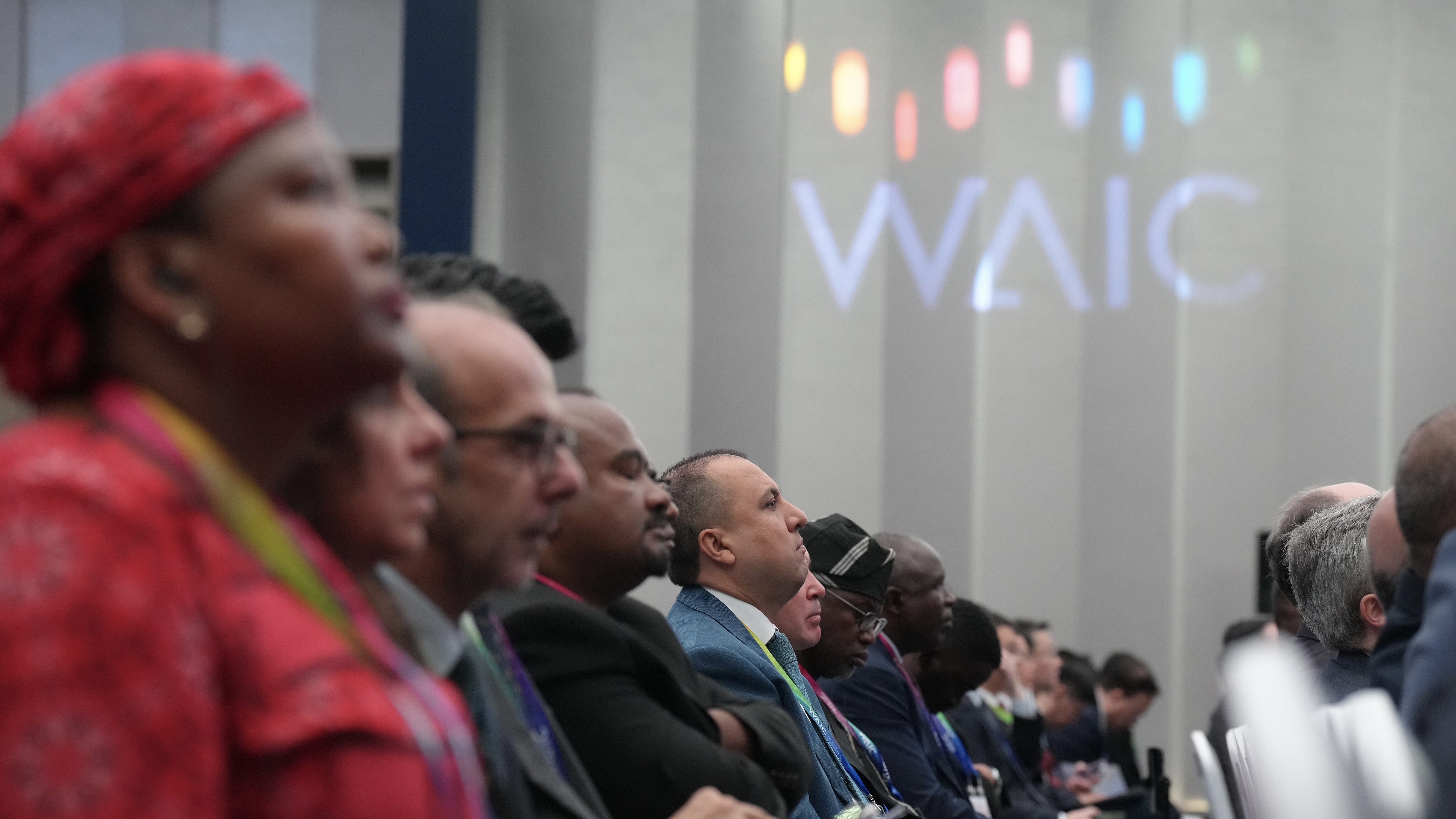
People attend the opening ceremony of the 2026 World Artificial Intelligence Conference (WAIC) and High-Level Meeting on Global AI Governance in Shanghai, China, July 17, 2026. (Photo: VCG)
At the 2026 World AI Conference (WAIC) in Shanghai, experts from China and abroad discussed the complementary roles of AI ethics and governance, arguing that both are essential to ensuring AI develops safely and benefits society.
One focus of the discussions was the launch of Yijian 2.0, an upgraded AI ethics review agent unveiled at the Forum on Global AI Governance and Sustainable Development.
Building on its existing capabilities for research ethics review, Yijian 2.0 expands into AI ethics, initially focusing on medical AI applications through upgraded knowledge rules, intelligent agent capabilities, and application systems.
Wang Guoyu, vice chair of the International Strategic Expert Committee of the Center for Global AI Innovative Governance, said the upgraded system is designed to review not only traditional research ethics issues but also ethical challenges posed by AI itself.
He said he hopes Yijian 2.0 will help countries in the Global South strengthen their AI ethics review capabilities and narrow the AI divide.
UNESCO Chair on AI and Data Science for Society Lampros Stergioulas stressed the importance of ethics in AI governance.
"Artificial intelligence can be an enabler, but humans must remain in control," he said.
Stergioulas warned that AI carries risks of misuse and unintended harm, adding that governance should go beyond safety considerations to address the broader capabilities and societal impact of the technology. Ultimately, he said, the goal is to protect people and ensure AI benefits society as a whole. He also praised China's commitment to advancing AI governance and called for faster efforts to build a globally coordinated governance framework.
While ethics provides guiding principles for AI development, experts said governance also requires clear rules to define the boundaries of how the technology should be developed and used.
At the Forum on Global Dialogue and Coordinated Development of AI Rules, the China University of Political Science and Law and the Collaborative Platform for Global AI Governance Rules released the "Global AI Governance Rules Map 2.0," an interactive platform that systematically maps AI regulations, policy tools, and regulatory approaches across major countries and regions.
Former UN High-level Advisory Body on Artificial Intelligence co-chair Carme Artigas described the platform as a valuable resource because it allows users to compare AI governance and legislation in China with approaches adopted around the world.
She said China is among the world's leading countries in AI development while also maintaining a comprehensive regulatory framework, adding that countries should learn from different governance models to strike a balance between innovation and safeguards.
Zhang Linghan, dean of the Institute of AI Law at the China University of Political Science and Law, said AI safety is a shared challenge facing all of humanity.
She noted that China was among the first countries to introduce regulations requiring labels for AI-generated content. With the establishment of the World AI Cooperation Organization, she said future international collaboration should extend beyond technological innovation to include the joint development of AI governance rules.
China has said it supports building an inclusive global AI governance framework and is committed to providing international public goods related to AI. Discussions at WAIC reflected a growing consensus that effective AI governance requires both ethical principles and robust regulatory frameworks to harness AI's benefits while managing its risks.