


China's MAZU meteorological platform is helping countries use artificial intelligence to improve forecasts and early warnings for floods, typhoons, heatwaves, and other extreme weather, as countries increasingly look to AI to strengthen disaster preparedness in a changing climate.
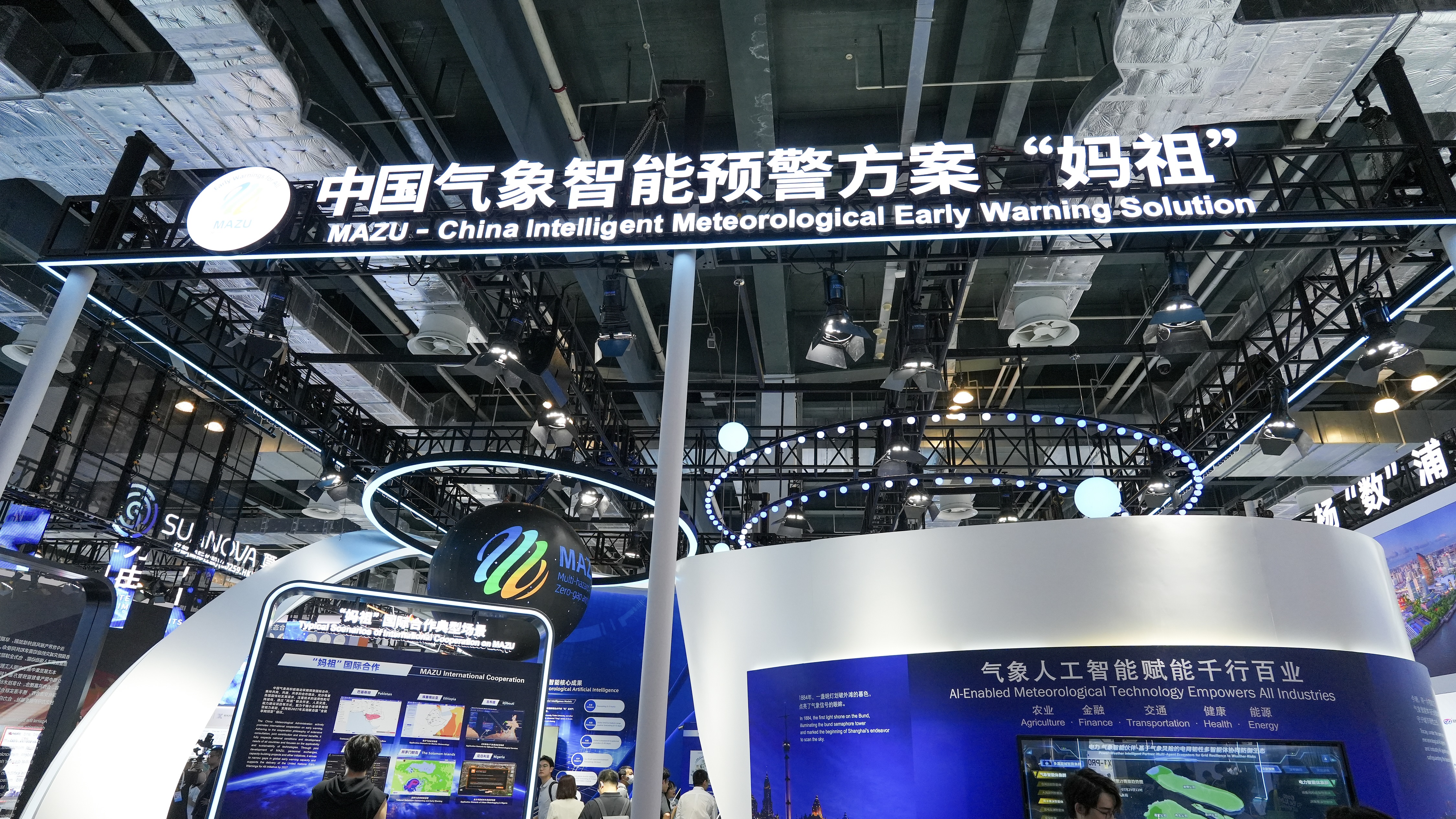
An exhibition booth showcases the MAZU AI meteorological early-warning platform at the 2026 World AI Conference (WAIC) in Shanghai, China, July 17, 2026. (Photo: VCG)
Developed by the China Meteorological Administration (CMA), MAZU is a cloud-based AI meteorological early warning platform that combines weather observations, forecasting models, and warning-generation tools. Its name is both an acronym for "Multi-hazard, Alert, Zero-gap and Universal" and a reference to Mazu, the sea deity revered in China's coastal communities as a protector of sailors.
Unlike conventional forecasting systems that rely on individual prediction models, MAZU integrates multiple AI models with meteorological observations and early warning tools on a single platform. Countries can further adapt the system using their own weather data, allowing forecasts to better reflect local conditions and disaster risks.
Pakistan offers one of the best examples of how the platform is being used.
Chinese and Pakistani meteorological authorities began jointly developing a localized version of MAZU in 2023, tailoring the system to weather risks including monsoon rainfall, heavy precipitation, and glacial lake outburst floods.
As Pakistan enters this year's monsoon season, the localized MAZU platform is helping forecasters monitor risks associated with floods, droughts and other extreme weather. According to the Pakistan Meteorological Department, the cloud-based system also allows meteorologists to access forecasting information from anywhere in the country.
"Using this platform, we can make more accurate predictions of floods, droughts and other extreme weather events," said Furrukh Bashir, head of the Research and Development Department at the Pakistan Meteorological Department. "We look forward to seeing more products like this that can benefit people around the world."
Pakistan is one of seven countries where customized versions of MAZU have been deployed. According to the CMA, meteorological agencies in more than 40 countries have also accessed the platform through cloud services.
The platform has also been adapted to different climate conditions around the world. In Mongolia, the customized version has been configured to monitor hazards such as snowstorms, strong winds, and dust events. Jordan's version supports forecasts for floods, droughts, heatwaves, and cold spells, while Sri Lanka's meteorological agency says locally trained AI models have improved forecast accuracy and strengthened disaster response capabilities.
The latest expansion came on Friday at the 2026 World AI Conference (WAIC) in Shanghai, where China and Thailand launched the world's first bilateral laboratory dedicated to AI-powered meteorological forecasting. Built on the MAZU platform, the joint laboratory will develop AI technologies for forecasting and early warning of hazards, including typhoons, heavy rainfall, heatwaves, and droughts, while supporting cross-border applications in agriculture, energy, and infrastructure.
At the conference, China said it is always committed to providing international public goods relating to AI. As more countries explore the use of AI in weather forecasting, MAZU is emerging as one example of how international cooperation can help local meteorological agencies strengthen early warning capabilities against increasingly frequent extreme weather.