


Japan's push for nuclear weapons discussion could 'erode restrictions, fuel dangerous trend carrying inflammatory effects': Chinese expert
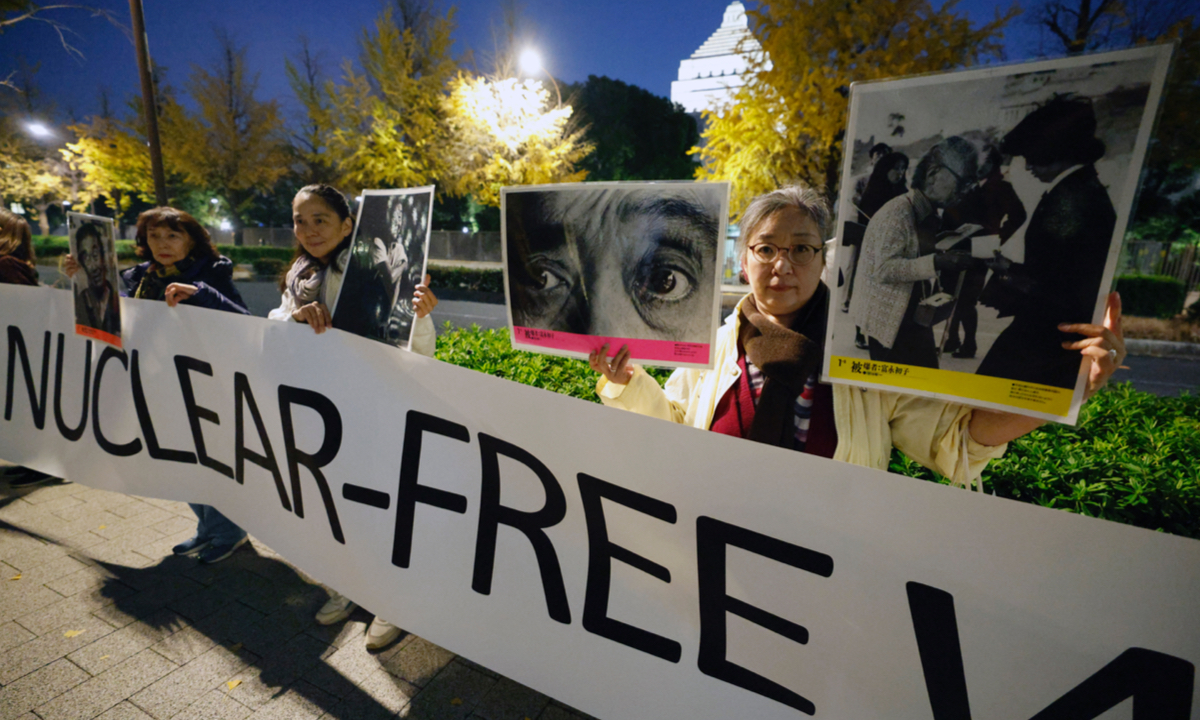
Protesters hold a banner during a rally in Tokyo, Japan, on November 21, 2025, after Japanese Prime Minister Sanae Takaichi criticized the country's traditional policy against nuclear weapons. (Photo: VCG)
Japan has continued to push for looser nuclear restrictions, with Defense Minister Shinjiro Koizumi calling for discussions on nuclear weapons as part of efforts to strengthen the country's so-called defense capabilities, according to media reports.
A Chinese analyst described Tokyo's move as gradually chipping away at nuclear restrictions, warning that the trend, driven by rising neo-militarism, could have an inflammatory effect by fueling extreme sentiments in Japan, posing further serious risks. The analyst called on the international community to firmly oppose nuclear development by a country witnessing a resurgence of militarism.
Japanese Defense Minister Shinjiro Koizumi claimed in an online program released on Saturday that discussions on nuclear weapons were necessary to strengthen Japan's defense capabilities, according to Kyodo News. While acknowledging that the issue was difficult to discuss in Japan, he claimed it was something that "could not be avoided."
Referring to the debate as "unavoidable," Lü Chao, an expert at the Liaoning Academy of Social Sciences, told the Global Times on Sunday that Koizumi's push to ease restrictions on nuclear weapons including his open call could be seen as gradually chipping away at the Three Non-Nuclear Principles, and represents another step in a dangerous trend that poses serious risks to neighboring countries and global security.
The remarks by Koizumi were also believed to have been made with the government's review of three key security documents in mind, per the report by Kyodo News.
The expert added that Japan has failed to properly reflect on and acknowledge its past acts of aggression and wartime crimes. Japan still faces strong domestic resistance to breaking through the Three Non-Nuclear Principles, as many Japanese citizens retain painful memories of the devastation caused by nuclear weapons.
However, the push for nuclear weapon framed under the slogan of becoming a "normal country" could fuel extreme forces in Japan advocating nuclear development, posing further serious risks, and the move should be cautioned, Lü added.
According to Japanese media outlet Nikkei Asia on Sunday, the Japanese government will also look for ways to bolster the extended nuclear deterrence provided by the US as part of revisions to three key security documents at the end of the year. This media report also claimed that this comes in response to "China strengthening offensive nuclear capabilities," underscored by this month's firing of a submarine-launched ballistic missile into the Pacific Ocean.
The test launch of a strategic missile by a submarine on July 6, which was part of the annual training arrangements of the PLA Navy, complied with international law and international practice, and is not directed at any specific country or target, the PLA navy said on the day of launch.
By repeatedly hyping the so-called "China threat," the US and some Western countries have provided Japan with an opportunity to create an international public opinion environment favorable to its possession of nuclear weapons, Lü said, adding that the primary goal of Japan for the hype is to gain US' supports.
In fact, a nuclear-armed Japan would pose significant risks to the US itself, Lü added. This development should serve as a warning to Japan's neighboring countries, the international community, and also some Western countries led by the US, that Japanese militarism has not disappeared. The international community should firmly oppose a country with a resurgence of militarism acquiring nuclear weapons, the expert added.
The country in recent months has continued efforts to break through the postwar constraints and advance military expansion, which a Chinese Foreign Ministry spokesperson said in a June's press conference that Japan has torn off the mask of "pacifist country" all by itself.
Spokesperson Lin Jian said during a press conference on June 11 that opposing militarism is the unwavering common will of the international community. "Any country that cherishes peace and upholds the postwar international order should make their just voice heard," Lin stressed.