


China hailed for boosting global AI push
China is an active advocate and practitioner of global governance in artificial intelligence, committed to ensuring that the benefits of AI are shared more broadly and equitably among people around the world, experts said.
Guided by the principles of multilateralism, openness and inclusiveness, China works to build the broadest possible international consensus on AI governance and contributes Chinese solutions to advancing global development in the age of intelligence, they said.
Speaking in Shanghai at the opening ceremony of the 2026 World AI Conference and High-Level Meeting on Global AI Governance, President Xi Jinping called for joint efforts to build a just and equitable system for global AI governance.
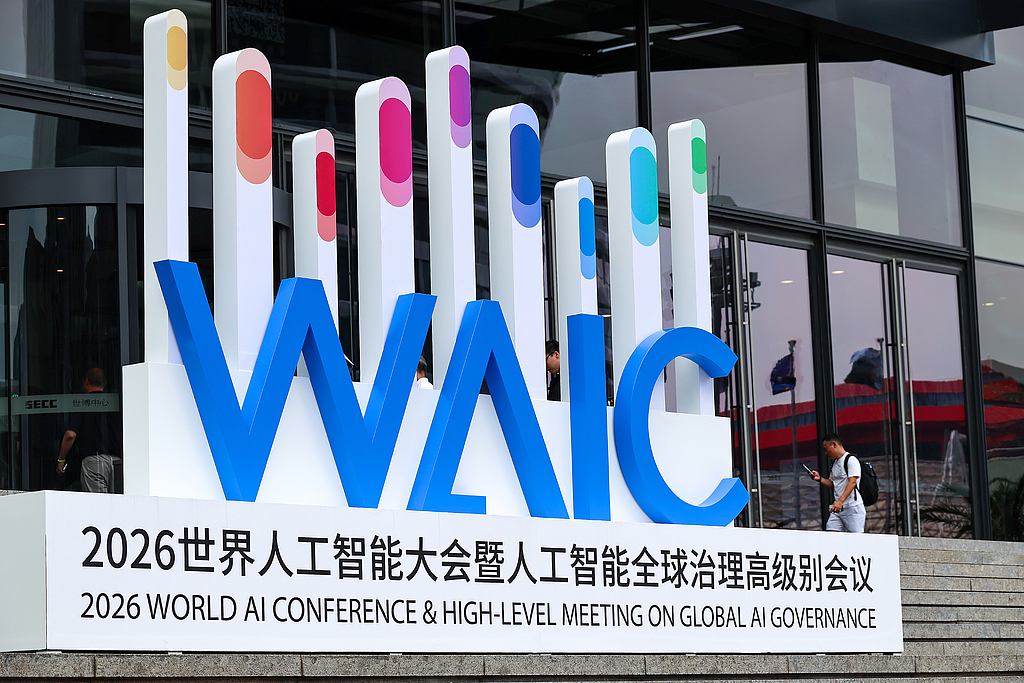
The logo of the 2026 World AI Conference (WAIC) is seen outside the Shanghai World Expo Exhibition and Convention Center, east China, July 19, 2026. (Photo: VCG)
"All countries should take a people-centered approach and develop AI for the positive and for good. We should ensure that AI is an important driver for shared prosperity and common security," Xi said.
In his keynote speech, Xi stressed the need for adhering to the principles of openness and win-win and boosting innovation-driven development. He called for strengthening risk awareness, ensuring that AI is secure and controllable, encouraging inclusiveness, promoting mutual learning between civilizations, advocating solidarity and improving global governance.
Gordon K'achola, founder and CEO of the Africa Center for Diplomatic Affairs, highlighted that China has promised to help developing countries build their own AI know-how.
"For Africa and the broader Global South, the goal isn't just getting the latest tech. It's about building the capacity to create and control their own AI writing algorithms, growing research centers, and strengthening local institutions," he said.
Xi said that China will develop international AI application cooperation centers with the Association of Southeast Asian Nations, the League of Arab States, the African Union, the Community of Latin American and Caribbean States, the Shanghai Cooperation Organization and BRICS.
Furthermore, China will promote the deployment of MAZU, an AI-powered meteorological early-warning solution, in 30 countries, he said.
Philip Okello, principal meteorologist at the Kenya Meteorology Service, noted that China has made significant advances in meteorological forecasting, satellite observation and early warning of disasters, adding that deeper cooperation in these areas could help enhance Africa's forecasting capabilities and strengthen its resilience to climate change.
"President Xi's speech is timely because climate change is no longer a future risk; it is a present-day reality that is affecting countries across the globe," he said.
Okello also said that Xi's emphasis on strengthening meteorological science, innovation and international cooperation "aligns closely with what Africa needs to better prepare for increasingly frequent droughts, floods and extreme weather events".
Xi also announced the establishment of the World Artificial Intelligence Cooperation Organization, whose headquarters will be in Shanghai, as "a major move by China to answer the call of the Global South and unite the international community" to vigorously promote AI development and governance.
Maria Sun, co-chair of the FIRA RoboWorld Cup 2026, said the rapid development of AI has brought new challenges, underscoring the need for stronger international cooperation to address them collectively.
"China's efforts to promote AI cooperation with developing countries are very encouraging. International exchanges like these help bring more countries into the AI era," she said.
"China has maintained an open approach to AI development, and that will contribute significantly to technological progress worldwide. Today, China is one of the global leaders in AI, and its continued openness will help drive innovation and international cooperation," Sun added.
Humprey Arnaldo Russel, head of the ASEAN-China Research Center at the University of Indonesia, said that AI creates transnational challenges involving safety, ethics, misuse, technical standards, regulatory fragmentation, and widening digital and governance divides.
He said that the Global AI Governance Initiative, put forward by President Xi in 2023, advances global AI governance through solidarity and multilateral cooperation, which requires the greatest attention from the international community.
"The proposal is especially important for the Global South, whose interests remain underrepresented in global technology governance. A broadly accepted, United Nations-centered framework could strengthen developing countries' participation (in global AI governance) while respecting different national conditions," he added.
David Tuffley, an adjunct senior lecturer at Griffith University's School of Information and Communication Technology in Australia, said the people-centered approach seeks to address a major challenge in AI governance: ensuring that the benefits of the technology are shared broadly rather than remaining concentrated in the hands of a few.
President Xi's speech highlighted China's commitment to promoting global AI governance and the development of international norms, he noted.
Tuffley also said that for the international community, particularly developing countries, the commitment to capacity building and greater access to computing power is especially significant, as much of the world's population currently has little voice in shaping the rules that govern AI.
"Australia and China share an interest in AI safety research, in standards for evaluating frontier systems, and in ensuring AI serves rather than displaces human judgment in critical domains such as healthcare and education," he said.