


Footage obtained by Global Times shows how the Philippines distorts truth, provokes clashes with Chinese law enforcement personnel near China's Ren'ai Jiao
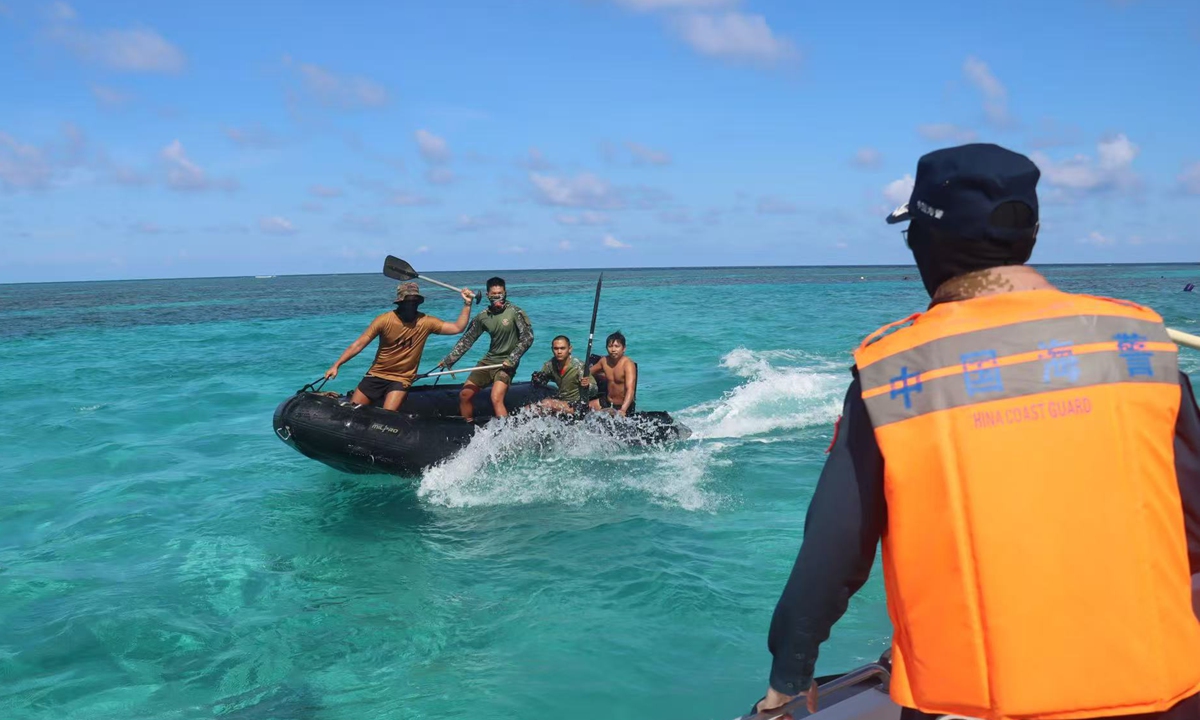
Philippine military personnel deliberately provoke CCG law enforcement officers. (Photo: courtesy of CCG)
The China Coast Guard (CCG) said on Monday that the Philippine side has distorted facts and falsely accused China after Philippine personnel maliciously attacked Chinese law enforcement personnel in waters near Ren'ai Jiao, urging the Philippine side to immediately stop infringement, and provocative actions.
Ignoring repeated clear warnings from the Chinese side, the Philippine rubber boats approached the Chinese patrol vessel at high speed in a dangerous manner and attempted to surround and ram it. During the incident, Philippine personnel first used tools including paddles and long poles to maliciously attack Chinese law enforcement officers.
The Chinese side took measures including verbal warnings, maneuvering, and corresponding countermeasures to stabilize and control the situation on site in accordance with the law and regulations, while exercising maximum restraint and rationality.
After the incident, the Philippine side distorted facts and falsely accused Chinese side, reversing right and wrong. We urge the Philippine side to immediately stop infringement, provocative actions and the dissemination of false information, the CCG said.
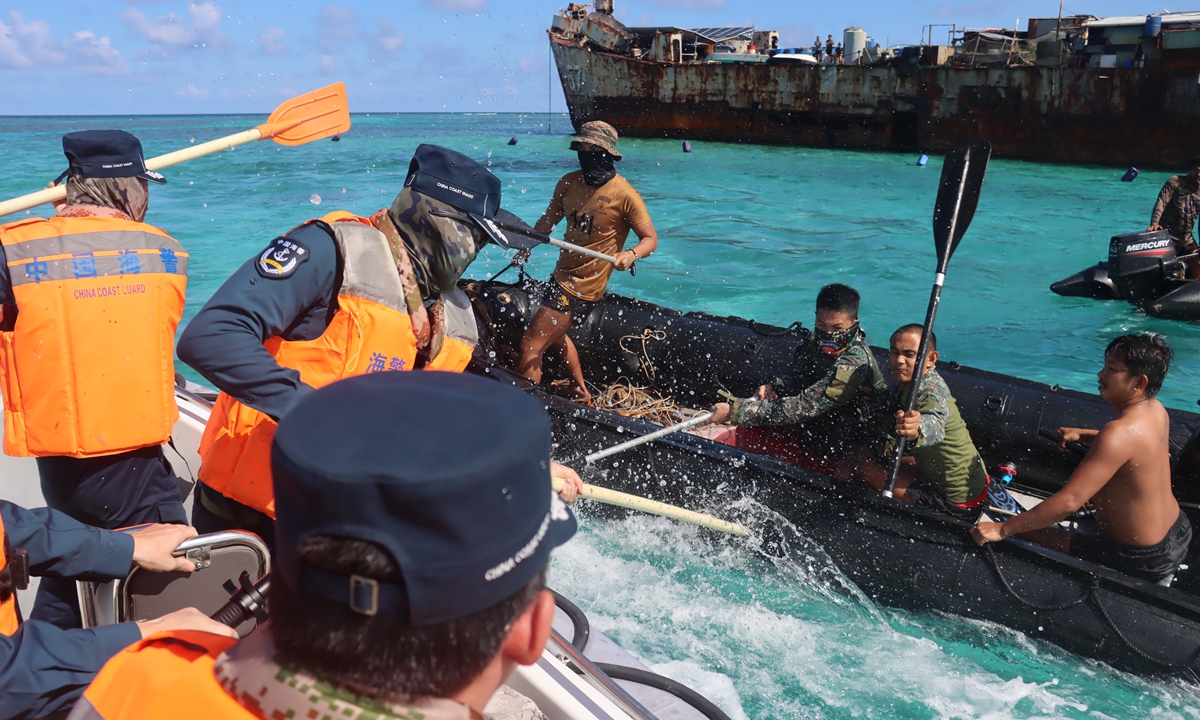
Philippine military personnel deliberately provoke CCG law enforcement officers. (Photo: courtesy of CCG)
On July 20, a video allegedly showing "Chinese coast guard personnel attacking Philippine personnel aboard a grounded warship" appeared in several major Philippine media outlets. In the low-resolution footage released by Philippine media, with unclear context and no indication of what happened before or after the incident, a white rigid-hull inflatable boat (RHIB) and a black rubber boat are seen colliding. Personnel on both boats engage in a fierce confrontation, swinging sticks at each other. In the end, the black rubber boat, apparently "outmatched," retreats from the scene of the clash.
Subsequently, the Philippine Department of National Defense and the Armed Forces of the Philippines issued statements one after another regarding the incident, confirming that some Philippine personnel were injured during the confrontation and releasing photos of a Philippine personnel with a head injury in an attempt to portray themselves as victims.
The Philippine military authorities also distorted the facts in their statements, accusing Chinese coast guard personnel of carrying out what they described as "aggressive" actions during law enforcement operations to safeguard China's rights.
In its official statement, the Armed Forces of the Philippines claimed that "the Philippine Navy rubber boats "calmly and non-confrontationally" drive it away, while alleging that Chinese coast guard personnel took aggressive actions, using a wooden stick to strike a Philippine Navy personnel in the head, causing injury and damaging the Philippine Navy rubber boat.
Both the Philippine armed forces and the Philippine Department of National Defense sought to bolster their own image in their statements, claiming that Philippine Navy personnel exercised restraint and acted in according with the Rules of Engagement and vowing that the Philippines would not back down.
The first-person high-definition video recorded by CCG law enforcement personnel and obtained by the Global Times provides a more comprehensive, authentic and multi-dimensional account of the incident, exposing what it described as the Philippine military's "violent" narrative.
The footage shows that the confrontation was entirely triggered by provocative actions from the Philippine side. Two Philippine rubber boats repeatedly harassed a CCG patrol boat that was drifting in the area, making high-speed maneuvers around the vessel to create wake waves, while Philippine personnel also made provocative moves.
After being rammed by the Philippine rubber boats and subjected to physical attacks, CCG personnel were forced to respond. They quickly brought the Philippine side's aggressive actions under control and compelled the Philippine personnel to retreat after recognizing the disparity in capabilities, preventing the situation from further escalating.
According to information obtained by the Global Times, the CCG vessel conducting routine patrols in the waters near Ren'ai Jiao carried out verification activities involving Philippine military personnel. The move also served as a strong countermeasure against the repeated provocative harassment by personnel aboard the Philippines' illegally grounded warship, who have recently continued to operate rubber boats to interfere with Chinese law enforcement vessels.
A source familiar with the matter told the Global Times that frontline CCG officers maintained a high level of rationality during the reciprocal response. In terms of size, the Chinese law enforcement boat was larger, and in terms of performance, rigid-hull law enforcement boats have stronger horsepower and impact capabilities. If it had carried out a full-force collision, the Philippine rubber boat would have had little chance of escaping. However, during the encounter with the Philippine rubber boats, the Chinese law enforcement vessel exercised restraint throughout the entire process.
"Recent provocations by the Philippines and its deliberate creation of confrontational incidents in waters near China's Ren'ai Jiao serve a hidden agenda," Yang Xiao, a research professor at the Institute of Peaceful Development under the Chinese Academy of Social Sciences, told the Global Times on Monday.
July 12 marked the 10th anniversary of the release of the illegal "South China Sea arbitration award." Recently, China has released a series of important reports exposing the nature of the arbitration case from a legal perspective, further reinforcing the fact that the illegal award is "nothing more than a piece of waste paper," Yang said.
He noted that recent statements by Philippine officials also show that some Philippine politicians have become "desperate." In addition, the 59th ASEAN Foreign Ministers' Meeting and related meetings are currently being held in Manila, and the Philippines is serving as ASEAN's rotating chair this year. In an attempt to use the multilateral meetings to hype up the South China Sea issue and "dominate" the narrative on the South China Sea, the Philippines has the motivation to take risky actions and create confrontational incidents, Yang said.
"But the Philippines has clearly once again underestimated China's determination to safeguard its territorial sovereignty and maritime rights and interests. No matter how the Philippines escalates tensions or creates provocations, it will not change China's resolve and determination to defend its rights," Yang said.
The CCG will continue to carry out law enforcement and rights-protection activities in accordance with the law in the Nansha Qundao, including Ren'ai Jiao, and adjacent waters, and will firmly safeguard China's territorial sovereignty and maritime rights and interests, according to the CCG's statement on Monday.