


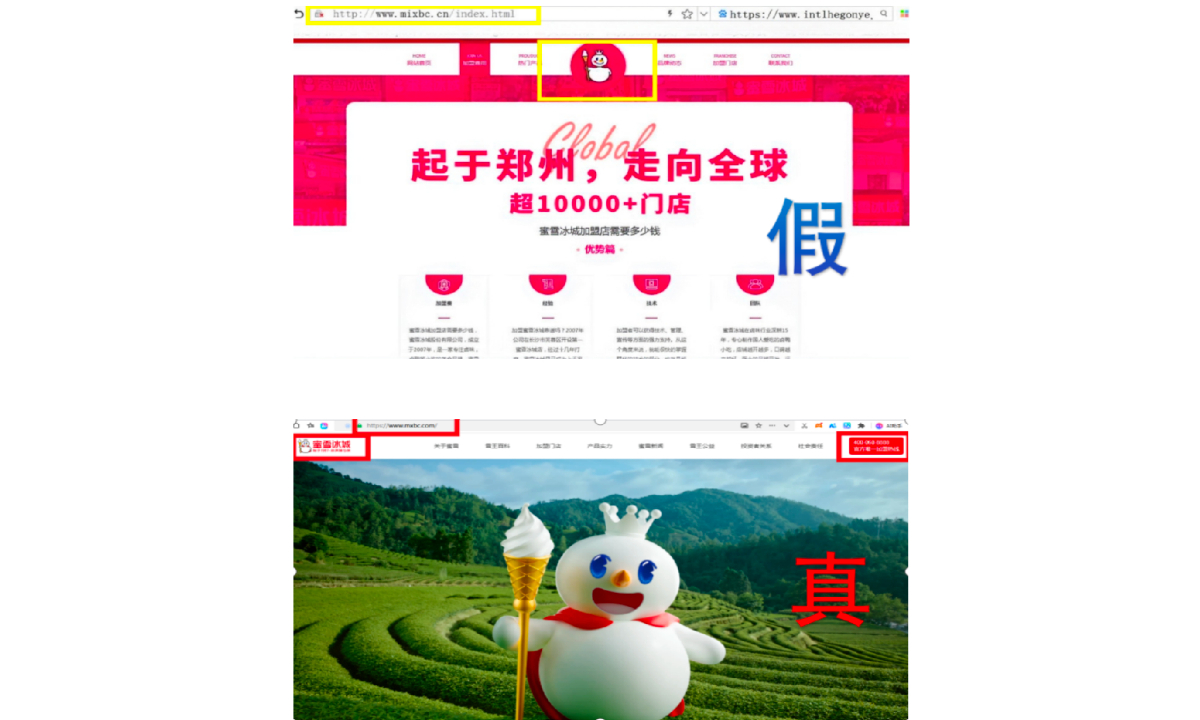
A comparison of fake and the authentic websites of Mixue Ice Cream & Tea Photo: Screenshot from the website of the Cyberspace Administration of China (CAC)
The reporting center of the Cyberspace Administration of China (CAC) transferred 759 fake and impersonation websites for handling in the first half of this year, a 150 percent increase from the same period last year, CAC announced on Tuesday.
The websites involved fell into five categories, including Party and government organs, public institutions, companies, social organizations and international organizations.
By category, 127 websites impersonating Party and government agencies – including the Ministry of Human Resources and Social Security and the Xiong’an New Area – were referred for disposal, accounting for 16.7 percent of the total.
These websites typically lure users with claims of subsidies or preferential household registration policies, or exploit the names of renamed or abolished agencies to appear official and carry out scams.
Fake public institution websites totaled 310, representing 40.8 percent of the total, including 180 bogus academic journal submission sites, as well as schools and hospitals.
Fake public institution websites typically lure users with registration, information inquiry, or credential certification services, while bogus academic journal sites steal personal data and original manuscripts or fraudulently charge application, certification, and peer-review fees by impersonating legitimate journals.
Websites counterfeiting enterprises – including state-owned, private, and foreign-funded companies – made up the largest category, with 313 cases, accounting for 41.2 percent of the total.
Fake company websites typically impersonate well-known firms or e-commerce platforms, using fake services and false information to trick users into registering accounts, sharing personal information, or making payments, putting them at risk of data theft, financial losses, and damaging corporate reputations.
The CAC’s statement attached side-by-side screenshots of the genuine and fake websites for the Ministry of Human Resources and Social Security and the Xiong’an New Area to help the public identify fraudulent sites.
The center also posted a comparison of the authentic and counterfeit websites for Sinopharm and Mixue Ice Cream & Tea as examples.