


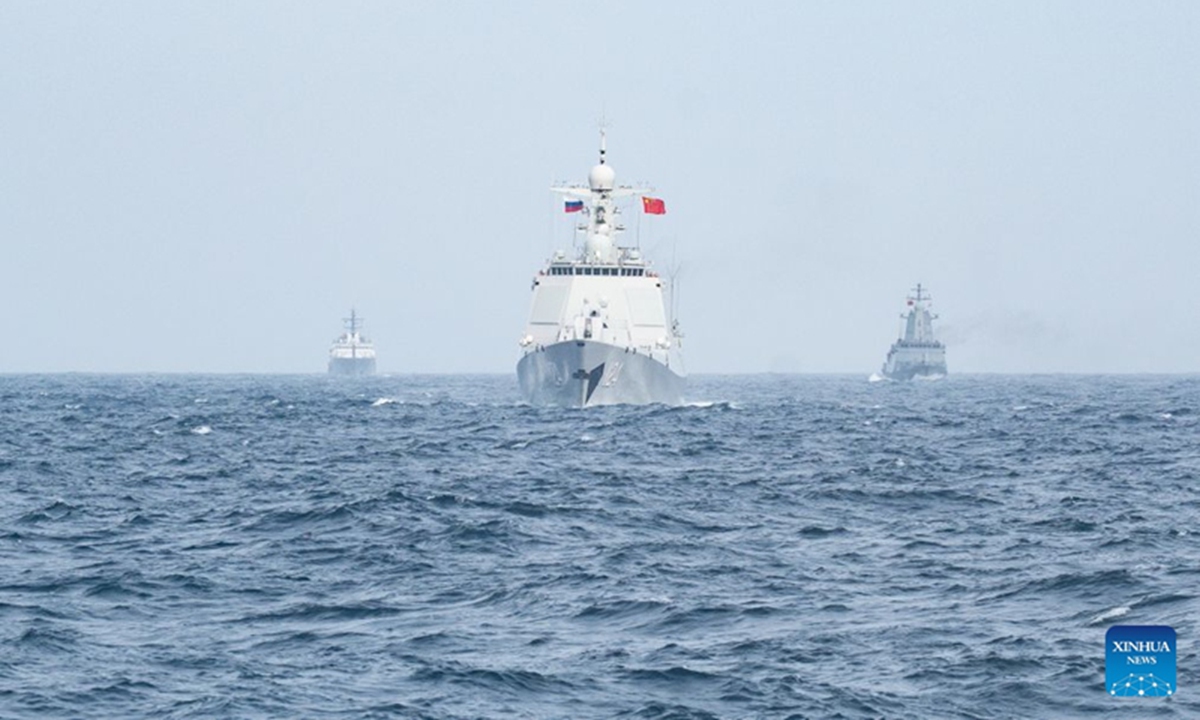
Chinese and Russian naval vessels sail in formation towards the designated sea area during the maritime phase of the "Joint Sea-2026" exercise between China and Russia, July 10, 2026. (Photo: Xinhua)
China has firmly rejected Japan's "concerns" over Chinese naval vessels' shooting drills in Japan's so-called exclusive economic zone (EEZ), with Foreign Ministry spokesperson Lin Jian telling reporters on Tuesday that Japan's objections are baseless. Lin added that China's competent authorities have already made clear China's stance regarding the China-Russia joint military exercises and maritime patrols.
Lin said that it must be stressed that under the UN Convention on the Law of the Sea, Okinotori is a rock, not an island, and is not entitled to an EEZ or continental shelf. Japan's claim to an EEZ based on the Okinotori rock runs counter to international law. China's activities on the relevant high seas are consistent with international law and customary international practice, Lin added.
Japan smears and hypes up other countries' legitimate and lawful actions, stokes fears of external threats, and fabricates pretexts to advance its remilitarization at an accelerated pace and challenge the post-war international order, said Lin, adding that the international community must stay highly vigilant and jointly resist such dangerous trends.
Japan's Ministry of Defense Joint Staff claimed on Tuesday that it had confirmed four Chinese and Russian naval vessels sailing southwest of what the Japanese side claimed as "Okinotori Island" on Sunday, with a Chinese guided-missile destroyer conducting a live-fire exercise. Japanese media alleged that the exercise took place within what Japan claims as its "exclusive economic zone (EEZ)." Meanwhile, Japanese defense minister Shinjiro Koizumi during an airshow speech in Britain reportedly signaled Japan's readiness to make strides toward more robust defense production while commenting the development.
Chinese experts said there is no such thing as "Okinotori Island," only Okinotori Reef. Therefore it is not entitled to an exclusive economic zone under the UN Convention on the Law of the Sea. Regular joint military exercises between China and Russia in the high seas are both reasonable and legitimate, leaving Japan no grounds for hype or criticism. Japan's real aim is likely to create confrontation and disrupt regional order in the Asia-Pacific.
According to Kyodo News, Japan's Defense Ministry claimed that two Chinese guided-missile destroyers, a Chinese replenishment ship and a Russian frigate were spotted sailing northeast at around 2 am on Sunday in waters about 330 kilometers southwest of Okinotori.
It also claimed that one of the Chinese guided-missile destroyers later conducted live firing training about 180 kilometers southwest of Okinotori, while a Japan Maritime Self-Defense Force frigate monitored the vessels. The information was also released on the Joint Staff website.
At an international airshow in Farnborough in southern Britain, Japanese Defense Minister Shinjiro Koizumi reportedly commented on the development and signaled Japan's readiness to make strides toward more robust defense production, Tokyo-based Japanese media outlet Japan Today reported on Tuesday.
No damage to other ships in the area has been reported. However, Tokyo has communicated its concern to Beijing through a diplomatic channel, according to the ministry, per Japan Today.
Song Zhongping, a Chinese military affairs expert, told the Global Times on Tuesday that there is no such thing as "Okinotori Island," only Okinotori Reef, whose natural status is that of a reef rather than an island. Under the UN Convention on the Law of the Sea, Okinotori is not entitled to generate an exclusive economic zone. Therefore, the Chinese-Russian navy activities took place on the high seas and had nothing to do with Japan, Song said.
A report from Reuters on Tuesday said that a spokesperson at the Joint Staff claimed it was the first time Japan had disclosed China's live-fire drills in its so-called "exclusive economic zone (EEZ)," while adding that the activity did not violate international rules
The Japan Today report also mentioned China and Russia conducting joint bomber flights over waters around Japan, and a submarine-launched ballistic missile test by the Chinese military earlier this month, while Koizumi claiming that "Each of these is yet another manifestation of the deepening military cooperation between China and Russia," and adding that the security of the so-called "Indo-Pacific" region is inseparable from that of Atlantic Europe, and that Japan assumes a role in bridging them.
Chinese expert pointed out that Tokyo has taken a series of increasingly assertive military steps in recent months, including conducting a live-fire anti-ship missile exercise with the US, Australia and the Philippines at the South China Sea in May and advancing missile deployments and related military activities across its southwestern islands. These moves have contributed to heightened tensions in the Asia-Pacific. Against this backdrop, regular joint military exercises between China and Russia are both reasonable and legitimate, leaving Japan with no grounds for hype or criticism. Lü Chao, a research fellow at the Liaoning Academy of Social Sciences, said.
Song also noted that Japan is well aware that it cannot rely solely on the US-Japan alliance and is therefore seeking to draw NATO countries further into the Indo-Pacific to jointly counter China. In his speech in the UK, Koizumi referred to China-Russia military cooperation as he claimed that the security of the "Indo-Pacific" and the Euro-Atlantic is closely interconnected, while portraying Japan as a key link between the two regions. Koizumi's rhetoric is aimed at fueling bloc confrontation and undermining regional stability, Song said.
Following the conclusion of the "Joint Sea-2026" joint exercise in July, some naval forces from China and Russia conducted a joint maritime patrol in relevant waters of the Pacific Ocean. The patrol was arranged under the annual cooperation plan between the two militaries and aims to jointly respond to security challenges and safeguard regional peace and stability, according to the Xinhua News Agency.
Responding a claim from Japan's Foreign Minister Toshimitsu Motegi ten years after the "2016 Arbitral Award on the South China Sea" and blatantly endorses the illegal "award," a Chinese Foreign Ministry spokesperson on July 12 questioned that according to the "award," Taiping Dao in the Nansha Qundao, an area that spans 500,000 square meters and has fresh water, vegetables, fruits and poultry to sustain human habitation, is not even considered an island and therefore cannot generate entitlement to exclusive economic zone (EEZ) and continental shelf. If that could stand, how could Okinotori—nothing more than two tiny rocks of less than 10 square meters in the Pacific—possibly justify a claim to EEZ and continental shelf of hundreds of thousands of square kilometers?