


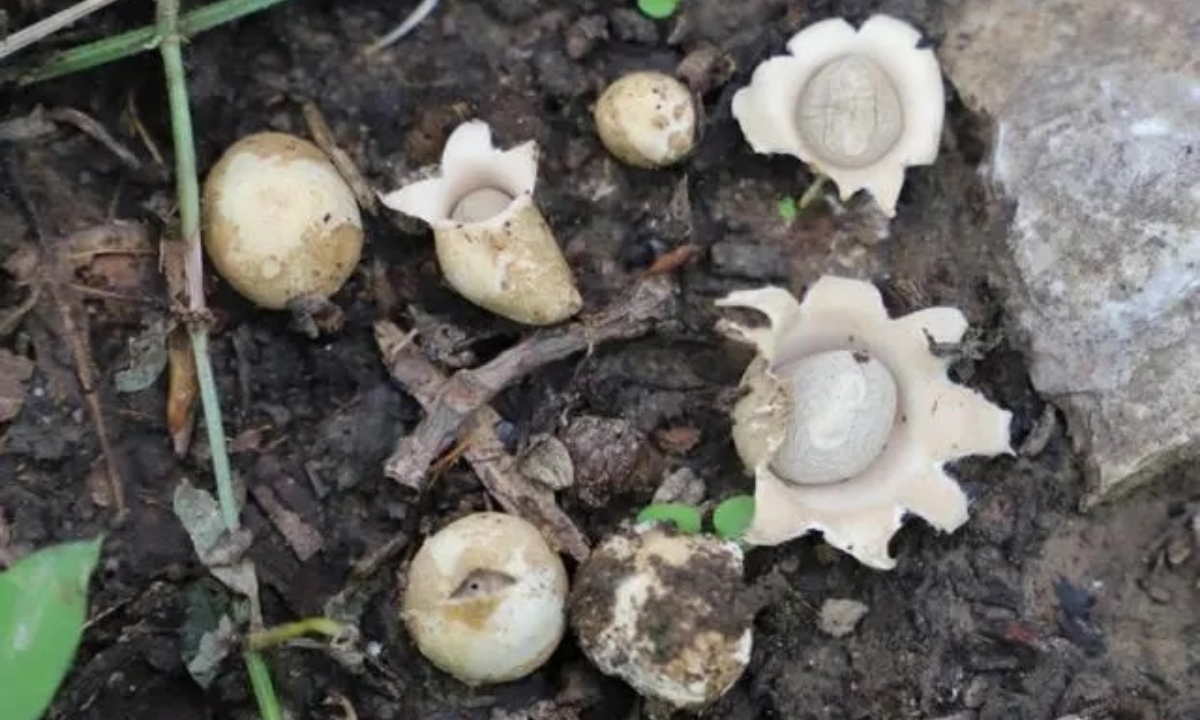
Cape Verde earthstar (Photo: Screenshot from Beijing Daily)
Chinese scientists have discovered a rare macrofungus species, Geastrum gorgonicum – commonly known as the Cape Verde earthstar – in Beijing’s Shunyi district. The species takes its name from Cape Verde, the home of the notable dark horse team in the 2026 FIFA World Cup. The discovery adds a new record to Beijing’s macrofungal biodiversity, according to Beijing Daily on Tuesday.
During a biodiversity survey conducted in 2023 in Shunyi, over 10,000 kilometers away from Cape Verde, a research team led by He Shuanghui, professor from the Institute of Microbiology, Beijing Forestry University, collected specimens of the Cape Verde earthstar.
The researchers collected specimens of the Cape Verde earthstar at three locations in Shunyi.
The Cape Verde earthstar is a spherical fungus belonging to the Geastrum genus. These fungi are typically ground-dwelling, and when mature, their outer layers peel back to reveal a characteristic star-like form, accodong to Professor He.
He explained that this species was first collected and formally described in 2021 by Spanish mycologists in Cape Verde, and was therefore named after the country. Chinese mycologists later discovered it in North China’s Inner Mongolia Autonomous Region and Southwest China’s Guizhou Province. Its latest discovery in Beijing marks it as a new record for the city’s fungal species list.
According to He, some fungi are widely distributed, possibly spreading across continents through evolutionary history before being dispersed by geological changes and migration. The origin and evolutionary center of Cape Verde earthstar remain unclear and require further biogeographical research.
The discovery of Cape Verde earthstar is not an isolated case. The research team has discovered many new species, species newly recorded in China, and a large number of species recorded in Beijing for the first time in recent years, according to the prorfessor.
According to He, China has a rich diversity of macrofungal species. Establishing baseline data and gaining a clear understanding of species diversity will provide essential data and scientific support for the future conservation and sustainable utilization of macrofungi.
He also warned that while some Geastrum species have medicinal uses, the Cape Verde earthstar should only be used for research and not eaten until its composition and safety are scientifically verified.