


Inside Hongshan Experimental Primary School in Luoyang, central China's Henan Province, the summer break is anything but ordinary. Students are carefully polishing glider wings, adjusting flight angles and practicing launches as they prepare for the national finals of a youth aviation and aerospace model competition.
Having won gold at the national competition in 2023, the rural school has long nurtured students' interest in science and innovation.
"Over the past few years, our teaching facilities and learning environment have improved significantly, allowing children in rural areas to enjoy educational resources comparable to those in cities," Principal Zhang Weiying said.
The school's transformation reflects a broader shift in China's education system as the country moves beyond expanding access to improving the quality of basic education.
From access to quality
China has built the world's largest basic education system and is shifting its focus from ensuring access to improving education quality, with major progress in equity, digital learning and student development, according to the Ministry of Education.
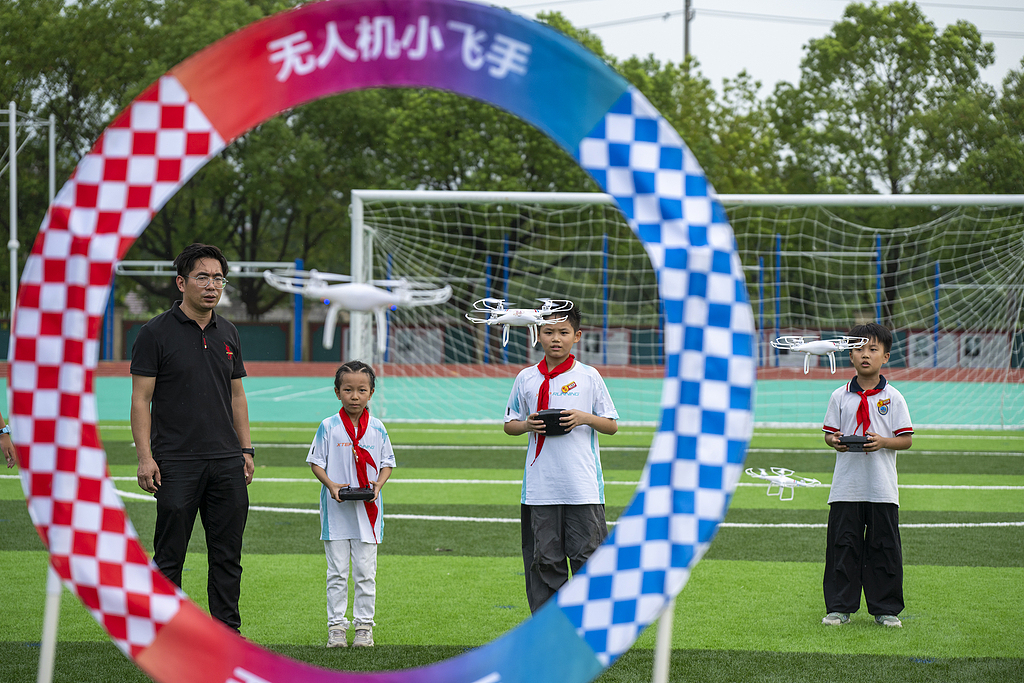
Students learn drone piloting techniques under a teacher's guidance at a village primary school in Wuhu, Anhui Province, east China, September 11, 2025. (Photo: VCG)
The country now has around 430,000 primary and secondary schools and kindergartens, serving 220 million students and supported by 15.77 million teachers. Officials said China's basic education system has reached the average level of high-income countries in terms of overall development and is entering a new stage of high-quality growth.
According to official data, all county-level regions nationwide have passed the national assessment for balanced compulsory education. The retention rate for the nine-year compulsory education program has risen to 96.1%, while the gross enrollment rate for senior secondary education has reached 92%.
China's free one-year preschool education program has benefited over 14 million children, and internet connectivity has been extended to 100% of schools, enabling more rural schools to participate in real-time online classes with urban counterparts.
Meanwhile, more than 99.5% of primary school admissions are now conducted through nearby school placement without entrance examinations, while the enrollment rate of school-age children with disabilities in compulsory education has remained above 97%.
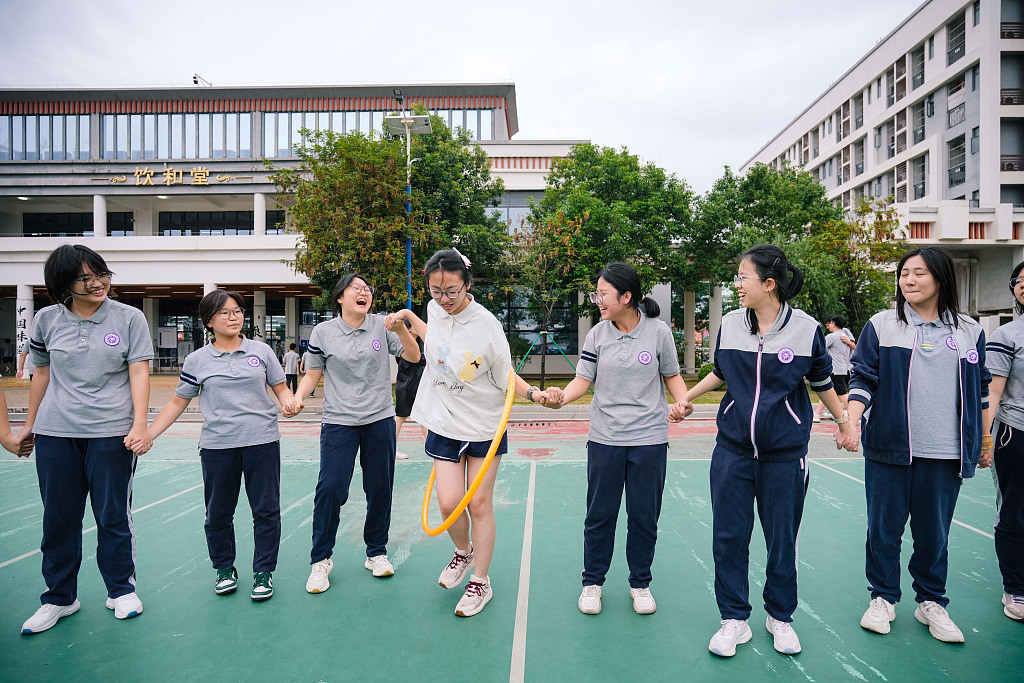
Students engage in after-class activities at a high school in Huizhou, south China's Guangdong Province, May 26, 2025. (Photo: VCG)
Promoting well-rounded development
Beyond expanding access, China is placing greater emphasis on students' all-round development.
Schools across the country have expanded opportunities for moral, intellectual, physical, aesthetic and labor education by integrating classroom learning with community activities. During the summer break, students are participating in a wide range of programs, including red tourism study trips, hands-on labor education, science and technology activities, and sports camps.
In line with the "health first" principle, primary and secondary schools have generally introduced 15-minute breaks between classes and are implementing a policy requiring students to engage in at least two hours of integrated physical activity each school day.
China's State Council has recently issued the outline plan for the development of the education sector during the 15th Five-Year Plan period (2026-2030), stressing efforts to build a strong, globally competitive educational system to underpin the country's modernization drive.
Zhu Dongbin, deputy director-general of the Ministry of Education's Department of Basic Education, said the efforts include establishing a basic education system that is both fair and high-quality.
He said the ministry will steadily expand the coverage of free preschool education, explore the possibility of extending the length of compulsory education, increase the supply of senior secondary school places, promote a more balanced distribution of teachers and students among county-level high schools, strengthen science and technology education, uphold the "health first" principle, and prudently advance the application of artificial intelligence in education.