


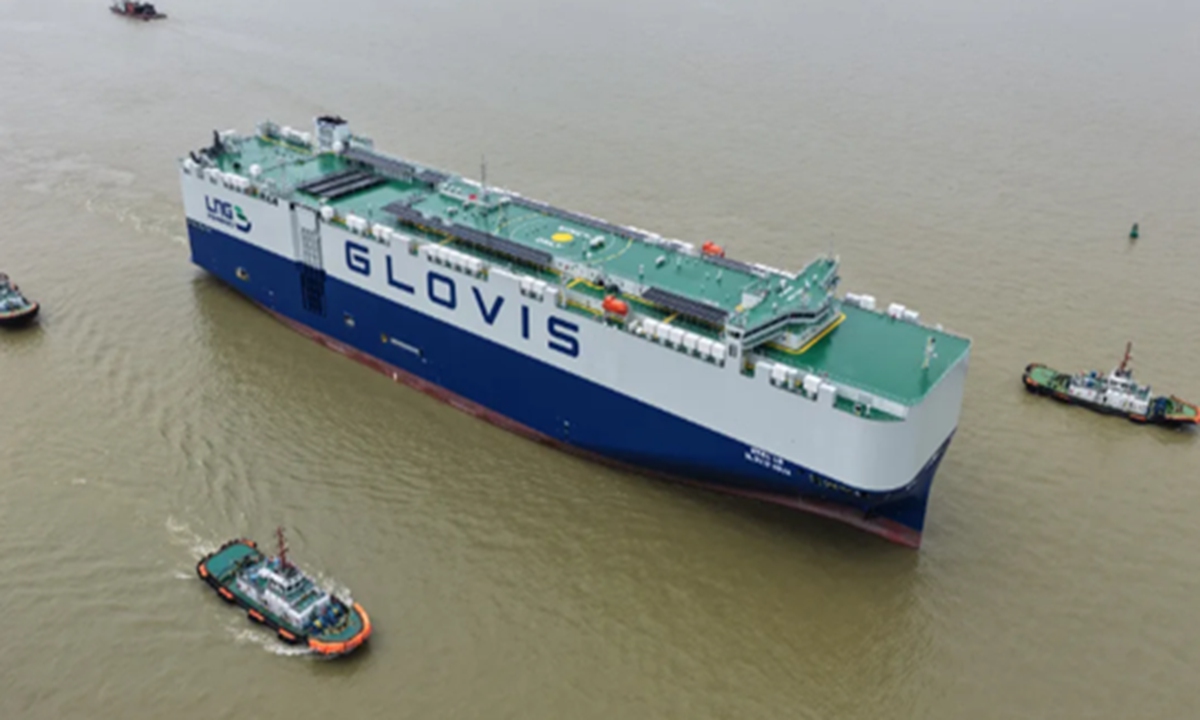
Photo courtesy of the Guangzhou Shipyard International
China delivered the world's first 10,000-vehicle-class car carrier equipped with a photovoltaic power generation system on Tuesday to a South Korean enterprise, according to a report by Science and Technology Daily on Wednesday.
The Guangzhou Shipyard International Co., Ltd. (GSI), together with China Shipbuilding Trading Co., Ltd., completed the remote online signing ceremony on Tuesday to deliver the 10,800-vehicle liquefied natural gas (LNG) dual-fuel car carrier to South Korea's Korea Ocean Business Corporation. The vessel is the fourth 10,000-vehicle-class car carrier delivered by China and the first in the world of its kind to be equipped with a photovoltaic power generation system, according to the report.
Jointly developed by GSI and Shanghai Merchant Ship Design and Research Institute, the vessel is classed by the Det Norske Veritas (DNV) and Korean Register (KR), and is capable of operating in unrestricted waters worldwide.
The ship measures 230 meters in length overall, with a length between perpendiculars of 225.5 meters and a beam of 40 meters. Powered by both conventional fuel and LNG, it is equipped with a shaft generator and a 200-kilowatt peak photovoltaic grid-connected power system, offering improved energy efficiency and reduced emissions. Its onboard LNG storage capacity can meet the vessel's fuel needs throughout the entire voyage.
The vessel features 14 vehicle decks, including nine fixed decks and five adjustable decks, allowing it to carry various types of vehicles, including passenger cars, vans, trailers carrying freight containers and heavy trucks. In addition to vehicles, it can also transport certain packaged dangerous goods covered under the International Maritime Dangerous Goods (IMDG) Code.
After delivery, the vessel will be leased to Hyundai Glovis and operate on routes connecting Asia with Southeast Asia, North America and Europe, supporting global automotive trade, according to the report.