


"The salt lake looks like a pool of green juice. Photos simply don't do it justice," said Ms. Zhang, a visitor from Qingdao, East China's Shandong Province, as she snapped photos beside the salt ponds at the Qairhan Salt Lake scenic area in Golmud, Northwest China's Qinghai Province.
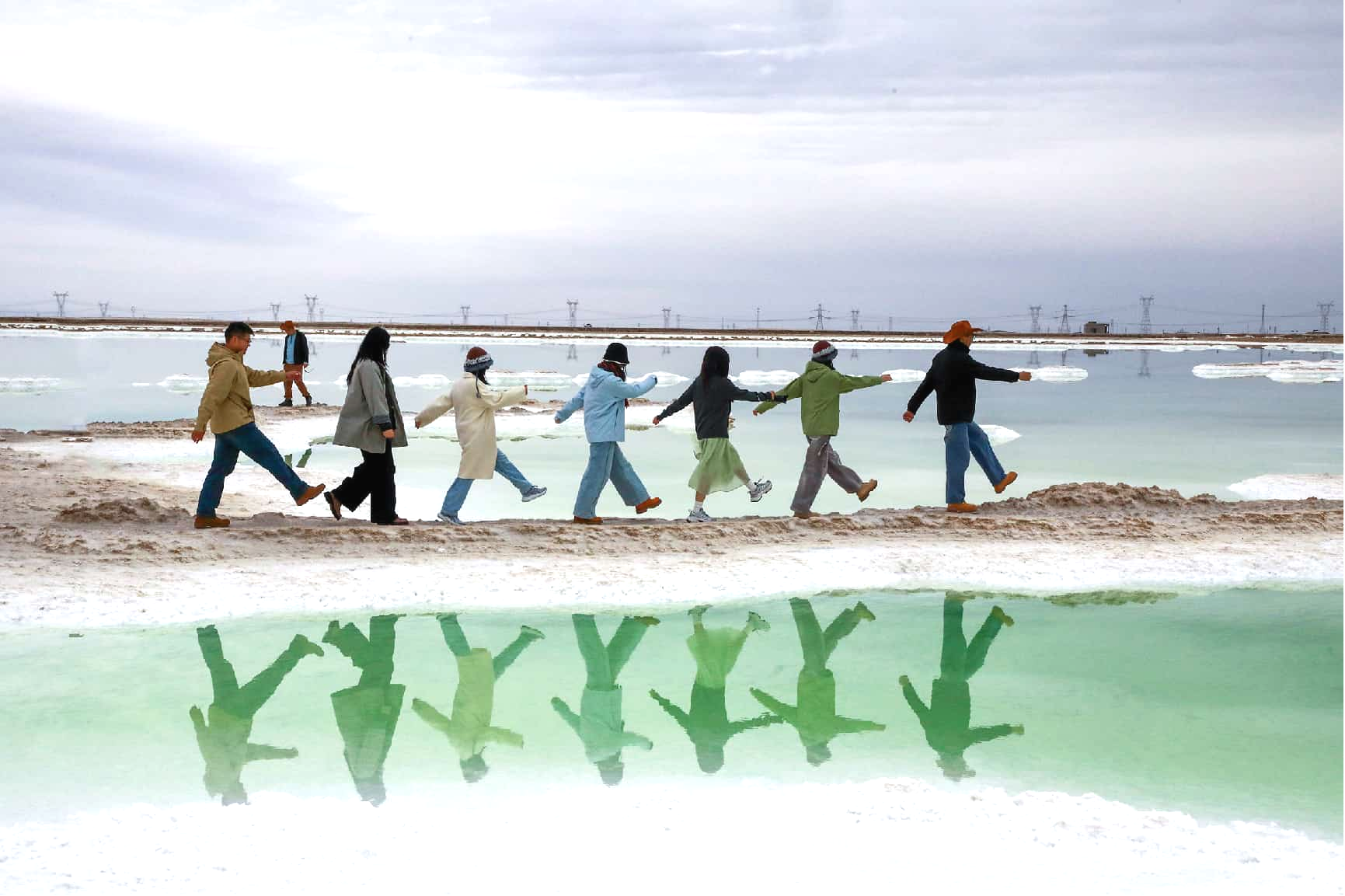
Tourists visit the Qairhan Salt Lake scenic area in Golmud, Northwest China's Qinghai Province. (Photo/Zhang Hongxin)
In front of her lay emerald-green brine, and behind her, white salt crystals glistened in the sun. In the distance, pipelines linking a brine pumping station stretched across the landscape. This vast expanse of water is both a vital link in the potash fertilizer production chain and a striking natural canvas for visitors. Here, industry and tourism coexist in harmony.
Beneath the emerald surface, the brine begins a journey that lasts dozens of days and spans more than 100 kilometers. It is first evaporated in salt ponds to separate sodium salts, and processed to extract potassium. The remaining brine is refined into lithium carbonate. Every drop is reused through successive stages of extraction until valuable resources such as potassium and lithium are fully recovered.
Covering 5,856 square kilometers in the heart of the Qaidam Basin, the Qairhan Salt Lake is China's largest salt lake.
Potassium was the first treasure discovered here. In the 1950s, workers building the Dunhuang-Golmud Highway noticed that the lake's water had a bitter taste. Laboratory tests revealed it contained potassium chloride. In 1958, technicians successfully produced 10 kilograms of potash fertilizer from the brine, paving the way for the establishment of the Qairhan Potash Fertilizer Plant, now known as Qinghai Yanhu Industry Co., Ltd. That same year, the plant produced 950 tonnes of potash fertilizer, marking China's first-ever production of this essential agricultural input.
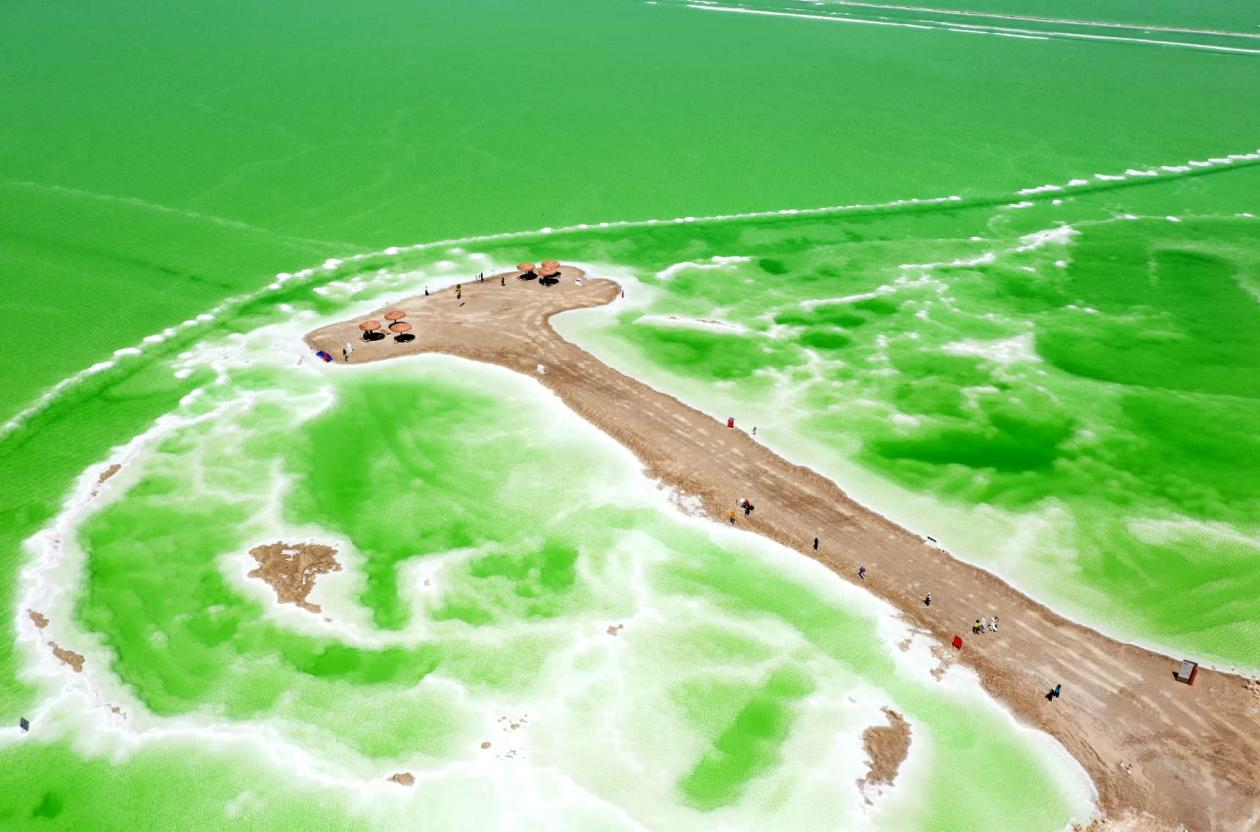
Photo shows a bird's-eye view of the Qairhan Salt Lake in Golmud, Northwest China's Qinghai Province. (Photo/Zhang Zhongping)
"Potassium is one of the three essential nutrients for crop growth," said Liu Qingqing, deputy director of the resource development center at Qinghai Yanhu Industry Co., Ltd. She added that expanding domestic potash fertilizer production is vital to safeguarding China's food security.
Over the past six decades, generations of salt lake workers have achieved breakthroughs in a series of key technologies, including large-scale deep-water solar evaporation, twin-cutting-head floating crawler harvesters, and solid-to-liquid conversion of low-grade potash ore.
The company's self-developed reverse flotation-cold crystallization process has significantly increased China's self-sufficiency in potash fertilizer. "Today, our annual potash fertilizer production capacity stands at 5 million tonnes, accounting for about 60 percent of the national total," Liu said.
While potash fertilizer has long been Qairhan Salt Lake's traditional pillar industry, lithium extracted from its brine is fast becoming a new growth driver.
To tackle the lake's high magnesium-to-lithium ratio, Qinghai Yanhu Industry Co., Ltd. developed an adsorption and membrane separation process. This technology uses proprietary adsorbents to selectively capture lithium ions, followed by membrane purification to produce battery-grade lithium carbonate. The output supports China's new energy vehicle and energy storage industries. According to Liu, the company has an annual production capacity of 80,000 tonnes of lithium carbonate.
"By extracting multiple resources from salt lake brine in successive stages, we maximize resource utilization while minimizing environmental impact," Liu said.
In 2021, Qinghai Province outlined plans to build a world-class salt lake industrial base, a national clean energy hub, an international ecotourism destination, and a major supplier of green and organic agricultural and livestock products. Following this, Qinghai Yanhu Industry Co., Ltd. began developing industrial tourism.
The Qairhan Salt Lake scenic area welcomed more than 500,000 tourist visits in 2023, one million in 2024, and over 1.43 million in 2025. "We expect to receive 1.8 million tourist visits this year," said Wu Guangya, deputy general manager of the scenic area. The site now covers nearly 10 square kilometers and plans to further improve its infrastructure while introducing new attractions and visitor experiences.
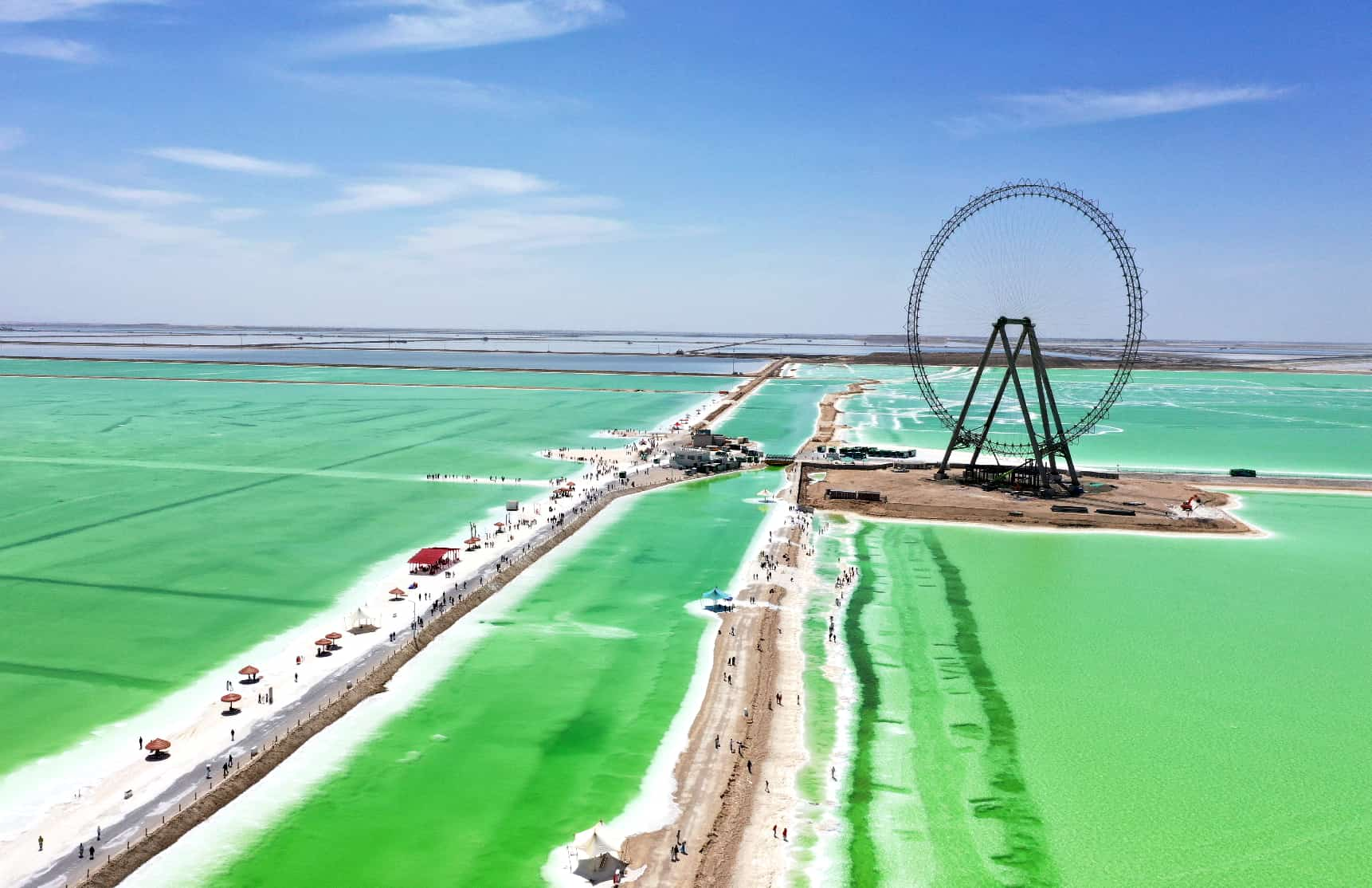
Photo shows a bird's-eye view of the Qairhan Salt Lake in Golmud, Northwest China's Qinghai Province. (Photo/Zhang Zhongping)
"We hope visitors come not only to enjoy the scenery, but also to learn more about the salt lake's resources and culture," Wu said.
As more visitors capture the emerald waters of the Qairhan Salt Lake through their lenses, the salt lake is gaining recognition for far more than its mining heritage.