


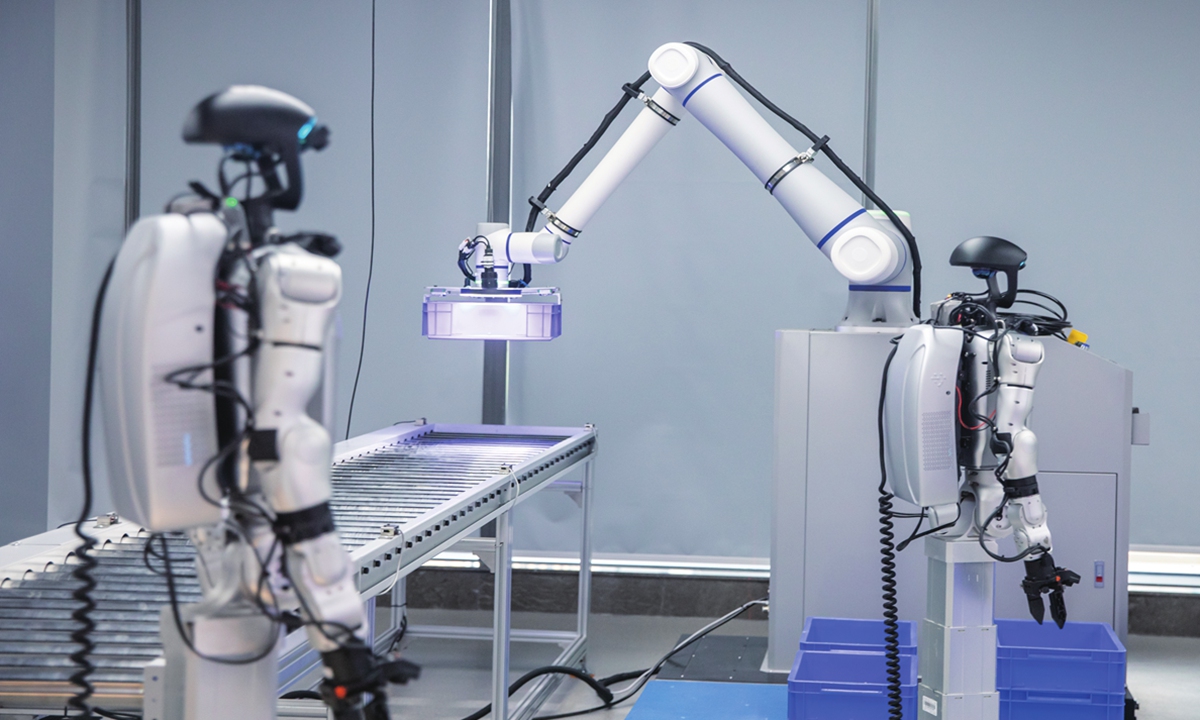
A robot trains for logistics and warehouse operations at an embodied AI demonstration center in Hangzhou, East China's Zhejiang Province, on June 11, 2026. (Photo: VCG)
China will implement the Catalogue of Encouraged Industries for Foreign Investment to guide foreign investment into advanced manufacturing sectors such as organic polymer materials and high-efficiency energy-saving maglev power equipment, as well as modern service industries including humanoid robot R&D and high-end shipping services, an official with China's Ministry of Commerce (MOFCOM) said at a press conference on Thursday.
"We encourage more foreign investment in central and western regions as well as the northeastern region," Meng said. The official said that MOFCOM will roll out measures to encourage foreign-invested service companies to transition toward integrated and digitalized development, promote producer services to extend toward specialization and high-end offerings, and facilitate the quality upgrading of consumer services.
"Furthermore, we will further refine support policies for foreign-invested research and development (R&D) centers, streamline the introduction of more high-level foreign professionals, and step up support for the commercialization of innovative achievements," Meng said.
According to data from the MOFCOM, China's actual utilized foreign investment reached 402.14 billion yuan ($59.4 billion) in the first half of this year, with the decline narrowing by 10.2 percentage points compared to the same period last year. Both May and June recorded year-on-year growth, and the absorption of foreign investment showed a stabilizing and improving trend.
Foreign investors remain bullish on the Chinese market, with nearly 4,800 foreign-funded enterprises increasing their investment in China in the first half of 2026. The structure of inbound investment continued to optimize, with investment in high-tech industries surging by 33.2 percent year-on-year over the period and accounting for 42.4 percent of the total, reaching a historical high, MOFCOM data showed.
"Deepening roots in the Chinese market is an inevitable choice," Li Changan, a professor at the Academy of China Open Economy Studies at the University of International Business and Economics, told the Global Times on Thursday.
Foreign-funded enterprises no longer regard China merely as a sales market and manufacturing base, but increasingly position it as a source of innovation. A complete industrial system, a high-caliber talent pool, and diverse application scenarios have become key pillars underpinning opportunities in China, enabling foreign enterprises to capture new demands, validate new solutions, and pivot to new tracks more swiftly, Li said, expecting inflow of more foreign investment.
Looking ahead to the second half of the year, we will continue to focus on stabilizing, consolidating, and upgrading foreign investment, further cultivate new advantages in attracting foreign capital, and carry out solid work to expand incremental investment, stabilize stock investment, and improve quality, Meng said.
China is committed to high-standard opening-up, with efforts to be made to deepen pilot programs prudently and orderly in opening up sectors such as value-added telecommunications, biotechnology, wholly foreign-owned hospitals, and vocational skills training institutions, the official said.
In addition, efforts will be made to fully implement tax preferential policies for foreign investors who reinvest distributed profits in China. The authorities will roll out measures to support foreign-funded enterprises in further scaling up local production in China, helping them operate well and develop further, Meng said.
We will also optimize services, give better play to the role of key foreign-funded project task forces at all levels, and earnestly ensure national treatment for foreign-funded enterprises - particularly by removing various implicit barriers - to guarantee that foreign-funded enterprises can both "enter the market and do business," the official said.