


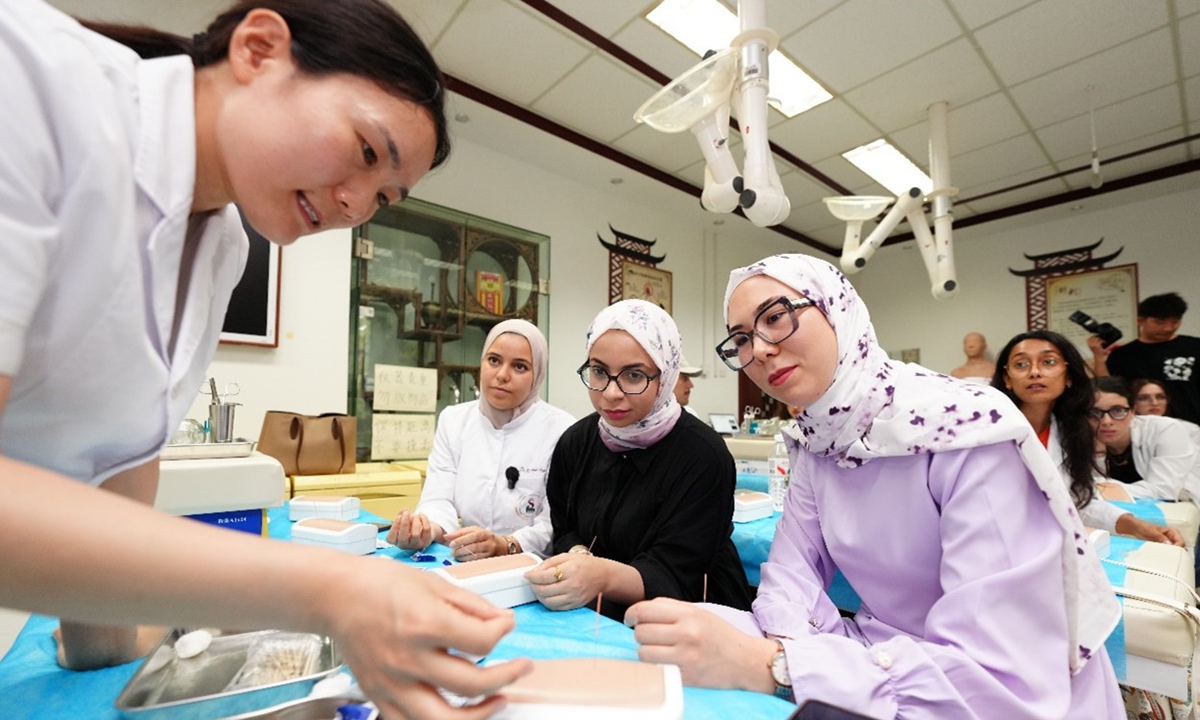
International students from Tunisia learn traditional Chinese medicine techniques under the guidance of an instructor in Tianjin Municipality, North China, on July 14, 2026. (Photo: VCG)
China on Thursday released a new plan for the high-quality development of traditional Chinese medicine (TCM) during the 15th Five-Year Plan (2026-30) period, a move that an expert said will accelerate the modernization and global expansion of TCM while giving overseas patients and international visitors greater access to more standardized, higher-quality services.
The plan comes as China's TCM sector continues to expand. According to a report by The Paper, TCM institutions recorded 1.82 billion patient visits in 2025. Public TCM hospitals provided 0.82 beds per 1,000 people, county-level TCM medical institutions had achieved near-universal coverage, and 96.26 percent of secondary and tertiary public general hospitals had established TCM clinical departments.
The plan will follow the principles and distinctive characteristics of TCM, improve mechanisms for its inheritance and innovation, accelerate its modernization, and promote its development globally, providing strong support for achieving decisive progress in the Healthy China initiative during 2026-30, CCTV reported.
As international interest in TCM continues to grow, a Beijing-based expat told the Global Times that the plan could give fresh momentum to the sector, encouraging more foreigners to visit China for firsthand TCM experiences while also expanding access through greater international cooperation and overseas TCM exchange centers.
Brad, an expat living in Beijing, described TCM as "a big cultural asset with real global demand." He said China is already a global leader in TCM, and many of his friends and family members are interested in visiting the country not only for its food, culture and natural scenery, but also for firsthand TCM experiences. In his view, the new plan will further boost international confidence and interest in TCM, encouraging more people from overseas to explore it firsthand.
On the Chinese social media platform Xiaohongshu, also known as RedNote, many foreigners have shared their experiences of visiting TCM practitioners and receiving traditional treatments. One American user, Lucian George, wrote that TCM has always fascinated him because it is a medical practice that has been around for thousands of years.
In his post, he documented the consultation process, during which the doctor checked his pulse and examined his physical appearance before administering acupuncture and cupping therapy. Describing the cupping cups as a "contraption" on his back, George said he felt deeply relaxed after the treatment.
While highlighting the plan's importance for the domestic healthcare system, Yang said it would also benefit international patients by making TCM services more standardized and accessible. He said China's integrated approach combining TCM and Western medicine represents a distinctive "China solution" in healthcare, with TCM offering unique advantages in treating chronic and complex diseases through both herbal medicine and non-drug therapies such as acupuncture, moxibustion and therapeutic manipulation.
The plan also calls for greater international cooperation and the establishment of more overseas TCM exchange centers. As the plan is implemented, Yang said, people overseas, including foreign patients and Chinese communities abroad, as well as international visitors to China, will have greater access to higher-quality TCM services.
According to CCTV, the plan aims to establish a more comprehensive TCM service system covering the entire population and all stages of life by 2030. It also sets goals of achieving new breakthroughs in the prevention and treatment of major diseases, improving grassroots TCM services, strengthening basic research, boosting innovation in the Chinese medicine industry, and further enhancing the global influence of TCM, with the ultimate goal of making TCM services more widely accessible.
The plan also serves as an important guide for grassroots hospitals and clinicians, particularly TCM practitioners. With the national blueprint in place, grassroots hospitals will be able to develop their own TCM development plans in line with national requirements while adapting them to local conditions, the Global Times learned from Yang Kexin, a vice president of Wangjing Hospital of the China Academy of Chinese Medical Sciences, on Thursday.
Yang said that, from his perspective as a frontline clinician, three key themes stand out in the newly released TCM development plan: inheritance, innovation and scientific research.