


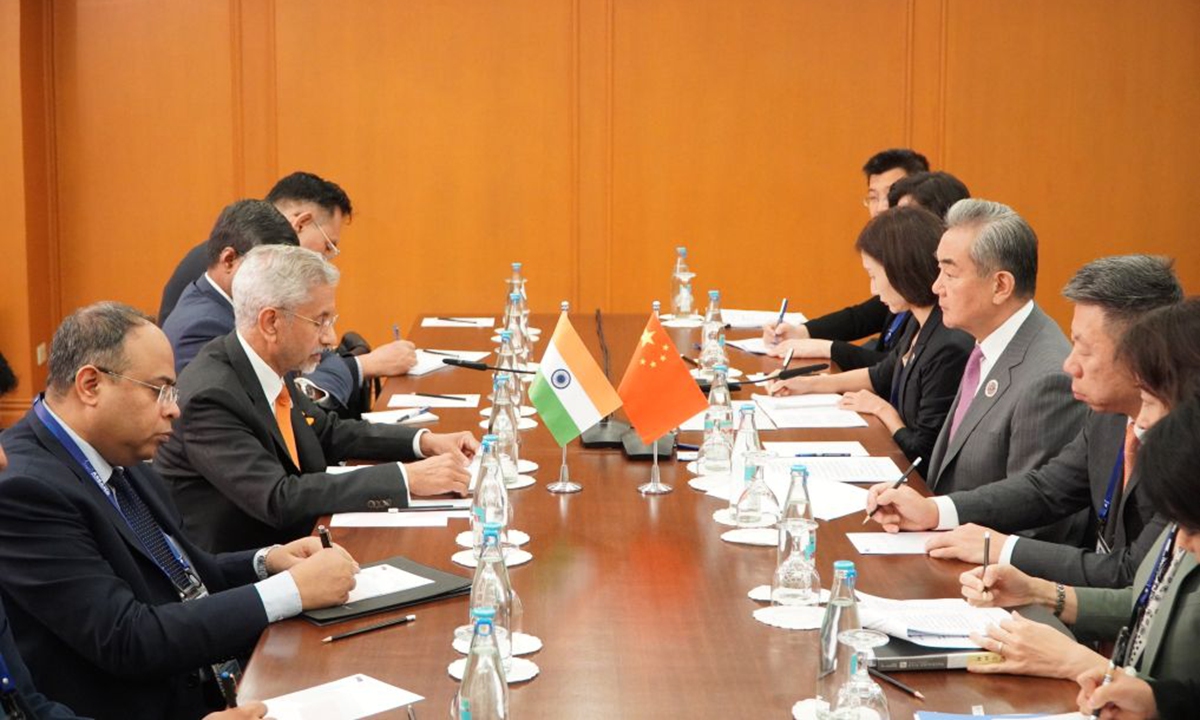
Chinese Foreign Minister Wang Yi, also a member of the Political Bureau of the Communist Party of China Central Committee, meets with Indian External Affairs Minister Subrahmanyam Jaishankar in Manila, the Philippines, July 22, 2026. (Photo: Xinhua)
China stands ready to work with India to implement the important common understandings reached by the leaders of the two countries, maintain close high-level exchanges, strengthen cooperation in areas including economy and trade, media, and people-to-people and cultural exchanges, and properly handle sensitive issues, Chinese Foreign Minister Wang Yi said on Wednesday, according to a readout released by Chinese Foreign Ministry earlier on Thursday.
Wang, also a member of the Political Bureau of the Communist Party of China Central Committee, made the remarks when meeting with Indian External Affairs Minister Subrahmanyam Jaishankar.
Chinese experts noted that these remarks clearly outlined the current trajectory of China-India relations, which have overcome difficulties, seen an overall improvement and stabilization, and are advancing practical cooperation.
Wang said China and India should bear the well-being of humanity in mind, demonstrate a sense of responsibility as major countries, consolidate the positive momentum in bilateral relations, and strengthen coordination and cooperation in international and regional affairs.
He called on the two countries to make positive contributions to advancing multipolarity and greater democracy in international relations.
China will continue to support India in hosting a successful BRICS summit this year, Wang added.
According to Xinhua, Jaishankar said that India's positions on issues concerning Taiwan and Xizang have not changed, and India respects China's sovereignty. He added that India has consistently advanced a positive and cooperative bilateral relationship with a forward-looking approach.
The meeting between the two foreign ministers was the latest in a series of recent high-level interactions between China and India, and was held in a highly positive tone. The focus was on consolidating the strategic consensus reached by the leaders of the two countries and mapping out future cooperation, injecting new momentum into bilateral ties, Lan Jianxue, director of the Department of Asia-Pacific Studies at the China Institute of International Studies, told the Global Times.
Chinese foreign minister reviewed the past development of China-India relations while also outlining the "correct way for the two countries to get along." He stressed that the improvement of China-India relations was hard-won and should be cherished. Taking a broader global perspective and elevating the strategic dimension, Wang highlighted the need for China and India, as representatives of emerging economies, to strengthen "greater BRICS cooperation" amid "profound changes unseen in a century" and the rise of the Global South, reflecting the shared interests of the two countries within multilateral frameworks, Lan said.
Earlier, India has offered various signals of an intention to strengthen economic cooperation with China. Rakesh Mohan, a part-time member of Indian Prime Minister Narendra Modi's Economic Advisory Council, said New Delhi should use its low-cost manufacturing base to attract investment from Chinese companies instead of relying mainly on protectionist measures. Such a strategy, he said, could help create jobs, strengthen exports and make India more competitive in global supply chains, according to The Economic Times.
China and India have taken various measures to rebuild strategic trust and promote the recovery of bilateral ties in recent years, Qian Feng, director of the Research Department at Tsinghua University's National Strategy Institute, told the Global Times on Thursday.
Experts noted that India last year resumed issuing tourist visas to Chinese citizens, simplified procedures for technology and business visas, and agreed to resume direct flights in October.
Meanwhile, China has also made a series of goodwill gestures, including resuming Indian pilgrims' visits to Mount Gang Renpoche and Lake Mapam Yun Tso in Xizang, and adjusting visa policies to facilitate people-to-people exchanges, experts said.
Regarding Jaishankar's remarks, Lan noted that they were generally positive, clearly stating that India's position on issues including Taiwan and Xizang had not changed and that India respects China's sovereignty. This was undoubtedly an important positive signal from the Indian side. At the same time, Jaishankar stressed the need to "maintain peace and stability along the border and properly handle differences", showing that India also recognizes the need to pursue cooperation while managing divergences, Lan stressed.
Qian particularly highlighted Jaishankar's reaffirmation of the positioning of China and India as "partners rather than rivals" and his emphasis that China-India relations carry regional and global significance. "This shows that the Indian government views bilateral ties from a strategic perspective and is willing to work with China in both bilateral and multilateral areas, creating a positive atmosphere for the continued improvement of relations," expert said.