


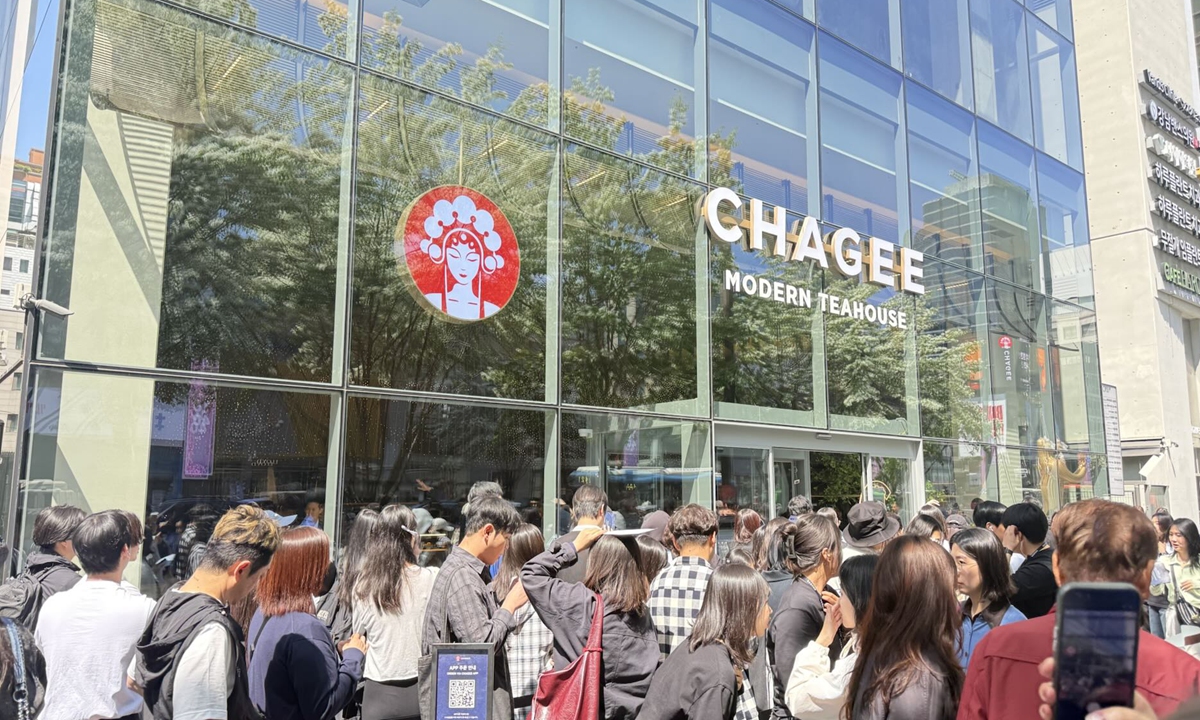
Consumers queue at a Chinese milk tea brand store in Gangnam, Seoul, South Korea on April 30, 2026. (Photo: Courtesy of Chagee)
Amid surging cross-border travel fueled by China's visa-free entry for South Korean sightseers, authentic Chinese food brands from new-style milk tea chains to hot pot outlets have emerged as a fresh cultural bridge between the two peoples.
On bustling Nanjing Road in Shanghai, a staff member from Chinese milk tea brand Chagee told the Global Times that visitors from South Korea have become frequent customers eager to experience unique Chinese tea flavors.
"The brand has just launched three stores in Seoul, and they are extremely popular. It is not uncommon for people to wait as long as five hours for a cup, which is why I listed this stop as a must-see during my trip to Shanghai," Lee, a visitor from South Korea who ordered the shop's signature jasmine green milk tea, told the Global Times.
She said that South Korea boasts a pervasive coffee culture with locals drinking iced Americanos daily, yet more young South Koreans have taken a liking to Chinese-style milk tea after trying it on their trips to China.
Chagee marks the latest milestone in South Korea's growing consumer interest toward authentic Chinese flavors. Chinese tea chains including Mixue, Chabaidao and Heytea had already opened stores across South Korea before Chagee, according to Korea Herald.
Cultural bridgesThe trend extends far beyond milk tea. The Korea Herald reported that malatang, the customizable spicy broth, entered South Korea's mainstream lunch menus in the late 2010s, followed by Chinese hot pot chains. Meanwhile, tanghulu, a traditional Chinese candied fruit skewer, became a viral street food across South Korea in 2023, underscoring the surging popularity of Chinese catering culture among South Korean consumers.
The rising popularity of Chinese food and beverage brands in South Korea represents far more than temporary success. It signals a new phase of bilateral consumption exchanges, in which Chinese firms are delivering youth-oriented consumption experiences, social value and emotional connection, market analysts said.
A Chinese national working in Seoul surnamed Xue told the Global Times that the core competitiveness of Chinese food brands in South Korea no longer relies on price advantages, but hinges on emotional and cultural connectivity, among young people in particular.
"Older generation mostly associate Chinese food with affordable, casual options like lamb skewers and Zhajiangmian. In contrast, younger generations are widely exposed to and fascinated by diverse authentic Chinese offerings and they actively share their dining experiences on Instagram," Xue said.
Chosun Biz reported that waitlists for Chinese hot pot chain Haidilao exceed 300 guests at certain outlets, with customers queuing for more than two hours to get a table.
Customers are attracted by the fun of selecting various ingredients and creating their own customized flavor combinations. Interactive performances, birthday celebrations and traditional noodle shows further set it apart from local competitors, according to the report.
"As a shared, interactive dining style that encourages diners to gather, select ingredients and communicate throughout the meal, Chinese hot pot offers a relaxing, engaging social experience that fits well with youngsters' preference for friend and family gatherings," a representative of Haidilao told the Global Times.
People-to-people exchangesXue observed another notable change: the South Korean market now places far greater emphasis on distinctive Chinese food flavors.
"Today even simple Chinese boxed lunch shops can build a good reputation quickly as long as they offer unique tastes," Xue said.
Against the backdrop of consumption upgrading and digital platform expansion, China is witnessing a new outward flow of its cultural consumption. The shift also comes as the visa-free travel policy has helped facilitate cross-border trips, encouraging more South Koreans to visit China and gain firsthand, authentic cultural experiences.
As more South Koreans get exposed to Chinese urban culture and homegrown brands that were once unfamiliar to them, these offerings have become increasingly accessible and familiar to young South Korean consumers.
People-to-people exchanges between South Korea and China have continued to pick up pace, driven by visa-free entry policies, rising mobility and expanding cultural interaction. Since China introduced the visa-free policy for South Korean citizens in November 2024, cross-border travel has increased significantly.
According to official figures, about 3.16 million South Korean visitors traveled to China in 2025, up 36.9 percent from a year earlier, marking the highest growth rate among major outbound destinations for South Koreans, according to the Korea Times.
The surge in exchanges is also clearly visible in the aviation sector. Korean Air's 2025 year-end report indicated a marked rise in passenger numbers on China-bound routes, with flights to Shanghai, Beijing and Qingdao in East China's Shandong Province all recording substantial increases on a yearly basis, the Xinhua News Agency reported.
Jeon Hong-jin, a visiting professor at Yanbian University, told the Global Times that the trend reflects the rising competitiveness of Chinese consumer brands and the growing attractiveness of Chinese culture in the world, as well as deeper people-to-people exchanges between the two countries.
The expert noted that China-South Korea cultural exchanges have gone beyond films, dramas, pop music and other forms of entertainment, now taking root in daily life through food, consumer brands and lifestyles. Consumption-led youth exchanges tend to build genuine emotional bond.
"Both nations should deepen cooperation in culture, tourism, youth engagement and brand collaboration to boost two-way exchanges of goods, services and culture. These efforts will strengthen mutual friendship among young people and support healthy, stable and long-term bilateral relations," Jeon said.