


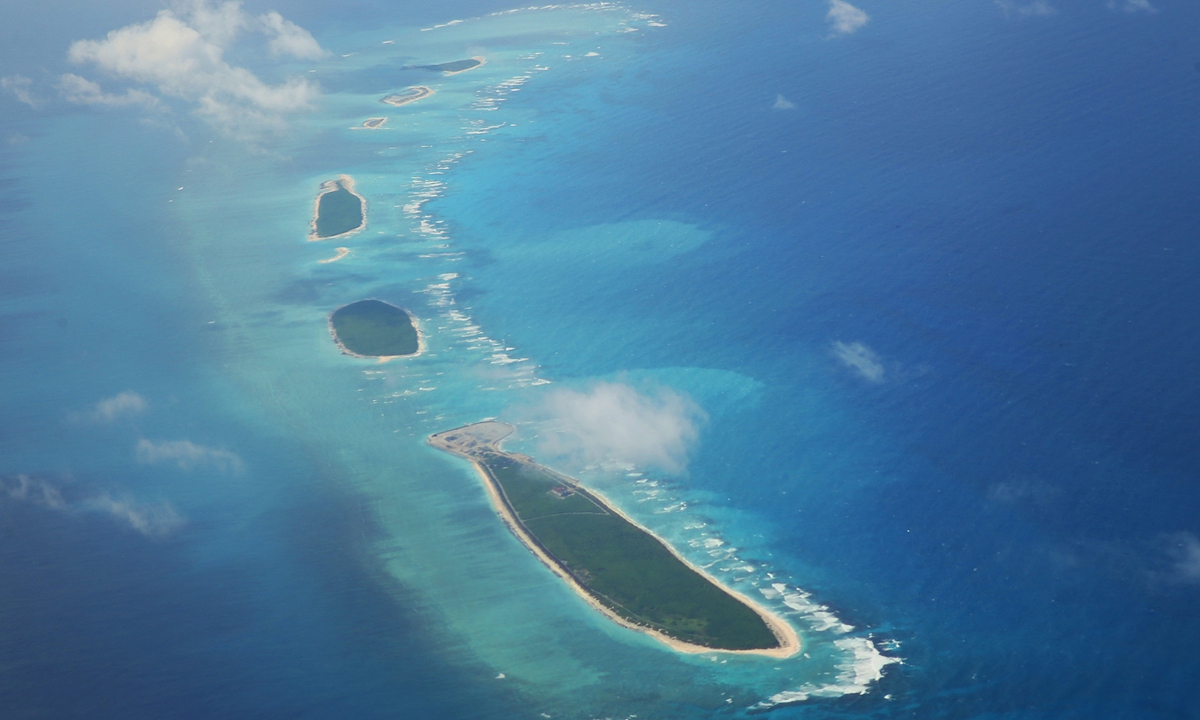
South China Sea Photo: VCG
The Chinese People's Liberation Army (PLA) Southern Theater Command on Sunday slammed the Philippines for drawing countries from outside the region into so-called joint patrols in the South China Sea, warning that such moves disrupt regional peace and stability.
The statement came after the Philippines concluded five days of joint maritime exercises with the US and Japan, amid an increased presence of US military assets in the region.
According to the official WeChat account of the PLA Southern Theater Command (STC), Senior Captain Zhai Shichen, spokesperson for the command, stated that "on July 26, naval and air units of the PLA STC conducted a routine patrol in the South China Sea."
In an attempt to stir up troubles in the South China Sea, the Philippines co-opted countries outside the region to conduct so-called joint patrols, disrupting peace and stability in the region. Forces of the STC will resolutely safeguard China's territorial sovereignty and maritime rights and interests, and firmly uphold regional peace and stability, Zhai said in the statement.
The Armed Forces of the Philippines (AFP), the Japan Maritime Self-Defense Force and the US Pacific Command conducted the 17th Multilateral Maritime Cooperative Activity from July 21 to 25, according to Philippine News Agency, citing the AFP.
The agency claimed the drills were conducted "amid renewed tensions between Manila and Beijing" over an incident near Ren'ai Jiao. Participating Philippine vessels included the BRP Antonio Luna (FFG-15), a Philippine Navy AW 109 helicopter among other equipment. Two Philippine Coast Guard vessels, the BRP Melchora Aquino (MRRV-9702) and the BRP Malabrigo (MRRV-4402).
The US sent the USS Santa Barbara (LCS-32), an MH-60S helicopter, and a P-8A maritime patrol aircraft, while Japan deployed the destroyer JS Yuudachi (DD-103). The drills included communication exercises, replenishment-at-sea operations, division tactics and fly-by operations, according to the Philippine News Agency.
The agency quoted AFP as claiming that the exercise demonstrated the participants' "enduring partnership" and AFP's commitment to freedom of navigation and overflight, while deterring what the Philippine military called "illegal, coercive, aggressive, and deceptive activities" in the South China Sea.
The continuation of such exercises represents a dangerous departure from the proper course of China-Philippines relations, Yang Xiao, a research professor at the Institute of Peaceful Development under the Chinese Academy of Social Sciences, told the Global Times on Sunday.
By repeatedly provoking confrontations and creating instability, the Philippine military is seeking opportunities to expand its forces and authority, increase military spending and obtain more external military assistance, Yang said.
Such actions will only have negative effects on China-Philippines relations and further destabilize the South China Sea, he said.
The drills coincided with the deployment of the George Washington Carrier Strike Group to the South China Sea. According to USNI News, the carrier strike group entered the waters after transiting the Luzon Strait on Wednesday. It comprises the aircraft carrier USS George Washington, with Carrier Air Wing 5 embarked, the cruiser USS Robert Smalls, and the destroyers USS Benfold and USS Shoup.
The USS Santa Barbara, which participated in the trilateral exercises, is on a rotational deployment in the US 7th Fleet area of operations, according to USNI News.
The US Embassy in the Philippines added to the tensions with a social media post on Sunday. Quoting US Ambassador Lee Lipton, it claimed: "The USS George Washington Carrier Strike Group's advanced capabilities, including the F-35, are upholding FREEDOM of Navigation and Overflight in the South China Sea. We challenge excessive maritime claims around the world."
Yang said the Philippines, the US and Japan have conducted repeated military exercises in the South China Sea since the beginning of the year. Through this continuous cycle of drills, the US military is seeking to normalize the deployment of offensive weapons in the Philippines and turn the country into a forward operating position, transforming the previously peaceful South China Sea into a potential powder keg, he said.
Washington should prevent military adventurism from creating destructive or accidental uncertainties, avoid further regional instability, he added.