


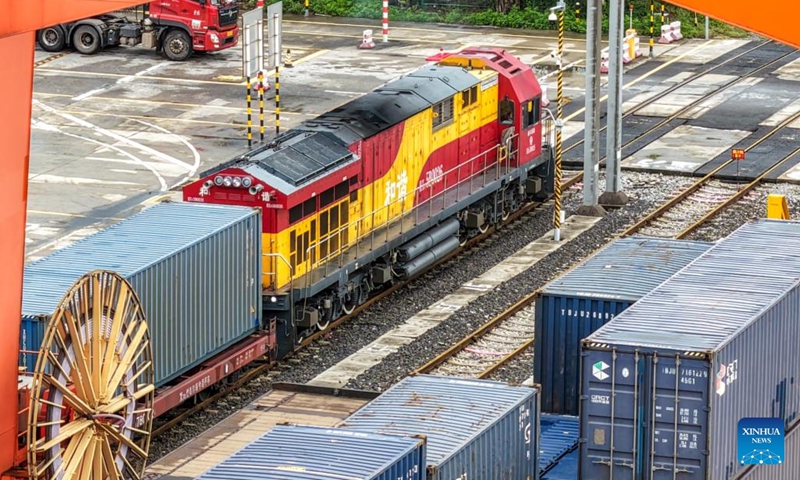
A drone photo taken on Sept. 13, 2025 shows a freight train bound for Central Asia loaded with auto parts, laptops and other goods waiting for departure at Tuanjiecun Station in Chongqing, southwest China. (Photo: Xinhua)
The total trade of the "13+2" provinces, autonomous regions, and cities along the New International Land-Sea Trade Corridor via the corridor reached 517.23 billion yuan ($76.38 billion) in the first six months this year, exceeding 500 billion yuan for the first time, the Xinhua News Agency reported on Sunday.
The New International Land-Sea Trade Corridor takes Southwest China's Chongqing Municipality as its operation and organization center and the western provinces and autonomous regions as key nodes. Utilizing railways, sea transport, highways, and other modes of transportation, it runs southward via coastal and border ports in South China's Guangxi Zhuang Autonomous Region, Southwest China's Yunnan Province, and other regions to reach destinations around the world.
This has formed the "13+2" cooperation and co-construction mechanism, which comprises the 12 western provinces, autonomous regions and municipality, South China's Hainan Province, as well as Zhanjiang in South China's Guangdong Province and Huaihua in Central China's Hunan Province.
An official from Chongqing Customs said that the corridor connects rivers to seas and links the interior smoothly with the outside world. Its role in expanding high-level opening-up, enhancing the resilience of industrial and supply chains, and facilitating both domestic and international dual circulation is becoming increasingly prominent, Xinhua reported.
The corridor connects the Silk Road Economic Belt in the north with the 21st Century Maritime Silk Road in the south, coordinating with the Yangtze River Economic Belt and playing a crucial role in China's coordinated regional development strategy. Since its pilot run in 2017, the corridor has evolved into a strategic route linking China's inland regions with the markets of ASEAN countries and other parts of the world.
"Over the past several years, the corridor has played an important role in strengthening trade, people-to-people exchanges, and investment between China's southwestern region with ASEAN. It has turned the western region into the frontier of the country's opening-up," Gu Xiaosong, dean of the ASEAN Research Institute of Hainan Tropical Ocean University, told the Global Times on Sunday.
Far beyond being a mere transport link, the corridor serves as a golden lifeline strengthening industrial and supply chain resilience, Gu said.
According to China Railway Nanning Bureau Group Co, freight train services on the New International Land-Sea Trade Corridor transported a cumulative total of 660,000 20-foot equivalent units (TEUs), averaging 110,000 TEUs a month. Container volume in the second quarter grew by 3.6 percent quarter-on-quarter, indicating that market demand for transportation remains robust.
On July 1, three more regular scheduled freight routes were added to the corridor, bringing the total number of scheduled routes to 52. This further expands Guangxi's logistics network connecting central and western regions such as Yunnan, Chongqing, and Southwest China's Sichuan Province.
China's Pinglu Canal, a key project on the New International Land-Sea Trade Corridor, completed water impoundment on June 3.
"After entering operation in September, the canal will effectively shorten the transport time for cargo from China's inland western regions to countries in the region, reduce logistics costs, and improve trade and investment efficiency. Thereby, it will further enhance Guangxi's capacity to connect with the ocean and serve regional development, and help the southwestern region integrate into China-ASEAN cooperation at a higher level," Gu said.