


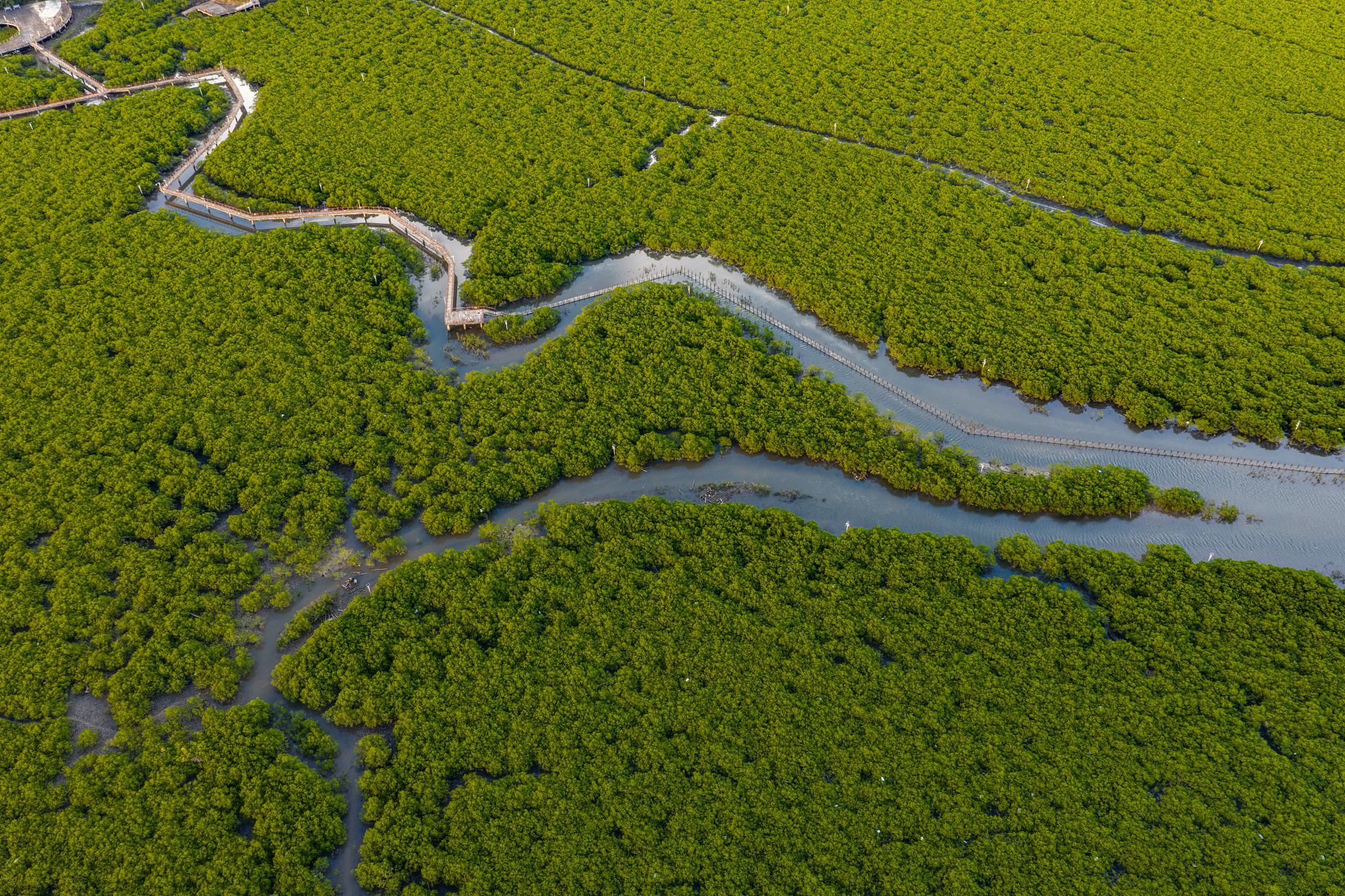
A view of the thriving mangrove forest at the Dongwan Mangrove Scenic Area in Fangchenggang, south China's Guangxi Zhuang Autonomous Region, September 16, 2025. (Photo: VCG)
China has planted and restored around 22,500 hectares of mangroves since 2020, including 11,600 hectares of newly planted forests, making it one of the few countries worldwide where mangrove coverage is increasing, the Ministry of Natural Resources and the National Forestry and Grassland Administration said on Sunday.
The announcement coincided with International Day for the Conservation of the Mangrove Ecosystem, observed annually on July 26 under a UNESCO designation.
Lin Cunyan, an official with the ministry's department of ecological restoration of land and space, said the newly planted area exceeded the 9,050-hectare target set under a special action plan for mangrove protection and restoration (2020-25).
"The 2025 national land use change survey revealed that China's mangrove area has reached 31,700 hectares, marking an increase of about 44 percent since the early 2000s. Alongside this expansion, the quality, stability and carbon sequestration capacity of mangrove ecosystems have significantly improved," Lin said.
Mangroves are globally important coastal wetland ecosystems. Often dubbed "coastal guardians", they help buffer shorelines against waves and storms, filter seawater, and provide critical habitats for marine life and migratory birds, making them vital for maintaining marine ecological balance and biodiversity.
According to Lin, more than 90 percent of China's mangroves are now protected under the country's ecological protection red line, a zoning mechanism that restricts development in ecologically sensitive areas.
He added that the legal framework was also strengthened by the Wetland Protection Law, which came into effect in 2022, as well as the revision to regulations on nature reserves enacted this year, further improving the standardization and science-based management of mangrove conservation and restoration.
Beyond ecological protection, coastal regions are exploring methods to convert mangrove conservation into economic value.
"Whether in Zhanjiang, Guangdong province, or Xiapu, Fujian province, many coastal areas have been advancing mechanisms to realize the value of mangrove carbon credits," Lin said.
He said other approaches include judicial carbon credit schemes, whereby courts require environmental offenders to finance mangrove planting as ecological compensation, as well as integrated models that combine mangrove conservation with aquaculture. In addition, science education programs and ecotourism have also been developed along mangrove coastlines.
Both the ministry and administration are drafting a new mangrove conservation action plan for 2026-30.
Ji Wenyuan, an official with the wetland management department of the National Forestry and Grassland Administration, said the plan will guide local restoration efforts, safeguard ecological security boundaries, clarify management responsibilities and consolidate the achievements made under the current action plan.