


New canal floats more trade opportunities with ASEAN
NANNING, July 27 (Xinhua) -- The Pinglu Canal is expected to shorten transport time, lower logistics costs and strengthen connectivity between China's western inland regions and Southeast Asia, ASEAN diplomats said during a recent visit to south China.
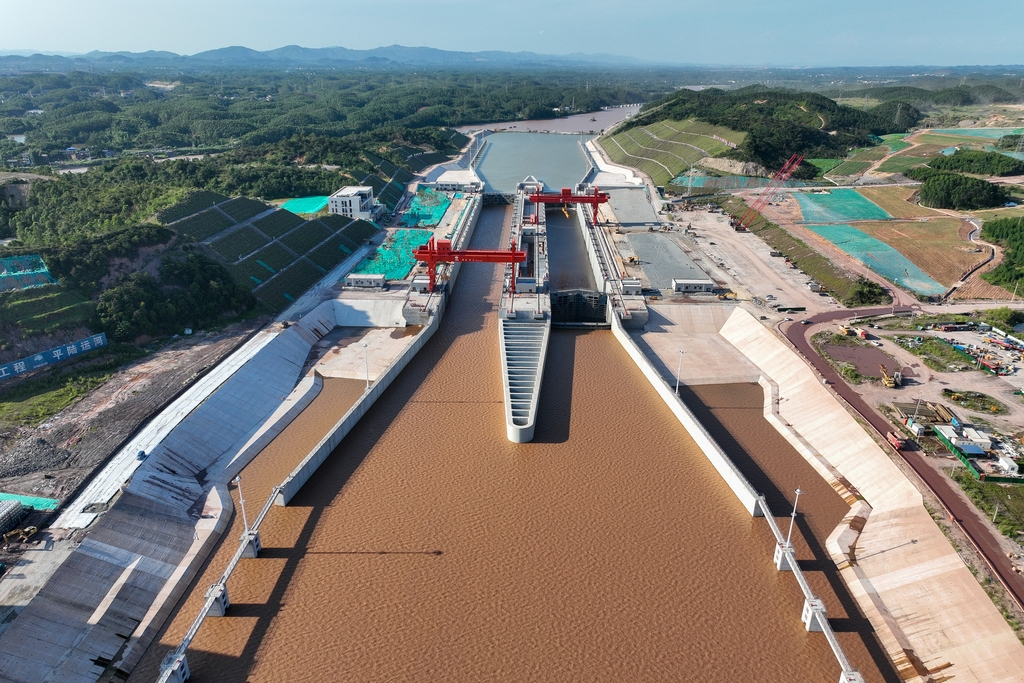
File photo: IC
Diplomats from ASEAN countries visited Guangxi Zhuang Autonomous Region from July 22 to 23, at the invitation of the regional government. They toured the Pinglu Canal, which is scheduled to open to navigation in September, as well as the Beibu Gulf Port and other projects supporting regional connectivity and industrial cooperation.
With total investment of more than 70 billion yuan (about 10.7 billion U.S. dollars), the 134.2-km Pinglu Canal is China's first major river-to-sea canal project planned and coordinated at the national level since 1949.
The canal starts at the mouth of the Pingtang River in Hengzhou City, passes through Luwu Town in Lingshan County and runs along the Qinjiang River into the Beibu Gulf. It achieved full-channel connectivity in June, entering the final phase ahead of its expected opening.
Capable of accommodating 5,000-tonne vessels, the canal is expected to shorten the inland waterway journey for cargo from southwest China by about 560 km compared with the route via the Guangzhou Port.
Vietnamese Ambassador to China Pham Thanh Binh said the project demonstrates China's technological capabilities and its determination to advance regional connectivity.
The canal will work in synergy with ports, railways and roads, extending its significance beyond the waterway itself.
Singaporean Consul-General in Guangzhou Cindy Wee said the canal, once operational, would shorten transport time for goods from China's western inland regions to ASEAN countries, reduce logistics costs and improve the efficiency of trade and investment. She expected it to further promote trade between China and Southeast Asia.
Lao Ambassador to China Somphone Sichaleune expressed the hope that the China-Laos Railway and other transport facilities could be linked with the canal, which would enable more regional transport corridors to become interconnected.
Myanmar Ambassador to China U Zaw Win Myint praised the project's construction efficiency, approach to ecological protection and vision for regional connectivity. The project includes dedicated wildlife crossings, ecological corridors for birds and fish migration passages.
At the regional level, the Pinglu Canal is a backbone project of the New International Land-Sea Trade Corridor, which has evolved into a strategic route linking China's inland regions with ASEAN and other global markets.
The corridor's rail service handled a record 1.425 million 20-foot equivalent units of cargo in 2025, up 47.6 percent year on year. As of early July, its network reached 593 ports in 128 countries and regions.
China-ASEAN trade reached 1.05 trillion U.S. dollars in 2025, surpassing the one-trillion-dollar mark for the first time, official data showed.
At the Qinzhou Port area of Beibu Gulf Port, automated quay cranes lift containers, while unmanned transport vehicles move through the terminal. The diplomats observed the smart port's operations and learned about the development of the New International Land-Sea Trade Corridor.
Beibu Gulf Port's annual container throughput surpassed 10 million TEUs in 2025, while the number of its container shipping routes reached 100.
The diplomats later visited a comprehensive cold-chain logistics base at Qinzhou Port to learn how specialty agricultural products from ASEAN countries are stored, processed and distributed. In 2025, Qinzhou Port, a key hub of the trade corridor, had 44 shipping routes serving ASEAN countries.
Cambodian Ambassador to China Soeung Rathchavy said her country is also developing the Funan Techo Canal and described both canals as major projects connecting inland areas with the sea. She expressed the hope that the two landmark projects would complement each other and advance bilateral and regional cooperation.
The 172.6-km Funan Techo project stretches from the Mekong River's Preak Takeo tributary in southern Kandal province to the sea in southwestern Kep province, traversing Takeo and Kampot provinces.
Pham said the development of the Pinglu Canal and the New International Land-Sea Trade Corridor, together with deeper practical cooperation in various fields, would strengthen connectivity between China and ASEAN countries, including Vietnam, and provide new momentum for the rapid and sustainable growth of ASEAN-China economic cooperation.