


AI laser weeder transforms soybean farming in Heilongjiang, NE China
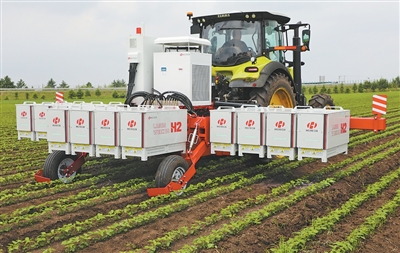
An AI-powered laser weeder works in the field in Hongwei village, Tongquan township, Mingshui county, northeast China's Heilongjiang Province. (Photo courtesy of the Publicity Department of the Communist Party of China Mingshui County Committee)
Black soybean fields are flourishing in Hongwei village, Tongquan township, Mingshui county, northeast China's Heilongjiang Province. A high-horsepower tractor moves steadily through the rows, pulling an AI-powered laser weeder. Beneath the machine, slender blue laser beams sweep across the crop rows, burning away weeds while leaving the soybean seedlings unharmed.
Walking alongside the machine, Liu Yunhong, head of an agricultural cooperative, stops to inspect its work. She picks up a barnyard grass plant that has just been struck by the laser. Its growing point is already scorched, while the soybean plants beside it remain lush and healthy.
Weed control has long been one of the biggest challenges for local farmers. More than a dozen species compete with soybean crops, requiring three or four rounds of weeding each season. In the past, a farmworker could clear just 1 mu (0.067 hectares) a day, at a labor cost of around 200 yuan ($30).
Last year, Harbin Huagong Zhiyun Technology Co., Ltd. approached Liu about testing its AI-powered laser weeding technology at one of her farms.
"The system relies entirely on physical weed control without using a single drop of herbicide, which is exactly what we needed," Liu said.
Over the past year, Liu worked closely with the company's R&D team, conducting repeated field trials and helping refine the AI model. She collected local weed samples for the researchers and spent countless hours in the fields with engineers, fine-tuning the system.
This year, the AI-powered laser weeders entered large-scale commercial use.
Jiang Yunfeng, manager of the company's agronomy department, monitors the machine through an operating tablet that displays real-time data, including detected plants, weeds removed and area covered.
Equipped with high-definition cameras and a high-performance edge computing platform, the system scans plants more than 1,000 times every second. Within milliseconds, the AI model distinguishes crops from weeds, keeping crop damage below 0.1 percent.
The machine is also equipped with a self-developed high-precision positioning system that keeps it accurately aligned with crop rows, even in irregular fields. Its terrain-adaptive robotic chassis enables stable operation across a wide range of field conditions.
The improvement in efficiency is even more remarkable. A single machine can weed nearly 100 mu a day, almost 100 times the productivity of manual labor. Operating it requires little training.
"It's just like using a smartphone or tablet," said Pan Zhiyuan, an operator at the cooperative who mastered the system after only an hour of training. "You simply select the appropriate crop model."
According to Liu, the machine has cut weeding costs by more than half while boosting yields by 10 to 30 percent.
"Organic black soybeans sell for about three times the price of conventional ones," Liu said. In the past, it was difficult to expand organic farming and secure stable high-end orders. Now, laser weeding gives growers the confidence to scale up production.
Under a cooperation agreement, Harbin Huagong Zhiyun Technology Co., Ltd. and Mingshui county will establish a large-scale demonstration zone for AI-powered laser weeding, creating a replicable model for smart agriculture and supporting the green development of farming across the region's fertile black soil.