


The "2026 Development Report of Shanghai International Financial Center", compiled by the Office for Advancing the Development of the Shanghai International Financial Center, has recently been published.
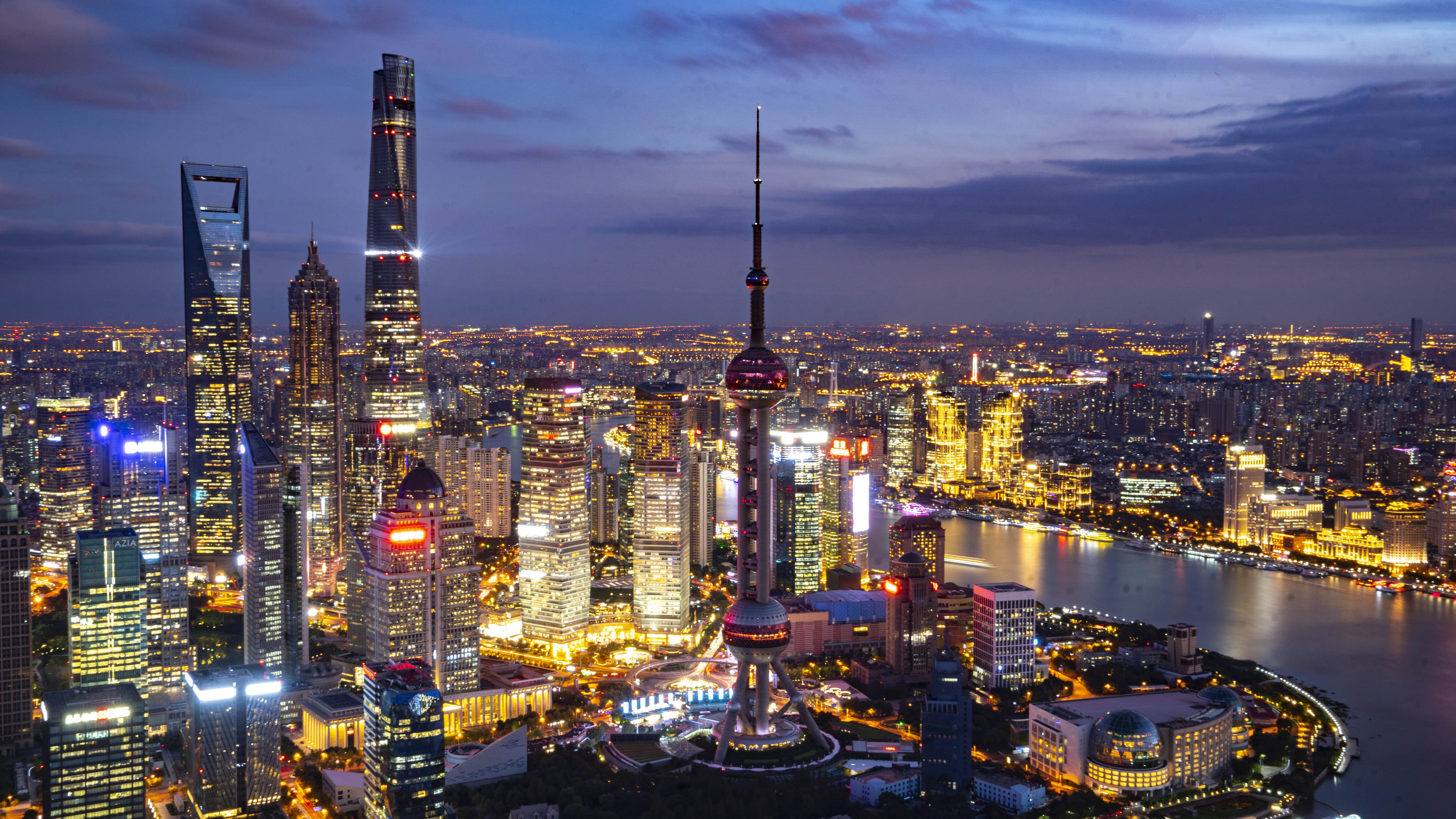
A night view of Shanghai, east China. (File photo: Xinhua)
A strong international financial center is one of the defining pillars of a leading financial nation. Building Shanghai into a world-class international financial center is a key hallmark of China's broader ambition to become a global financial powerhouse.
In 2025, trading volume across Shanghai's financial markets reached 4,059 trillion yuan, with key market indicators remaining among the world's leading. Cross-border renminbi receipts and payments accounted for 46 percent of the national total, maintaining Shanghai's position as the country's largest hub for cross-border renminbi transactions. The city is also home to about 70 percent of China's foreign-funded asset management institutions, while foreign-invested firms account for nearly one-third of all financial institutions operating in Shanghai. Released as China enters the first year of its 15th Five-Year Plan period (2026-2030), the report chronicles Shanghai's financial development in 2025, a pivotal year linking the two planning periods.
The report goes beyond reviewing Shanghai's progress to address a key question of international interest: as globalization undergoes profound change, how can an international financial center support the real economy at home while integrating more deeply into the global financial network?
The report is framed around the objectives of the 15th Five-Year Plan period, which aim to make Shanghai a global center for renminbi-denominated asset allocation and risk management by 2030, laying the foundation for the city to become, by 2035, a strong international financial center commensurate with China's overall national strength and global influence. It notes that during the 14th Five-Year Plan period, Shanghai focused on attracting financial institutions, building institutional frameworks, and expanding the scale of its financial markets. During the 15th Five-Year Plan period, the emphasis will shift toward strengthening core functions, enhancing the city's financial capacity, and improving the financial ecosystem, marking a transition from factor aggregation to delivering global financial functions.
These ambitions are backed by a solid foundation. In financial markets, reforms under the STAR Market's "1+6" framework have been implemented, a technology innovation board has been launched in the bond market, and the city's green finance standards system is taking shape. In terms of institutional opening-up, a pilot program for comprehensive reform of offshore trade finance services has been launched in the Lin-gang Special Area, while the Shanghai International Reinsurance Center has attracted 32 institutions. On connectivity, Shanghai has deepened cooperation with Hong Kong to build a more integrated dual-city international financial hub.
The report conveys a clear message: Shanghai is taking a distinctive approach to developing itself as an international financial center. Anchored by the internationalization of the renminbi and underpinned by institutional opening-up, the city is neither seeking to replicate the models of New York and London nor measure itself against other global financial centers. Instead, it is focused on strengthening its functions and upgrading its capabilities.
The report also suggests that Shanghai is writing a different story from traditional financial centers. Rather than chasing rankings, it is focused on deepening financial functions. Rather than replicating established models, it is defining its own model of development. As Shanghai moves toward its goal of becoming a strong international financial center by 2035, its legacy may extend beyond its own achievements to include a model of institutional opening-up that other financial centers may draw on.