



Two cleaners from the Luqiao district in Taizhou, East China's Jiangsu Province, carry out routine river cleanup on June 4, 2026, ahead of World Environment Day falling on June 5. (Photo: VCG)
With less than three weeks remaining before China's Ecological and Environmental Code takes effect on August 15, the country's environmental authorities are reviewing and revising more than 500 existing legal and policy documents, while expanding the use of artificial intelligence to speed up environmental damage assessments.
The Ministry of Ecology and Environment (MEE) said on Tuesday that it is reviewing, amending and repealing more than 30 administrative regulations, over 80 departmental rules and more than 400 normative documents to ensure that they align with the code before it takes effect.
"The life of a code lies in its implementation, and so does its authority," Zhao Ke, director of the Department of Laws, Regulations and Standards of the MEE, said during the press conference.
The code, adopted in March and set to take effect on August 15, China's National Ecology Day, will bring together rules covering pollution prevention and control, ecological conservation, green and low-carbon development, environmental risk management, and legal liabilities.
According to Zhao, ecological and environmental authorities will be responsible for implementing around 75 percent of the matters covered by the code. The term "ecological and environmental authorities" appears 380 times in the legal text, he noted, making the MEE and local environmental departments its principal implementing bodies.
The ministry has therefore entered what Zhao described as a period of intensive preparation. Its work includes reviewing related regulations, improving supporting systems, revising standards, deepening reforms to the ecological and environmental damage compensation system, and expanding public awareness activities.
The review is intended to ensure that existing rules are consistent with the code and that no regulatory gaps emerge during the transition.
Zhao said that once the code takes effect, ecological and environmental authorities at all levels will be required to apply its provisions. Existing measures that conflict with the code will cease to be implemented, even as the broader clean-up process continues.
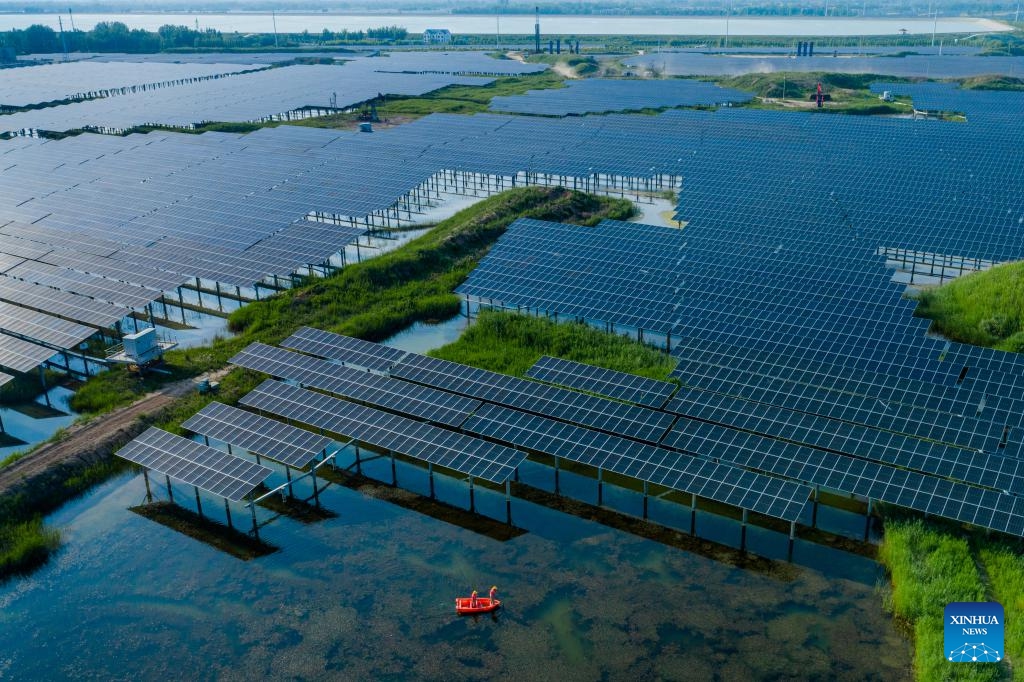
An aerial drone photo taken on June 2, 2026 shows staff members conducting routine patrol at a photovoltaic-aquaculture farm in Gaoqing County, Zibo City, east China's Shandong Province. Shandong Province has seen the development in its photovoltaic power sector with complementary modes in light of local conditions over recent years. These innovative modes blaze a path for "three wins" for clean energy exploration, ecological environment protection, and economic benefits. (Photo: Xinhua)
Standards will form another key part of the implementation framework. The code strengthens provisions on the formulation, implementation and supervision of ecological and environmental standards, while affirming the MEE's responsibility for developing environmental benchmarks.
Another part of the preparations concerns ecological and environmental damage compensation, a system formally incorporated into the code. The mechanism is intended to ensure that polluters bear the cost of restoring damaged ecosystems, rather than leaving the public or government to absorb the loss.
To address the difficulties and cost of damage appraisal, the MEE has developed an AI-assisted assessment system. It has been piloted free of charge in 28 provincial-level regions and applied in more than 300 cases, cutting average assessment time by more than 80 percent, according to Zhao.
The system will be expanded to improve the efficiency and accuracy of assessments, he said. It is not only used by environmental authorities; procuratorial organs have also used it when handling environmental public-interest litigation cases.
For environmental volunteers and members of the public, the code is also expected to offer a clearer legal basis for participation.
Yun Jianli, who has long taken part in environmental protection activities along the Hanjiang River in Central China's Hubei Province, told the Global Times in an earlier interview that environmental volunteers previously often had to consult different laws when trying to determine the legal basis for action.
"In the past, when dealing with some environmental issues, we often had to search across different laws to find a legal basis," Yun said. "The code integrates these systems, providing clearer and more authoritative legal support for environmental actions."
In her view, provisions concerning information disclosure and public participation may encourage more people to take part in ecological protection.
To make the code more accessible to the public, ecological and environmental authorities have also experimented with more visual and localized forms of legal education.
According to Zhao, some localities have used familiar cultural images, including giant pandas and animated characters such as Ne Zha, to explain environmental rights, legal obligations and green lifestyles to residents, businesses and frontline law enforcement personnel. The aim, he said, is to bring the code closer to daily life rather than leave it as a set of abstract legal provisions.
"The goal is not simply to study the code, but to use it," Zhao said.