


BEIJING, July 29 (Xinhua) -- China's steady first-half growth in 2026 underscored the resilience of the world's second-largest economy and the growing role of new growth drivers as it embarked on a new five-year development period, Chinese officials said.
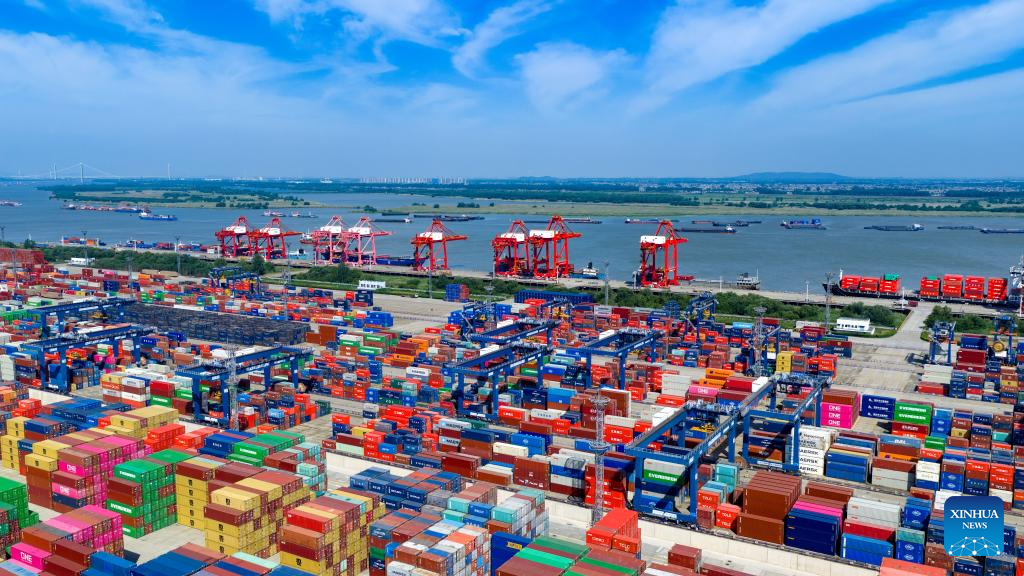
An aerial drone photo taken on May 17, 2026 shows a view of the Longtan Container Terminal at Nanjing Port, east China's Jiangsu Province. (Photo by Yang Suping/Xinhua)
Despite mounting external uncertainties, the country's gross domestic product (GDP) grew 4.7 percent year on year to 69.6 trillion yuan (about 10.25 trillion U.S. dollars) in the first half of 2026, according to the National Bureau of Statistics (NBS).
"These hard-won achievements have laid a solid foundation for achieving this year's economic and social development goals and provided a strong start for the 15th Five-Year Plan period (2026-2030)," Wang Guanhua, an NBS official, said during the latest episode of China Economic Roundtable, an all-media talk show hosted by Xinhua News Agency.
RESILIENCE IN VOLATILE WORLD
With many international institutions lowering their forecasts for major economies, China's first-half performance was particularly notable given the size of its economy, officials said.
The performance was in line with the annual growth target of around 4.5 to 5 percent and placed China among the fastest-growing major economies in the world, said Yang Te, an official with the National Development and Reform Commission (NDRC).
The 4.7-percent growth rate translated into an additional 3.6 trillion yuan in economic output in the first half of 2026 alone -- equivalent to the annual GDP of a medium-sized European economy, Yang noted.
Supporting the headline growth, the surveyed urban unemployment rate fell to 5 percent in June from 5.1 percent a month earlier, while per capita disposable income rose 5.2 percent year on year in the first half of 2026, the NBS said.
In the January-June period, the country's value-added industrial output rose 5.4 percent year on year, and its total retail sales of goods and services, a major indicator of the country's consumption strength, increased by 2.7 percent year on year.
Yang said the economy's strength was underpinned by two key strengths: resilient industrial and supply chains and strong energy security.
Despite various external shocks during the period, China's industrial and supply chains remained resilient, further reinforcing the country's role as both the "world factory" and the "world market," Yang said.
Meanwhile, as global energy supplies faced severe disruptions, China strengthened measures to ensure energy supply and stabilize prices, effectively safeguarding business operations and people's daily lives, Yang said.
"By maintaining steady development amid external uncertainties, China has continued to act as both a stabilizer and a key engine of global economic growth, further reinforcing its role as an anchor of global stability," Yang explained.
RISE OF NEW GROWTH DRIVERS
Behind the resilience lies an accelerating transition toward new growth drivers, officials at the roundtable said.
"The transition from old to new growth drivers has become one of the most distinctive features of China's economy," Wang Guanhua said. "It is not limited to breakthroughs in a handful of industries, but reflects broad-based upgrading across the economy."
New growth drivers, represented by high-end manufacturing, the digital economy and modern services, contributed more than 40 percent of economic growth in the first half of 2026, NBS data revealed.
This shift is particularly evident in strategic emerging industries. China's integrated circuit output reached 279.8 billion units in the first six months of the year, equivalent to producing more than 1.5 billion chips a day.
Huang Hanquan, head of the Chinese Academy of Macroeconomic Research under the NDRC, said China is now firmly positioned among the world's top tier in AI innovation, thanks to it seizing the opportunities presented by technological and industrial transformation.
Huang anticipated that AI-related industries would grow by over 30 percent this year, providing fresh impetus for the country's new growth drivers.
"The rapid development of emerging industries is not a short-lived windfall, but the result of years of sustained efforts to achieve breakthroughs in core technologies, promote full integration of technological and industrial innovation, and foster innovative enterprises," Wang said.
In the outline of its 15th Five-Year Plan unveiled in March, the country has pledged to focus efforts on areas including modernizing its industrial system and developing new quality productive forces.
As new growth drivers continue to gather momentum, they are becoming an increasingly important pillar underpinning the stable performance of the Chinese economy amid a complex external environment, Wang said.