


Wang Ji, born in 1969, is a researcher at the College of Computer Science and Technology at the National University of Defense Technology (NUDT). After losing both legs in 2013, he continued his defense software research from a wheelchair. The major national defense basic research project he led won the 2025 Military Science and Technology Progress Award, and he was honored as China's "Role Model of the Times" in 2026.
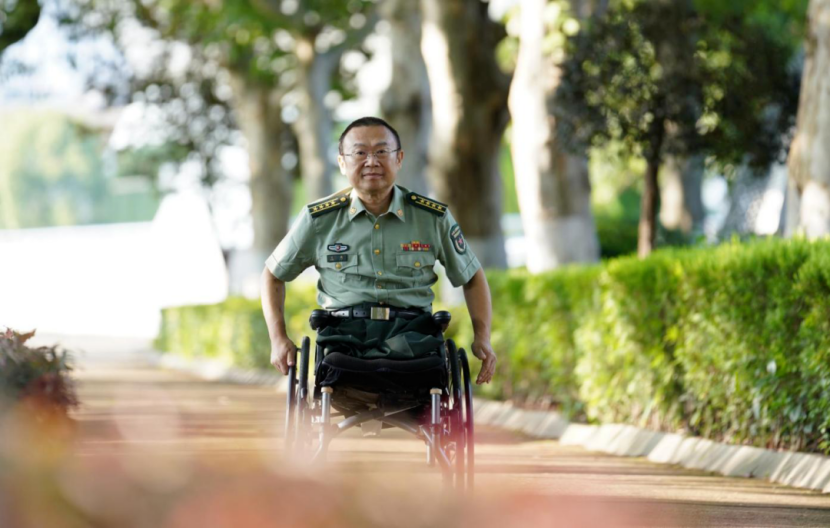
Wang Ji pushes a wheelchair along a tree-lined path on the NUDT campus. (Photo: Xinhua)
Wang is a pioneer in high-confidence software technologies in China, which involves verifying the correctness of software code based on underlying mathematical principles. Acting like a "software doctor," this technology performs comprehensive scans and precise diagnostics on critical national equipment systems to eliminate deeply hidden vulnerabilities and hazards. In the late 1990s, the mid-air explosion of a foreign rocket caused by a single software flaw deeply moved him. He keenly realized that China lacked a mature and complete technical system to troubleshoot underlying software risks in vital defense equipment.
In 1999, Wang led a team to assess software reliability for a major engineering project. Facing discrepancies between theoretical models and real-world results, he conducted day-and-night calculations and repeated testing until he successfully built a software reliability measurement tool. In 2003, he co-authored High Confidence Software Engineering Technologies, China's first systematic monograph on the subject, and introduced related postgraduate courses at NUDT, filling a key academic gap.
However, this brilliant scholar—who enrolled at university at just 13, became a full professor at 33 and earned the prestigious National Science Fund for Distinguished Young Scholars at 38—was suddenly struck by tragedy. In the early hours of January 23, 2013, Wang Ji suffered a life-threatening acute aortic dissection. A grueling 13-hour emergency surgery saved his life. However, large volumes of toxins released during the onset of his condition continuously eroded his leg muscles, forcing him to undergo an above-knee amputation on his left leg and a hip disarticulation on his right leg. Throughout 147 harrowing days in intensive care, medical reports warning of "massive hemorrhage," "heart failure," and "critical condition" underscored the extreme trial he endured.
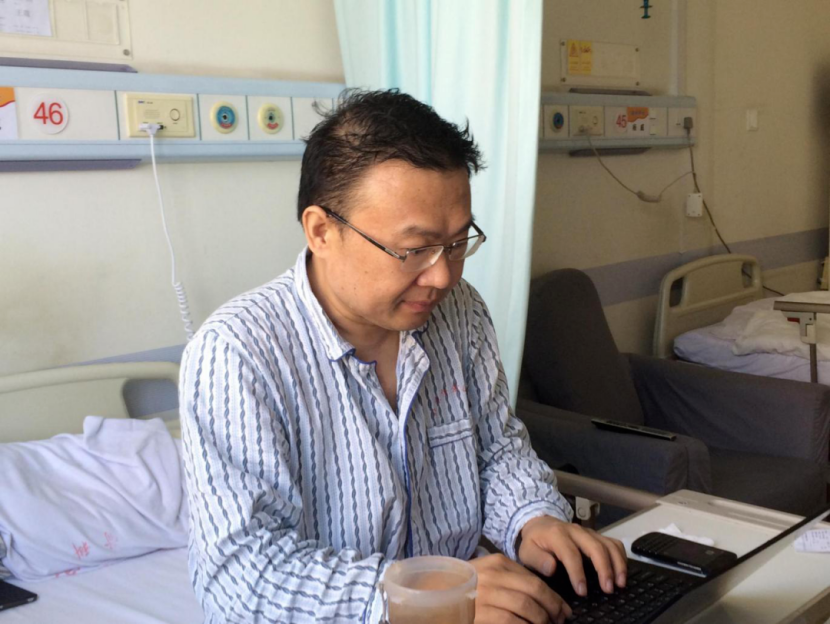
Wang Ji works on a computer while undergoing rehabilitation at Beijing Bo'ai Hospital. (Photo: Xinhua)
When Wang Ji woke from his coma and learned that he had permanently lost both legs, he fell silent. It was his mother's words that awakened his spirit: "If you cannot face it, people will say what a pity for this child; but if you can face your fate head-on, everyone will support you." During his bedridden recovery, Wang annotated his students' theses word for word on his sickbed and remotely guided his team through technical hurdles.
After the Spring Festival in 2015, Wang returned to work in his wheelchair. At that time, high-confidence software research was at a critical juncture. He wrote reports, prepared project defenses and delivered on-site presentations, taking charge of every key step in person. The project was successfully approved, and he was appointed chief technical expert. From then on, his wheelchair became his chariot on the battlefield of science and technology. Over a decade of tackling tough challenges, he shuttled between the laboratory, review meetings and the front lines of research, never missing a business trip or a seminar.
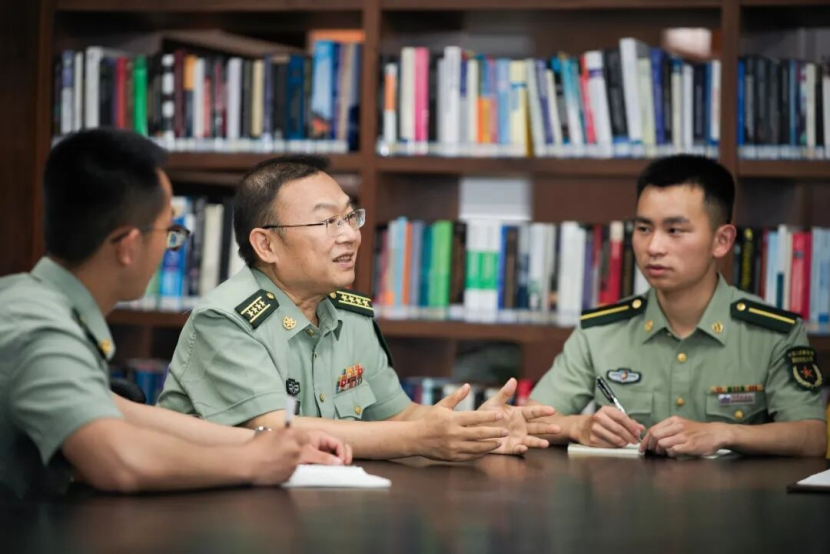
Wang Ji speaks with students in the library. (Photo: Xinhua)
Even now, with compromised kidney function and blood vessels in his arms repeatedly damaged by dialysis—requiring him to travel to Shanghai recently for repair surgery—he still arrives at his office before 8 am on non-dialysis days and returns straight to work after every dialysis session.
Having joined the faculty in 1995, Wang has taught for 31 years. He carries on the devotion of his mentor, Academician Chen Huowang of the Chinese Academy of Engineering, in nurturing the next generation. Basic research is a long and solitary journey. Seeing peers in popular fields publish papers one after another, many students grow restless with the slow pace and lack of immediate rewards in these less glamorous areas. Wang patiently advises them: "The country needs people who are willing to do the quiet, unglamorous work and solve fundamental problems. Students at NUDT must be tacklers of bottleneck challenges, not profit-seekers chasing hot topics."
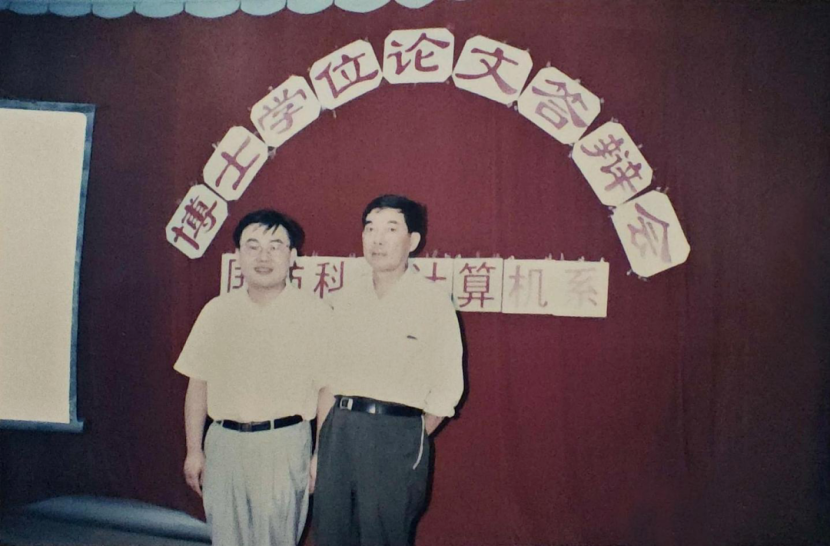
Wang Ji (left) with his mentor, Academician Chen Huowang, at his Ph.D. graduation. (Photo: Xinhua)
Today, Wang maintains an unrelenting pace, balancing dialysis treatment with project research and student mentorship. The patriotic ideal that took root in his youth, combined with the profound sense of duty inherited from generations of Chinese military personnel, is etched into every track his wheelchair leaves behind. As he puts it: "As long as my mind remains sharp and my hands can work, I will never stop."
(Compiled by Heng Shimin, Yang Ziyu and Wang Ruofan)