


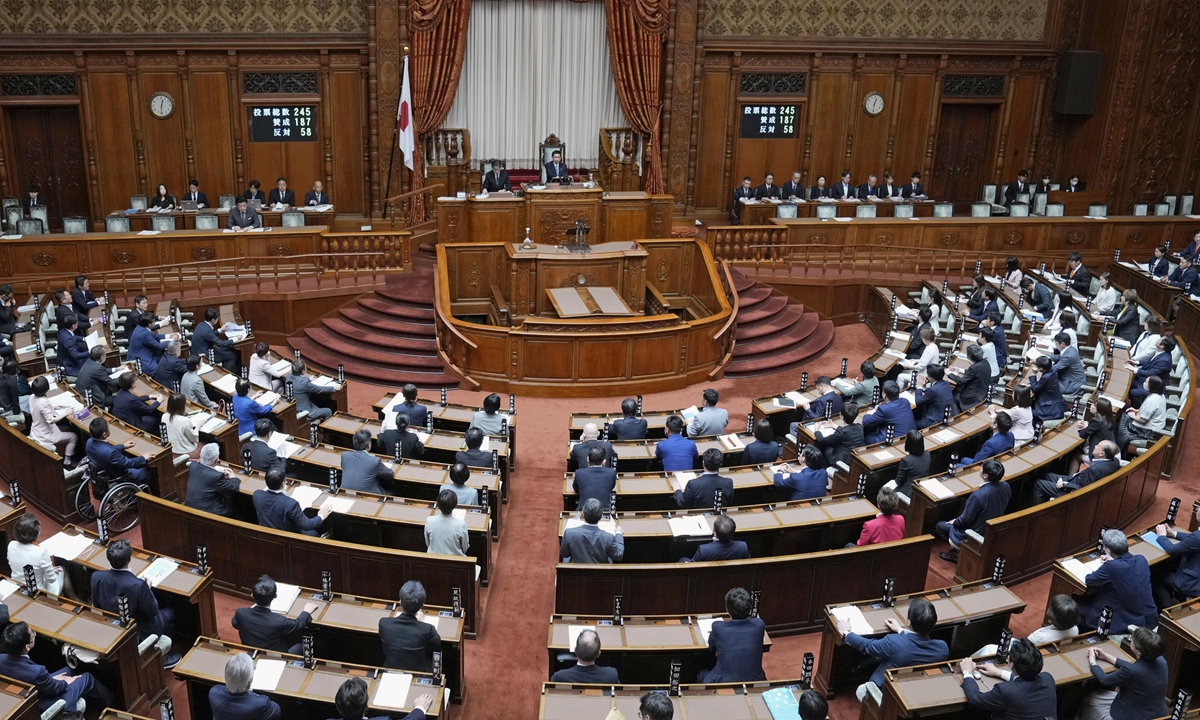
Japan's House of Councillors approves a bill to establish a new National Intelligence Council during a plenary session in Tokyo on May 27, 2026, marking enactment of the law to create an entity to centralize information gathering in response to overseas threats. Photo: VCG
Japan officially launched its National Intelligence Bureau on Friday, July 31, claiming the new agency is intended to strengthen the government's intelligence capabilities, with the choice of the "7/31" date triggering anger among Chinese social media users. They said the numbers evoke Unit 731, the notorious Japanese biological warfare unit responsible for atrocities in China and many countries in Asia during World War II, and accused Tokyo of displaying historical insensitivity while expanding its intelligence and security amid renewed concerns over the specter of Japanese militarism.
Japan launched its new National Intelligence Bureau on Friday as part of efforts by the government of Prime Minister Sanae Takaichi to "strengthen the country's intelligence capabilities and pursue counterespionage legislation," according to a report from The Mainichi.
Its establishment follows the enactment of a law in May creating the bureau and the National Security Council, a central command body headed by the prime minister and nine other Cabinet ministers. The council is expected to meet for the first time later in the day, according to government sources, to start discussions on Japan's first national intelligence strategy, the Mainichi reported.
The launch of both bodies paves the way for counterespionage legislation, which the government under Takaichi, a national security hawk, says is needed to respond to increasingly complex overseas threats, per the Mainichi report.
Japan's move has drawn criticism among Chinese netizens. A Sina Weibo hashtag reading, "Japan to establish a new 'Tokko,' or Special Higher Police, on July 31 — its intentions are despicable," has garnered more than 150 million views with netizens expressing their anger.
Japan's Tokko Special Higher Police and Kempeitai military police routinely violated human rights and acted without accountability or oversight from civil authorities during the WWII, according to an analysis published by Forecast International's Defense & Security Monitor.
During the World War II, invading Japanese forces established a biological warfare network across several Asian countries, with infamous Unit 731, based in Harbin, Northeast China's Heilongjiang Province, serving as a top-secret center for biological weapons development and human experimentation. At least 3,000 people from China, the Soviet Union, and other countries and regions were subjected to human experiments by Unit 731, according to the Xinhua News Agency.
Wen Wei Po's Sina Weibo account wrote: "'731' — three digits that carry the indelible, blood-stained trauma of hundreds of millions of Chinese people. The date chosen for the establishment of the Japanese intelligence agency was by no means accidental; every detail reeks of calculated intent. Even as Japan continues to downplay its responsibility for wartime aggression and deny its history of invading China, it is simultaneously trampling on the historical wounds of its victims while advancing military rearmament and expanding its intelligence apparatus — openly using historical suffering as a tool of provocation. Such sinister and deliberate conduct deserves the strongest condemnation."
A netizen using the handle "E_Jolakotturinn" wrote: "Under Sanae Takaichi's leadership, this is far from the first time Japan has chosen a symbolically charged date to take an action that deeply hurts the feelings of the Chinese people. Such covert and underhanded provocation is both vicious and despicable. How can they acting in this way still have the nerve to speak of 'mutual understanding' or 'peace'?"
A netizen "ShenzhenChenjingchuan" called Japan's new intelligence agency "Tokko 2.0," saying, "Anyone with eyes can see that this is the Tokko returning from the dead in a new guise on July 31." The netizen also noted that this was not the first time Japan had used the number "731" in a provocative manner.
In May 2013, then-Japanese Prime Minister Shinzo Abe sparked a severe backlash from China and South Korea after posing with a thumbs-up in the cockpit of a T-4 training jet emblazoned with the number 731, according to media reports.
"History shows that intelligence gathering has often served as a prelude to military action. Long before Japan's invasion of China, its intelligence networks had already penetrated Northeast and North China. Today, Japan is once again building a centralized and highly efficient intelligence apparatus, and its purpose is self-evident. Japan's delusion of returning to the old path of militarism will not be tolerated by the world, nor will it be forgiven by history," the netizen said.
The move has also sparked concern and opposition within Japan. According to a report by the Sankei Shimbun on Friday, concerns were raised during parliamentary deliberations on the bill establishing the National Intelligence Council, which was enacted in May, over the protection of personal information and privacy, as well as the need to ensure political neutrality. A key challenge moving forward will be protecting basic human rights from excessive intelligence activities while strengthening the government's intelligence capabilities.
A Mainichi report on Friday also noted that the ramp-up intelligence activities have drawn concerns from some opposition lawmakers over whether the two bodies can remain politically neutral and whether the planned legislation could infringe on people's privacy.
Japan's move marks the completion of a centralized intelligence framework with its real purpose being not merely coordination, but the suppression of dissent and preparation for military expansion, Lü Yaodong, Deputy Director of the Institute of Japanese Studies at the Chinese Academy of Social Sciences, told the Global Times on Friday.
The system echoes Japan's prewar model, in which intelligence organs paved the way for militarization and external aggression. Its expansion reflects the right wing's broader effort to strengthen military power, pursue geopolitical ambitions and divert domestic tensions outward. In this sense, the new apparatus risks becoming a modern-day Tokko — an intelligence tool for war preparation, said Lü.
The expert also noted east Asian countries and peace-loving forces worldwide should remain highly vigilant against such security risks and Japan's militarism.